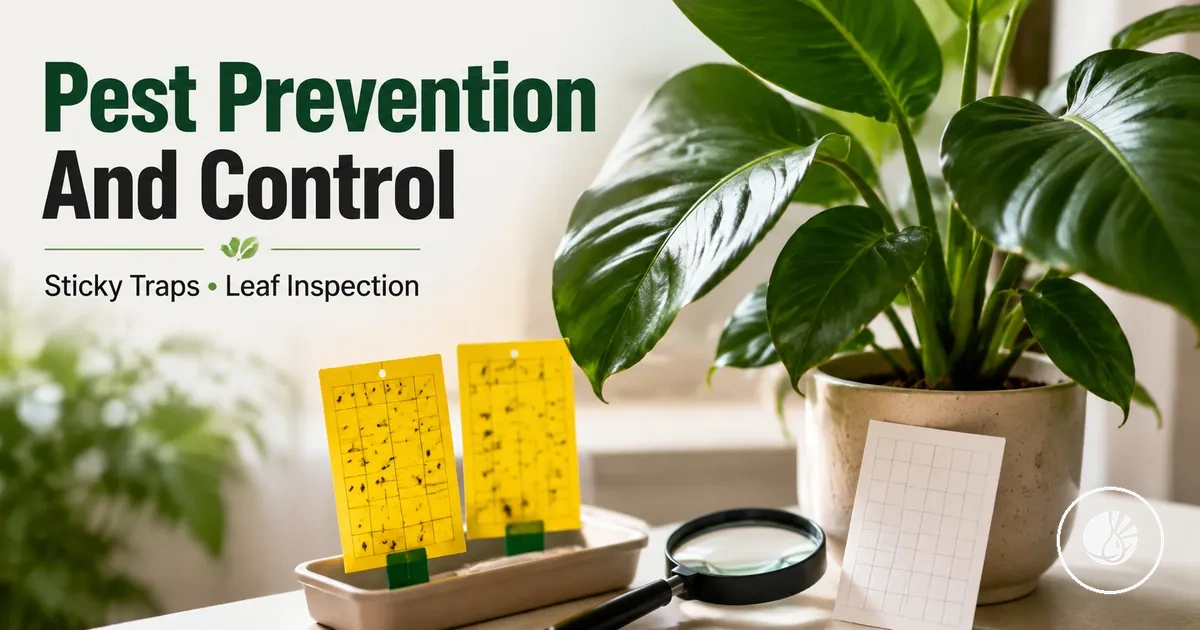
Safe pest prevention and control for indoor tropical plants
Safe pest prevention and control for indoor tropical plants is a careful troubleshooting process, not a rush to apply the strongest spray. It depends on correct identification, close inspection, prevention habits, and proportionate safe treatment before any infestation is treated.
Pest control should start by checking the foliage, stems, new growth, and soil for visible pests, residue, webbing, flying insects, or moisture-linked activity. Pest prevention also depends on reducing plant stress through cleaner leaves, better airflow, quarantine for new plants, and less favorable conditions for pest pressure. indoor tropical plant care solutions connect pest control with the wider care setup that affects plant condition.
An indoor infestation can worsen when symptoms are missed, when treatment risk is ignored, or when stressed foliage and damp soil create easier conditions for plant pests. The safer path is to identify first, inspect gently, and choose the least aggressive response that fits the pest signs before looking at why indoor tropical plants get pests indoors.
Why indoor tropical plants get pests indoors
Why indoor tropical plants get pests indoors is linked to a combination of plant condition, indoor environment, soil moisture, new plant introductions, and weak airflow. Pests indoors can arrive from outside sources or become more noticeable when indoor conditions support ongoing pest pressure. Indoor tropical plants are less exposed than outdoor plants, but indoor status lowers rather than removes pest risk.
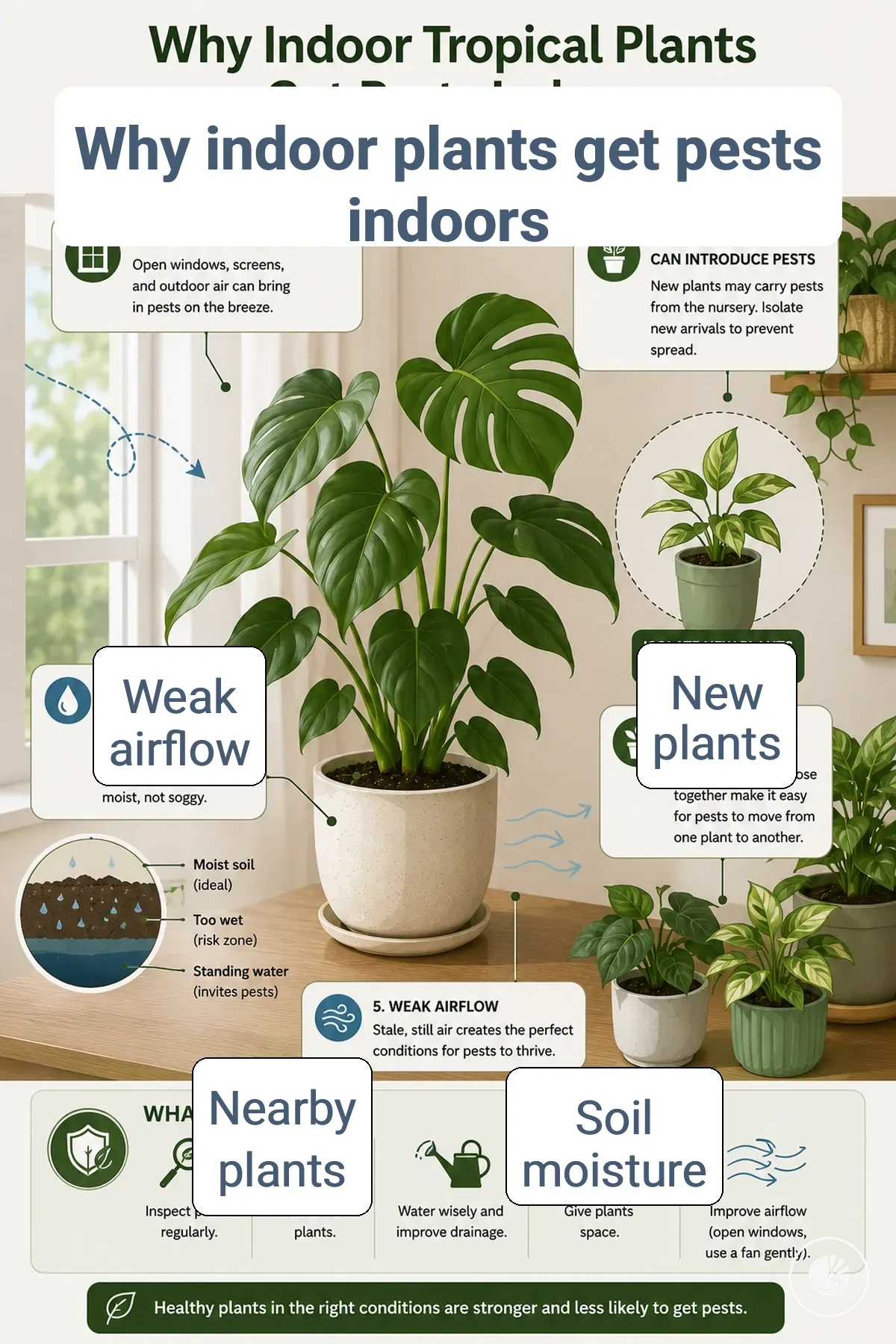
A common scenario starts when new plants, contaminated soil, or nearby plants introduce pests that are not detected during early inspection. Indoor conditions such as persistent soil moisture, weak airflow, humidity, organic debris, or plant stress may then make it easier for certain pests to remain active. Indoor tropical plants get pests indoors through a mix of entry sources and supportive conditions. These factors can be grouped into entry routes and care conditions.
- New plants may carry hidden pests, making quarantine and inspection useful before placement with other plants.
- Contaminated soil can introduce pest activity that may become noticeable after plants are brought indoors.
- Nearby plants can allow pests to spread when monitoring and isolation are limited.
- Open windows may create occasional pest entry routes depending on local conditions.
- High soil moisture and organic debris can increase conditions that support fungus gnat activity.
- Weak airflow, humidity, and plant stress may contribute to higher pest pressure in indoor conditions.
When pest pressure increases, the goal is to identify contributing factors without assuming that one condition caused the infestation. airflow and pest prevention describe one environmental factor that may influence pest risk, but pest presence still depends on multiple conditions. This distinction helps separate pest risk from broader environmental care decisions.
Signs that indoor tropical plants have pests
Visible pests, sticky residue, fine webbing, speckled leaves, flying insects, and soil activity can indicate an infestation, depending on pest type and plant condition. These pest signs may point to houseplant pests, but similar symptoms can also come from non-pest stress.
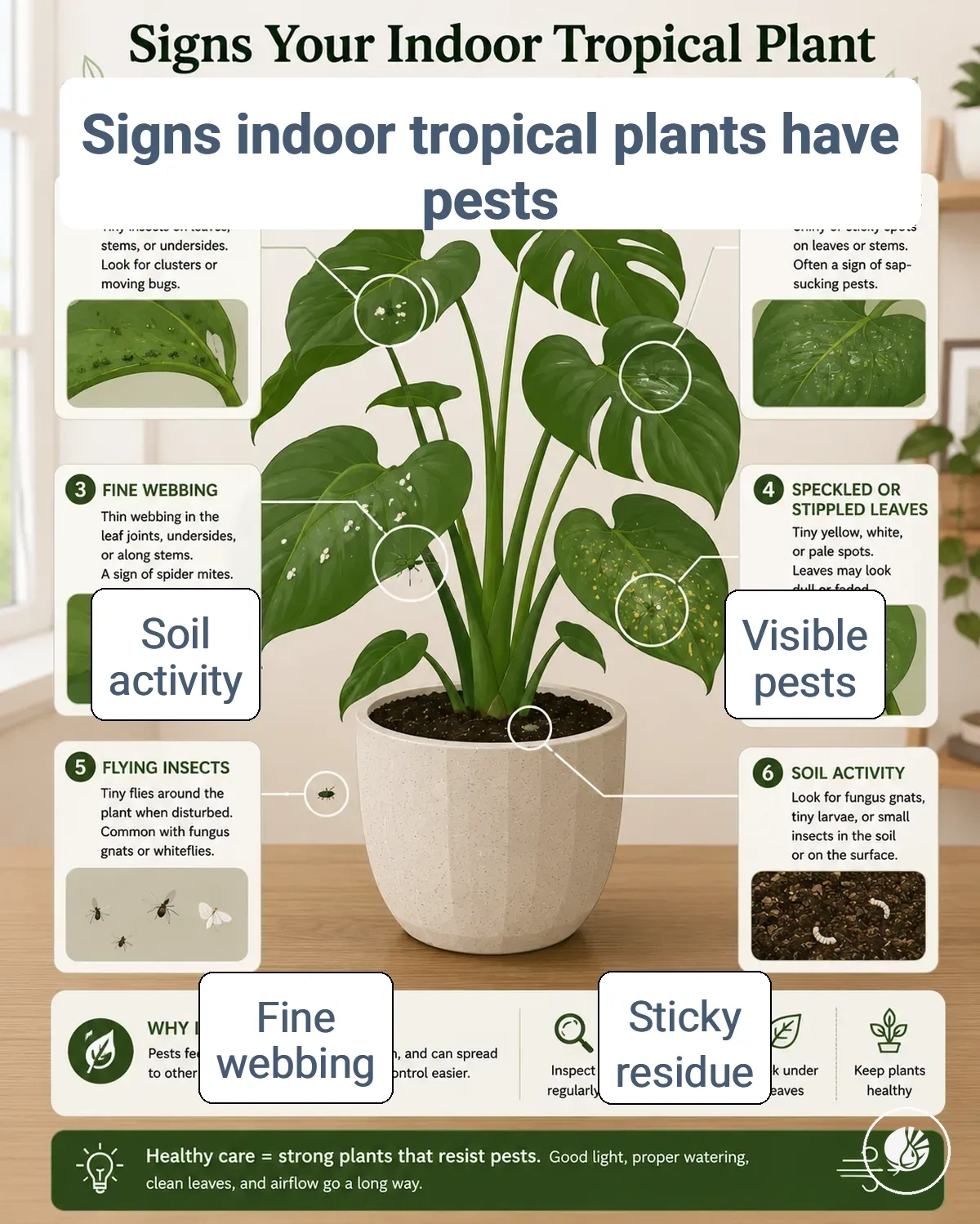
When leaf damage or unusual activity appears, careful inspection helps separate likely pest symptoms from other plant problems. Checking leaf surfaces, undersides, stems, new growth, the soil surface, pot rim, and nearby traps can reveal patterns that guide the next action. The table below organizes pest signs by symptom, likely pest area, inspection point, and risk level.
The diagnostic table groups common signs that indoor tropical plants have pests by where they appear and what they may mean during inspection.
| Symptom | Likely pest area | Inspection point | What it may mean |
|---|---|---|---|
| Visible pests | Leaves and stems | Leaf surfaces and stems | Active infestation may be present |
| Sticky residue | New growth and foliage | Leaf inspection | Feeding pests may be producing residue |
| Fine webbing | Leaf surfaces | Undersides and leaf edges | Spider mite activity may be present |
| Speckled leaves | Foliage | Leaf surfaces and undersides | Feeding damage may be occurring |
| Flying insects | Soil surface | Pot rim and nearby traps | Moist conditions may be supporting pest activity |
| Soil activity | Growing medium | Soil surface and pot rim | Pest presence may require closer inspection |
Not every symptom has a pest cause. Speckled leaves, leaf damage, or reduced plant appearance can sometimes relate to watering, humidity, or light stress rather than pests alone. troubleshooting indoor tropical plants can help when symptoms remain unclear or involve more than pest risk.
Leaf, stem, and webbing symptoms
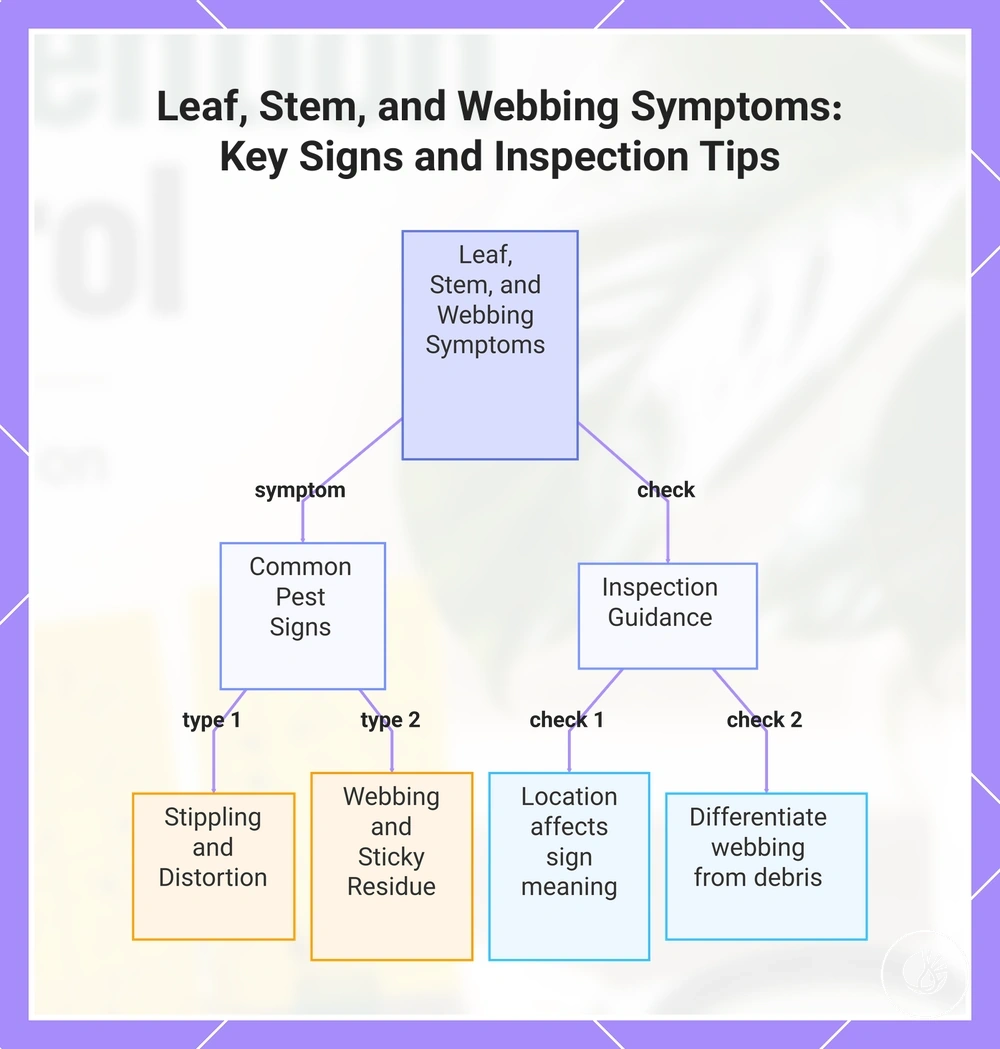
When leaf symptoms or stem symptoms appear, close inspection can help determine whether pest signs may be present. Leaves, petioles, stems, and new growth can show stippling, sticky residue, webbing, distorted growth, or unusual surface patterns that may indicate pest pressure, although interpretation should remain conditional until inspection is complete.
Surface symptoms need careful checking because location often changes what the sign may mean.
- Leaf surfaces: stippling or pale speckling may require inspection for pest activity.
- Undersides: fine webbing can suggest pest signs and should be checked closely.
- New growth: distorted leaves or uneven development may indicate a local problem.
- Stems and petioles: sticky residue or crawling insects can signal active inspection points.
- Leaf joints: cottony patches may warrant a closer look for indoor plant pests.
- Residue patterns: clustered deposits often provide more useful clues than isolated marks.
Visible webbing is a clear condition, but webbing does not always mean the same thing. Fine webbing attached across leaf surfaces or undersides may differ from loose dust or debris that collects randomly, making inspection of plant parts the safest local action before drawing conclusions.
This chart shows the main symptoms to inspect on different plant parts and the key inspection steps to interpret signs of pest activity.
Soil and flying insect symptoms
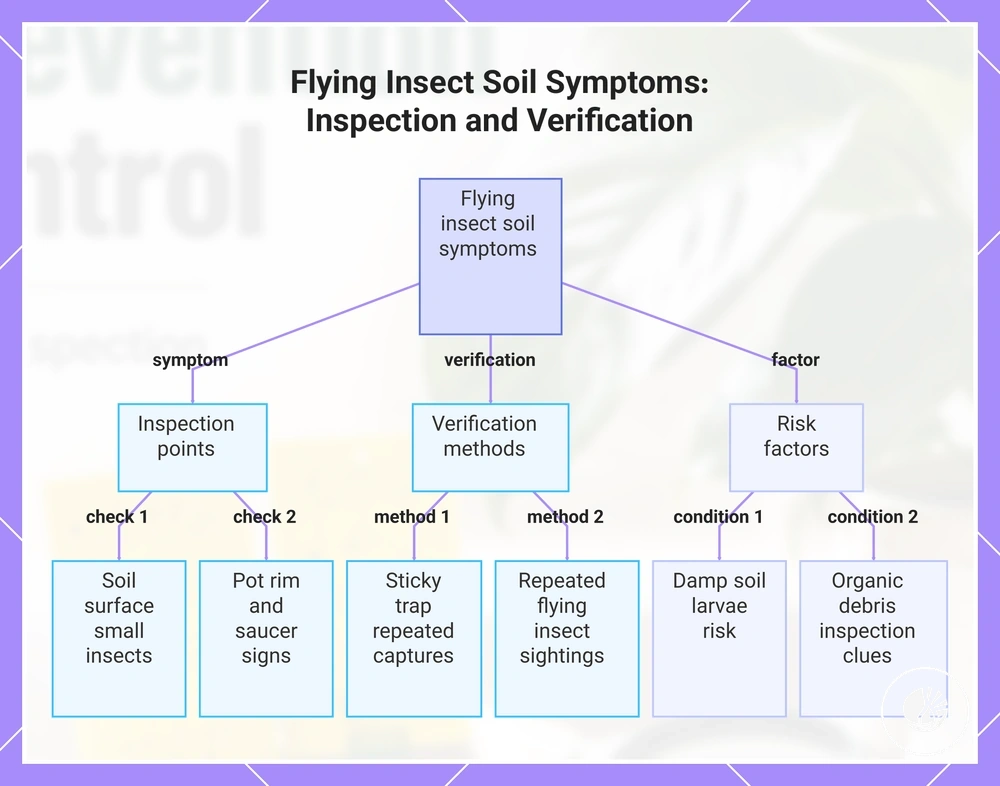
When flying insects appear repeatedly around a pot or movement is visible at the soil surface, pest activity may be present, but inspection is needed to determine the cause. Flying insects can be associated with fungus gnats in some situations, yet soil surface clues, sticky traps, and observations around the pot area provide more reliable context. Damp soil and organic debris may increase larvae risk under certain conditions, but pest-specific inspection should come before treatment decisions.
Focus observations on the soil surface, saucer, and nearby pot area where soil-linked signs are easiest to verify.
- Soil surface: small moving insects may indicate a need for closer inspection.
- Sticky traps: repeated captures can help verify ongoing flying insect activity.
- Pot rim: insect presence around the edge may provide a useful inspection point.
- Saucer area: moisture and debris can create conditions worth checking.
- Damp soil: persistent moisture may increase larvae risk in some situations.
- Organic debris: surface material can contribute to clues that require inspection.
Soil-linked pests often overlap with watering conditions, but the connection is not always direct. Repeated sightings of flying insects, trap captures, and activity near the soil surface provide stronger local evidence than moisture conditions alone.
This chart shows the main soil-related clues for diagnosing flying insect activity around pots, including inspection points, verification methods, and risk factors.
Common pests on indoor tropical plants
Spider mites, fungus gnats, mealybugs, scale, aphids, and thrips are common indoor plant pests that can appear on indoor tropical plants. Each pest group tends to leave different signs, and the safest first response depends on where the pest appears and what symptoms are visible.
Common houseplant pests are often easier to identify when location and damage patterns are considered together. Leaf-feeding pests may leave webbing, stippling, residue, or distorted growth, while soil-linked pests may be noticed near the soil surface or around the pot area. Looking at location, sign, and visible condition can help narrow the next inspection step.
Common pests on indoor tropical plants can often be distinguished by where they appear and what signs they leave behind. The comparison graphic and table below organize pest groups by location, sign, risk pattern, and safest first response, while keeping detailed treatment methods for later sections.
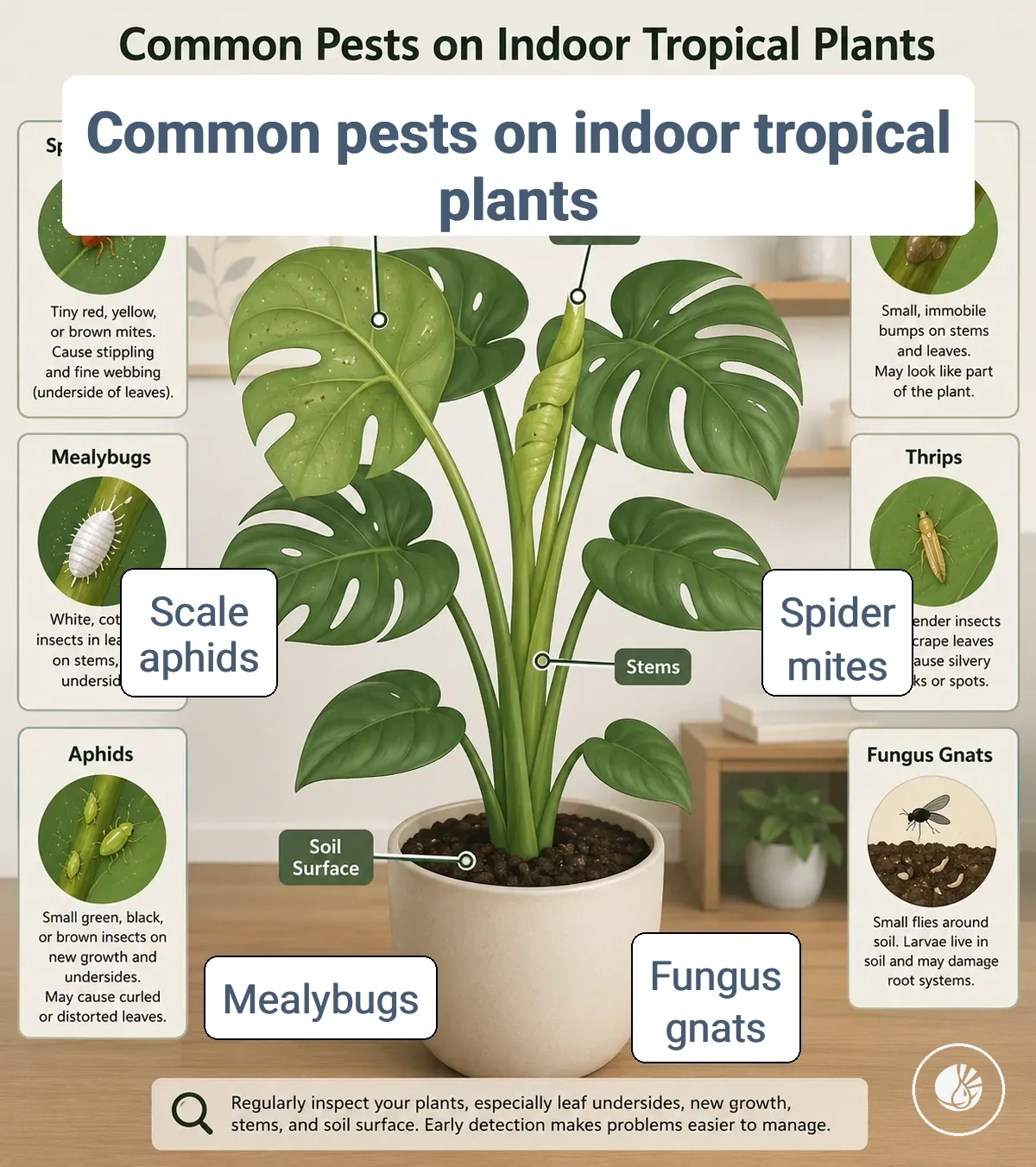
| Pest group | Usual location | Common sign | First safe check |
|---|---|---|---|
| Spider mites | Leaf undersides | Webbing and stippling | Inspect undersides for fine webbing and surface damage |
| Fungus gnats | Soil surface | Flying adults near pots | Check soil surface activity and sticky traps |
| Mealybugs | Stems and leaf joints | Cottony residue | Inspect stems and protected plant areas |
| Scale | Stems and leaves | Sticky residue and attached bumps | Check surfaces for persistent deposits |
| Aphids | New growth | Clusters and sticky residue | Inspect developing leaves and shoots |
| Thrips | Leaves and new growth | Surface scarring and distortion | Inspect affected foliage closely |
Spider mites and other leaf-feeding pests
When webbing, residue, leaf distortion, or visible feeding marks appear on foliage, leaf-feeding pests may be contributing to the problem. Spider mites, thrips, aphids, scale, and mealybugs can leave different signs on leaf surfaces, undersides, stems, or new growth, so inspection should focus on the affected plant parts before any response is chosen.
Leaf-feeding pests often differ by location and damage pattern. Spider mites may be associated with fine webbing and stippling on leaf undersides, while aphids and mealybugs may leave visible residue near new growth or stem joints. Scale may appear as attached bumps on stems or leaves, and thrips may be linked to surface scarring or distorted growth. Because leaf damage can sometimes resemble plant stress from environmental conditions, comparing residue, movement, webbing, and affected plant parts can help distinguish pest signs from non-pest leaf stress before taking further action.
Fungus gnats and soil-linked pests
When small adult flies appear around pots or activity seems concentrated near the soil surface, fungus gnats and soil-linked pests may be involved. These pests are often associated with damp organic soil, moisture-related conditions, and the pot zone rather than leaf surfaces, so confirmation should focus on soil evidence before moving beyond identification.
Fungus gnats and soil-linked pests are easier to assess when multiple signals appear together rather than in isolation.
- Adult flies repeatedly emerge from the soil area rather than simply passing near the plant.
- Larvae concern may increase when activity appears connected to damp organic soil.
- Drainage conditions may contribute to ongoing moisture that supports pest pressure.
- Trap evidence can help show whether flying insects are consistently associated with a specific pot.
Soil correction may help reduce pest pressure when moisture conditions contribute to the problem, but identification remains important if adult flies, larvae concern, or repeated trap evidence persist.
How to inspect indoor tropical plants safely
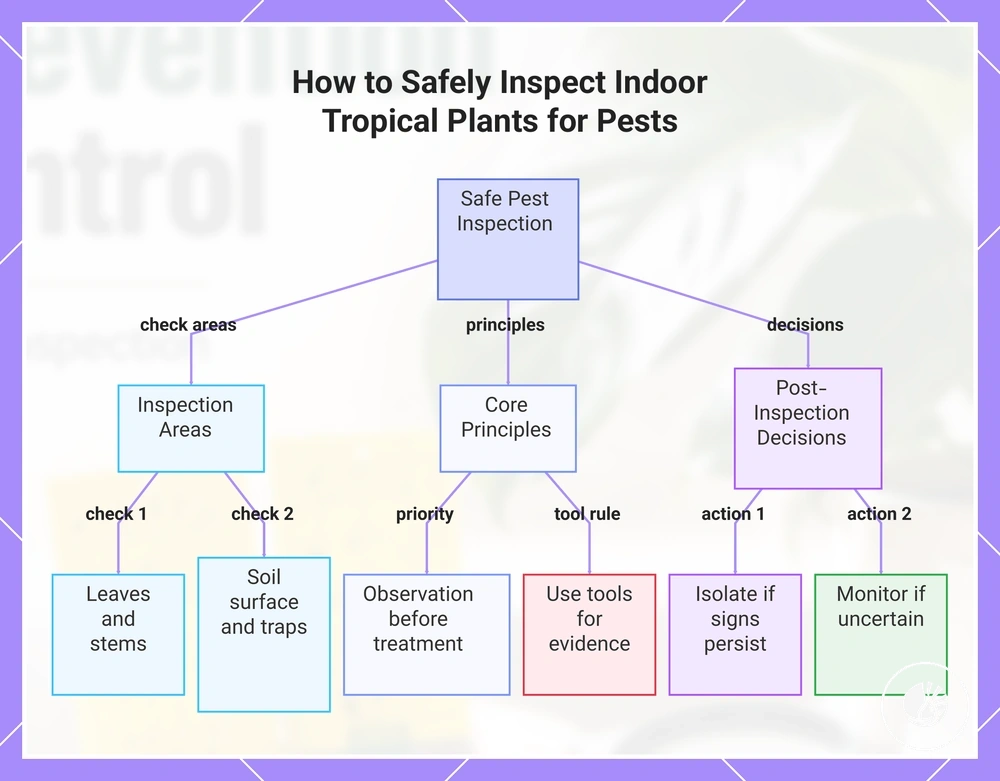
Safe inspection should move from visible leaves to leaf undersides, stems, new growth, the soil surface, and nearby sticky traps before any treatment is considered. This approach helps verify pest signs while reducing unnecessary plant stress from repeated handling, and it keeps identification as the priority before action.
A safe inspection focuses on careful observation rather than immediate treatment. A magnifier, clean cloth, light source, gloves, and sticky traps can support inspection, but these tools should be used to gather evidence rather than assume indoor plant pests are present.
- Inspect visible leaves for pest signs, residue, discoloration, or unusual surface patterns.
- Check leaf undersides with a light source or magnifier for insects, webbing, or feeding marks.
- Examine stems and new growth for clusters, residue, distortion, or other localized signs.
- Review the soil surface for movement, insects, or conditions that may be associated with pest activity.
- Check nearby sticky traps for patterns that may indicate ongoing insect presence.
- Handle delicate foliage gently and avoid assuming treatment is needed when evidence remains unclear.
Isolation may be appropriate after inspection when repeated pest signs appear on the plant, when insects are consistently observed, or when sticky traps show continued activity that could affect nearby plants. If inspection results remain uncertain, continued monitoring may be more appropriate than immediate treatment.
This chart shows the recommended inspection areas, key principles, and post-inspection decisions for safely identifying pests on indoor tropical plants.
Undersides of leaves, stems, and new growth
Inspect the leaf underside, stem junction, and new growth first because these plant parts can hold hidden pest signs that are easy to miss during a quick check. Lift leaves gently, follow the veins with a close visual inspection, and handle delicate foliage carefully to avoid damage while looking for evidence.
Undersides of leaves, stems, and new growth should be checked with a consistent part-to-sign-to-action approach.
- Lift the leaf underside carefully and inspect along the veins for pest residue, eggs, webbing, or crawling insects.
- Check each stem junction and petiole for hidden deposits, clusters, or movement that may indicate pest activity.
- Examine new growth and each new shoot for residue, distortion, eggs, or insects that may gather in protected areas.
- Compare suspicious marks with nearby plant tissue because pest residue, eggs, or webbing alone may not identify a specific pest.
- Repeat inspection only when signs remain unclear or additional evidence appears, while continuing to avoid stress to delicate foliage.
Soil surface, pot rim, and nearby traps
Inspect the soil surface, pot rim, and nearby traps because the pot zone can reveal pest activity that may be missed on leaves. Look for movement, larvae signs, residue, moisture patterns, or sticky trap captures without disturbing roots or turning the inspection into a repotting process.
Soil surface, pot rim, and nearby traps should be checked with a gentle evidence-gathering approach.
- Check the soil surface for movement, larvae signs, or pest residue that may indicate ongoing activity.
- Inspect the pot rim for deposits, residue, or insects that may gather around protected edges.
- Observe the saucer for moisture, organic debris, or conditions that may contribute to repeated pest signs.
- Review sticky traps for trap captures and note whether similar captures appear during repeated inspections.
- Document repeated trap captures before escalating control measures, since a single capture may not indicate a continuing problem.
Prevention habits that lower pest risk
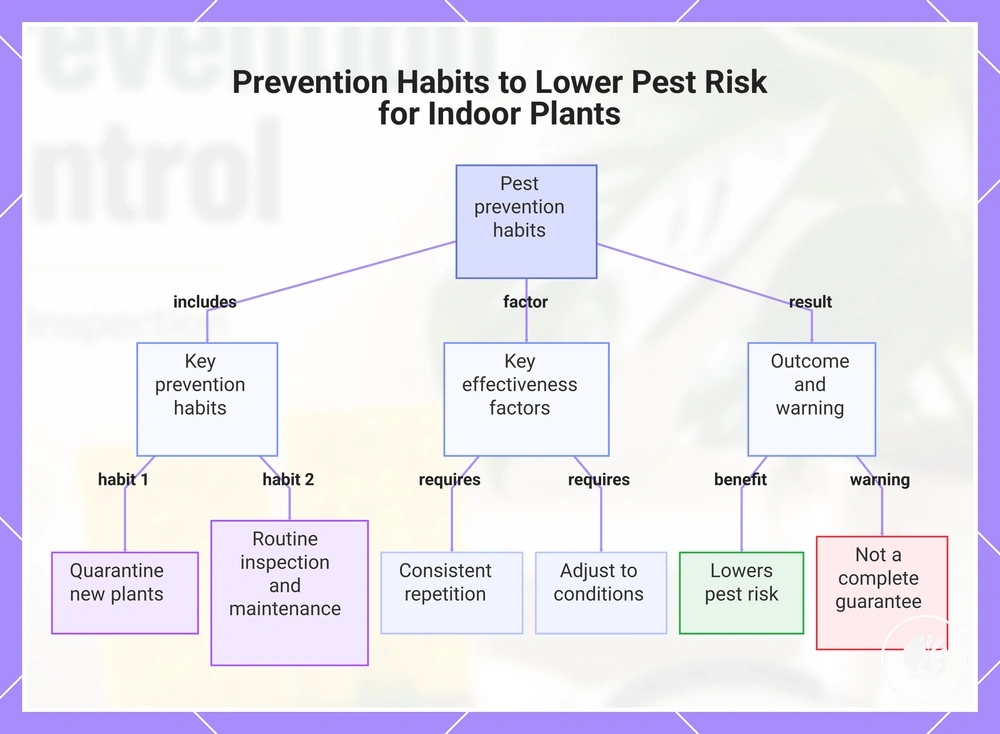
Prevention habits such as quarantine, routine inspection, balanced watering, clean leaves, and airflow can lower pest risk for indoor tropical plants without providing complete protection. These prevention habits help reduce pest pressure by making pest signs easier to detect and by limiting conditions that may support ongoing pest activity.
The checklist below organizes prevention habits by routine behavior and the type of risk each habit may help reduce. Prevention habits are most useful when they are repeated consistently and adjusted to plant condition and growing environment.
- Use quarantine for new plants before placing them near existing plants to reduce the chance of introducing hidden pest signs.
- Maintain plant spacing and airflow so foliage remains easier to inspect and crowded growth does not limit visibility.
- Keep clean leaves by removing dust and residue that can make inspection more difficult.
- Practice balanced watering and monitor repeatedly damp soil because excess moisture may increase pest pressure in some situations.
- Perform debris removal around pots and soil surfaces to reduce areas where pest activity may go unnoticed.
- Continue routine inspection to identify changes early and respond before pest pressure becomes more widespread.
New plants may benefit from a longer observation period before joining other plants, humid rooms may require closer monitoring of airflow and foliage condition, and repeatedly damp soil may justify more frequent inspection. Including pest checks in the maintenance routine can help document recurring patterns without making prevention habits a guarantee against indoor plant pests.
This chart shows the key prevention habits that lower pest risk for indoor tropical plants, the factors that make them effective, and their expected outcome.
Quarantine and routine inspection
Quarantine and routine inspection can reduce the risk of pest spread when new arrivals or recently treated plants may carry unnoticed pest signs. Separating plants from neighboring plants and performing recurring visual checks helps monitor changes before plants return to shared growing areas, while keeping the process within a practical observation boundary.
Quarantine and routine inspection focus on observation, documentation, and repeated checking rather than fixed timelines. The checklist below helps organize repeatable habits for new arrivals, recently treated plants, and situations where symptoms remain unclear.
- Keep new arrivals separate from neighboring plants during an isolation period that fits the observed condition.
- Perform routine inspection of leaves, stems, and new growth through regular visual checks.
- Use symptom documentation to record changes in pest signs, plant stress, or recurring patterns over time.
- Continue observing recently treated plants before placing them near other plants again.
- If symptoms remain unclear, maintain separation and repeat visual checks until the condition becomes easier to assess.
Watering, airflow, and leaf cleanliness
Watering, airflow, and leaf cleanliness can influence pest risk because wet soil, stagnant air, dust, and residue may create conditions that make pest signs harder to notice or allow pest pressure to persist. Balanced watering, better airflow, and cleaner leaf surfaces can support prevention efforts, but these care conditions do not replace inspection and identification when symptoms appear.
The habits below help reduce conditions that may favor indoor plant pests while keeping routine care focused on prevention rather than treatment.
- Avoid leaving wet soil in a consistently damp condition when moisture remains longer than expected.
- Maintain airflow and plant spacing so leaf surfaces and stems remain easier to observe during inspections.
- Remove dust from leaf surfaces because buildup can hide residue, discoloration, or other pest signs.
- Clear fallen debris from pots and nearby growing areas to reduce overlooked pest activity.
- Check foliage regularly for residue, surface changes, or plant stress that may require closer inspection.
Care conditions can support prevention, but they work best alongside regular observation. For broader guidance on airflow and pest prevention, use care adjustments as support for inspection rather than a replacement for identifying the cause of symptoms.
Safe control methods for indoor plant pests
Safe control methods usually begin with isolation and physical removal before stronger sprays or repeated treatments are considered. The control choice depends on pest identification, infestation severity, plant sensitivity, and treatment risk. Start with the least disruptive option that matches the affected plant part and visible pest signs before considering escalation.
Control choices are easier to evaluate when pest condition, method choice, treatment risk, and expected outcome are considered together.
| Condition | Method choice | Treatment risk | Possible outcome |
|---|---|---|---|
| Small number of visible pests | Isolation and physical removal | Usually low when handled carefully | May reduce pest pressure and support monitoring |
| Pests on leaves or stems | Leaf cleaning or selective pruning | Depends on plant tolerance and handling | Can help remove affected plant material or residue |
| Flying insects near pots | Sticky traps | Usually limited when used as directed | May help monitor ongoing activity |
| Persistent pest signs after inspection | Soap products with spray testing | Depends on foliage sensitivity | May support control when used carefully and repeated as needed |
| Ongoing infestation despite basic measures | Escalation to broader treatment | Higher treatment risk may require closer observation | Depends on pest type, coverage, and follow-up |
Before using soap products or sprays, perform spray testing on a small area and observe plant response. Any spray or soap should follow label directions and plant tolerance. When ongoing monitoring or repeated applications are needed, pest-control tools and care kits can support inspection and maintenance without replacing identification of the underlying pest.
Physical removal and pruning
Physical removal and pruning are appropriate when visible pests are concentrated on a specific plant part or when an affected leaf contains persistent pest signs that can be removed safely. Physical removal should target visible pests and localized pest clusters, while pruning should be limited to affected tissue where the reason for removal is clear. Heavy pruning may increase plant stress when plant size, growth rate, or condition does not support extensive tissue loss.
Physical removal and pruning follow a careful sequence when pest pressure remains localized.
- Inspect the affected leaf, stem, or pest cluster and confirm the location of visible pests before taking action.
- Use clean tools or a clean wiping method to remove visible pests from the affected plant part.
- Trim heavily affected tissue only when the pruning point contains concentrated pest signs or persistent damage.
- Complete disposal of removed plant material promptly so debris does not remain near the plant.
- Reinspect the affected area and monitor for additional pest signs before deciding whether further removal is necessary.
Small or slow-growing tropical plants may be more sensitive to heavy pruning. When only a limited affected leaf or localized pest cluster is involved, selective removal may present less regrowth risk than removing larger amounts of healthy tissue.
Leaf cleaning and rinsing
Leaf cleaning and rinsing can help when visible pests, residue, or dust interfere with inspection. Leaf cleaning may reduce surface buildup and reveal pest signs more clearly, but it should not be treated as a complete solution for every pest condition. Leaf cleaning and rinsing should remain gentle and plant-sensitive, especially when foliage is delicate, fuzzy, or easily stressed.
Leaf cleaning and rinsing work best when performed with a careful and consistent approach.
- Use a clean cloth with lukewarm water to support residue removal from broad leaf surfaces.
- Inspect the leaf underside and remove dust or residue that may hide pest signs.
- Keep rinsing pressure low so cleaning remains appropriate for plant tolerance.
- Allow foliage to dry after rinsing and check surfaces again for remaining residue.
- Perform repeat inspection when cleaning reveals additional pest signs or areas that need closer review.
Broad leaves may tolerate gentle wiping more easily, while delicate or fuzzy foliage may require lighter handling. Plant tolerance, residue level, and visible pest pressure should guide how much cleaning is appropriate.
Sticky traps for monitoring flying pests
Sticky traps support monitoring by helping identify flying pests, where activity is occurring, and whether captures continue over time. Sticky traps can indicate pest presence through trap captures, but they do not provide complete pest control by themselves. Monitoring is most useful when trap placement and follow-up inspection remain focused on the area where flying pests are being observed.
Sticky traps clarify pest presence, location, and recurrence when used as monitoring tools. Sticky traps and trap captures should be interpreted within their interpretation limits.
- Place sticky traps near affected plants and maintain soil proximity when flying adult capture is most common around pots.
- Review trap captures regularly to monitor whether flying pests continue to appear in the same location.
- Follow appropriate replacement timing when traps become covered with captures, debris, or dust.
- Recognize interpretation limits because trap captures may indicate activity without identifying the full source of the problem.
- Perform follow-up inspection when continued captures occur, especially when repeated activity suggests a need to inspect soil conditions and adjust prevention habits.
Indoor-safe sprays and soap products
Indoor-safe sprays and soap products may help when the pest, plant, and indoor setting are suitable for treatment. Indoor-safe sprays, soap products, plant tolerance, and label directions should be evaluated before application. Safe use depends on careful handling, and severe or unclear infestations may require escalation rather than repeated unsafe spraying.
Indoor-safe sprays and soap products require attention to safety conditions before and after use. The checklist below groups the main safety constraints in one place.
- Follow label directions exactly and avoid off-label mixing or application changes.
- Use spot testing on a small plant area before wider use, especially when leaf sensitivity is uncertain.
- Maintain ventilation during and after application when indoor conditions allow.
- Perform residue monitoring after treatment and watch for signs of leaf sensitivity or plant stress.
- Consider edible or pet exposure concerns before application, and follow repeat intervals only when label directions support additional use.
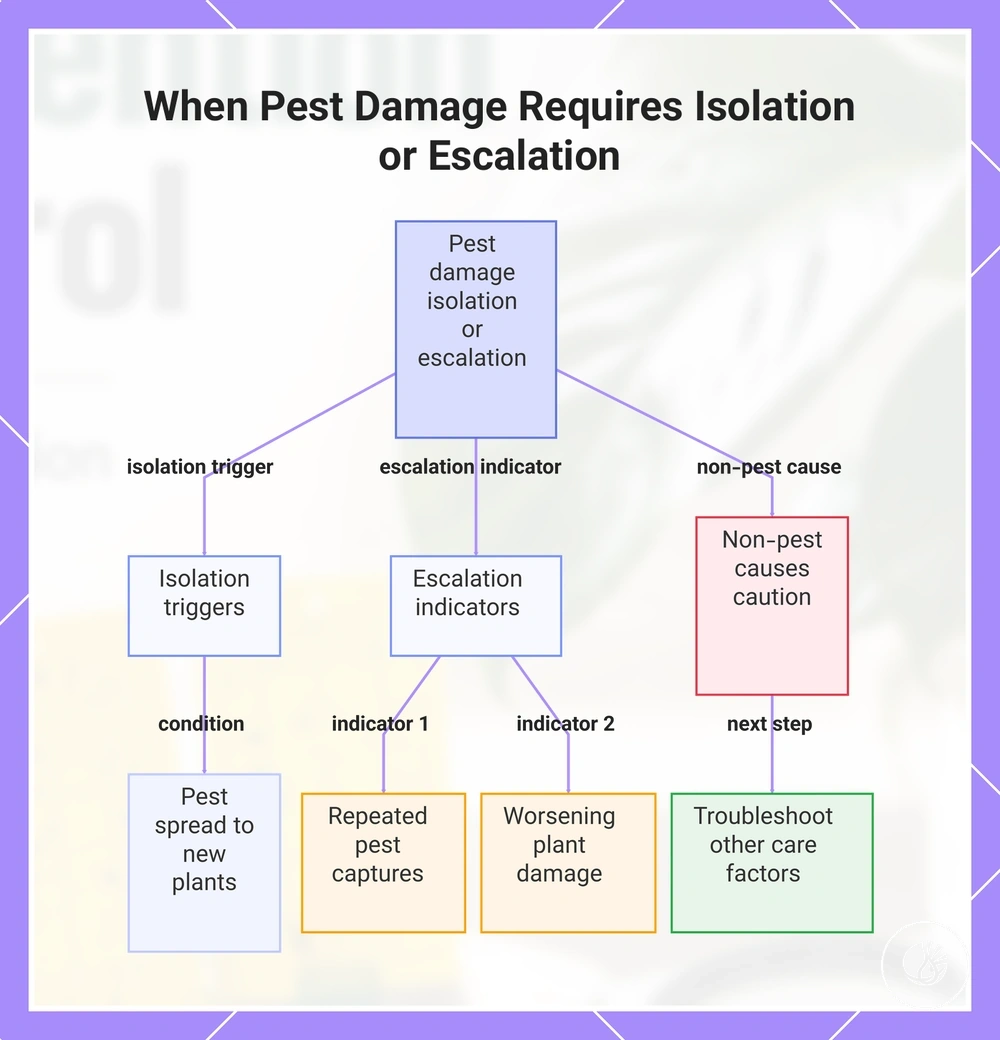
When pest damage needs isolation or escalation
Isolation or escalation is usually needed when spreading pests, continued damage, plant decline, or safe first responses fail to reduce pest activity. When these conditions persist or worsen, the issue may have moved beyond routine prevention and simple control, making a more cautious response appropriate.
The checklist below separates mild, moderate, and higher-risk situations so the response can match the level of pest pressure without assuming every infestation requires the same action.
- Use isolation when spreading pests begin appearing on nearby plants or when pest signs extend beyond the original plant.
- Consider escalation when repeated captures continue despite earlier monitoring and control efforts.
- Worsening leaf damage across new growth, stems, or additional plant parts may indicate increasing pest pressure.
- Heavy webbing or severe soil infestation can signal conditions that may require a broader response.
- Treatment sensitivity, ongoing plant stress, or visible plant decline may justify reassessing the current approach.
Not every symptom is caused only by indoor plant pests, and plant decline may involve multiple care factors. When pest-specific signals do not fully explain the condition, continue troubleshooting indoor tropical plants to evaluate other possible causes.
This chart shows the conditions that trigger isolation or escalation for pest damage, and when non-pest causes should be considered.