Soil, Potting Mix, and Drainage for Indoor Tropical Plants
Soil, potting mix, and drainage form the root-zone material system that supports indoor tropical plants, providing the environment for balanced moisture, aeration, and root health. Together, these components determine how water is retained and released, how roots access oxygen, and how pots interact with the growing medium to prevent water stress. Understanding them as an integrated root area helps maintain plant vitality while adjusting for pot size, plant need, and indoor climate.
Indoor tropical plants rely on a controlled root zone to maintain moisture without compromising oxygen access. Well-structured soil and potting media allow roots to absorb sufficient water while reducing the risk of waterlogging or root stress. Drainage paths and pore structure help regulate moisture levels and aeration. This section focuses on setup logic rather than detailed watering routines, providing a foundational understanding of soil, potting mix, and drainage interaction. For reference, see indoor tropical plant care solutions.

Selecting the right materials involves considering pot hardware, plant need, and observable root-zone conditions. Potting media composition, particle size, and drainage setup influence moisture management and oxygen delivery to roots. Appropriate drainage holes and compatible mix structure help mitigate standing water while supporting plant health. Understanding these interconnections enables adjustments that align with environmental conditions and plant-specific requirements.
Conditional considerations may guide media choices for species with varying root sensitivities. Adjusting drainage and aeration can support plants needing faster-drying conditions or consistent moisture. Monitoring waterlogging risk and balancing moisture with aeration ensures root health is maintained, allowing indoor tropical plants to thrive under diverse conditions.
How the Root Zone Shapes Indoor Tropical Plant Care
The root zone is the area where soil structure, water, air, roots, and pot space interact, shaping how indoor tropical plants access moisture and oxygen. This interaction influences drying speed, root confinement, and the movement of excess water through drainage exits. The root zone connects the growing medium and pot environment into a single system that affects everyday indoor watering behavior. Understanding this relationship helps explain why root-zone conditions matter for indoor care.
How the root zone shapes indoor tropical plant care depends on where water, air, roots, and pot exits meet. The diagram below highlights these root-zone parts so later soil and drainage choices are easier to understand.
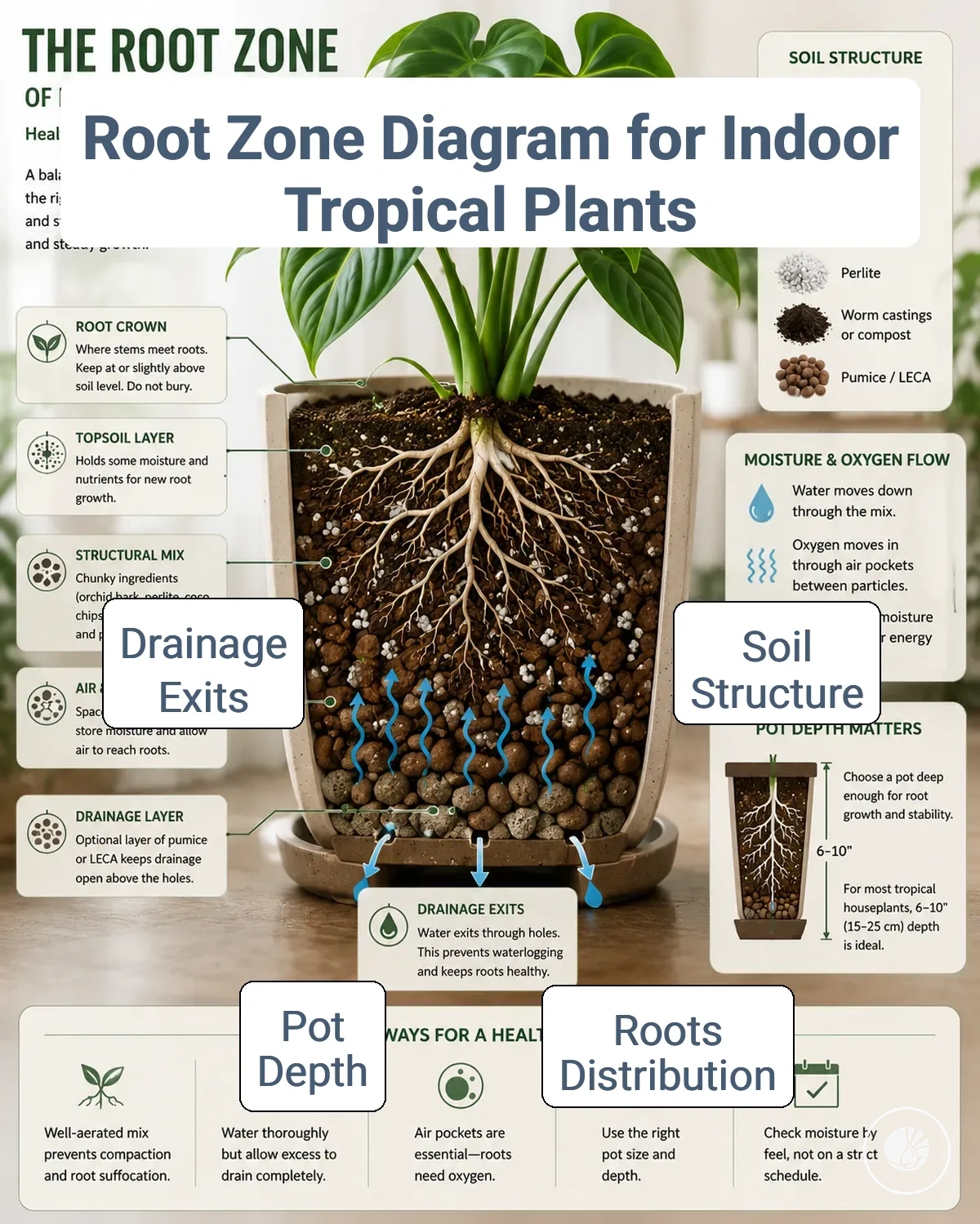
Visible root-zone conditions can help explain how moisture access, oxygen access, drying speed, and confinement influence plant response. Pot depth may affect how quickly the growing medium dries, while drainage exits help excess water leave the pot through a drainage path. Soil structure and pore space influence oxygen movement around roots, and limited pot space can increase root confinement and stress. Root-zone setup influences indoor watering behavior, but watering decisions still depend on moisture checks and plant condition. For further context, see watering control with the right potting setup.
Well-Draining Soil for Tropical Houseplants
Well-draining soil is a potting mix that releases excess water while retaining usable moisture for tropical houseplants. This balance helps roots access root oxygen while reducing waterlogging risk when the mix, pot size, and indoor conditions are suitable. Draining well does not mean drying instantly; it means the growing medium can hold useful moisture without staying saturated.
Well-draining soil depends on drainage rate, moisture retention, structure, and compaction risk. Drainage rate describes how easily excess water leaves the potting mix. Moisture retention describes how much usable moisture remains available after excess water drains. Structure affects aeration and pore space, while compaction can reduce root oxygen and increase waterlogging risk when the mix becomes too dense.
Fit varies by plant type, pot size, and indoor conditions, so one soil type should not be treated as suitable for every tropical houseplant. A useful potting mix should match the plant’s moisture need while keeping enough structure for air movement around roots. The table below organizes well-draining soil for tropical houseplants by plant-care effect.
| Soil attribute | Useful condition | Root-zone effect | Risk if unbalanced |
|---|---|---|---|
| Drainage rate | Excess water can leave the mix | Supports water movement away from roots | Waterlogging risk may increase |
| Moisture retention | Usable moisture remains after drainage | Supports steady root access to moisture | The mix may become too dry or too wet |
| Structure | Pore space remains open | Supports aeration and root oxygen | Air movement around roots may decrease |
| Compaction | The mix resists becoming dense | Helps maintain drainage and oxygen access | Water movement and root oxygen may decline |
Moisture Retention Without Waterlogging
Moisture retention in a mix ensures that tropical houseplants have access to usable moisture while preventing saturation that can lead to waterlogging. Usable moisture supports root oxygen and healthy growth, whereas a saturated mix may cause stress to roots. Damp and airy structure differs from saturated and stagnant conditions, and indoor drying conditions can affect how long moisture remains available.
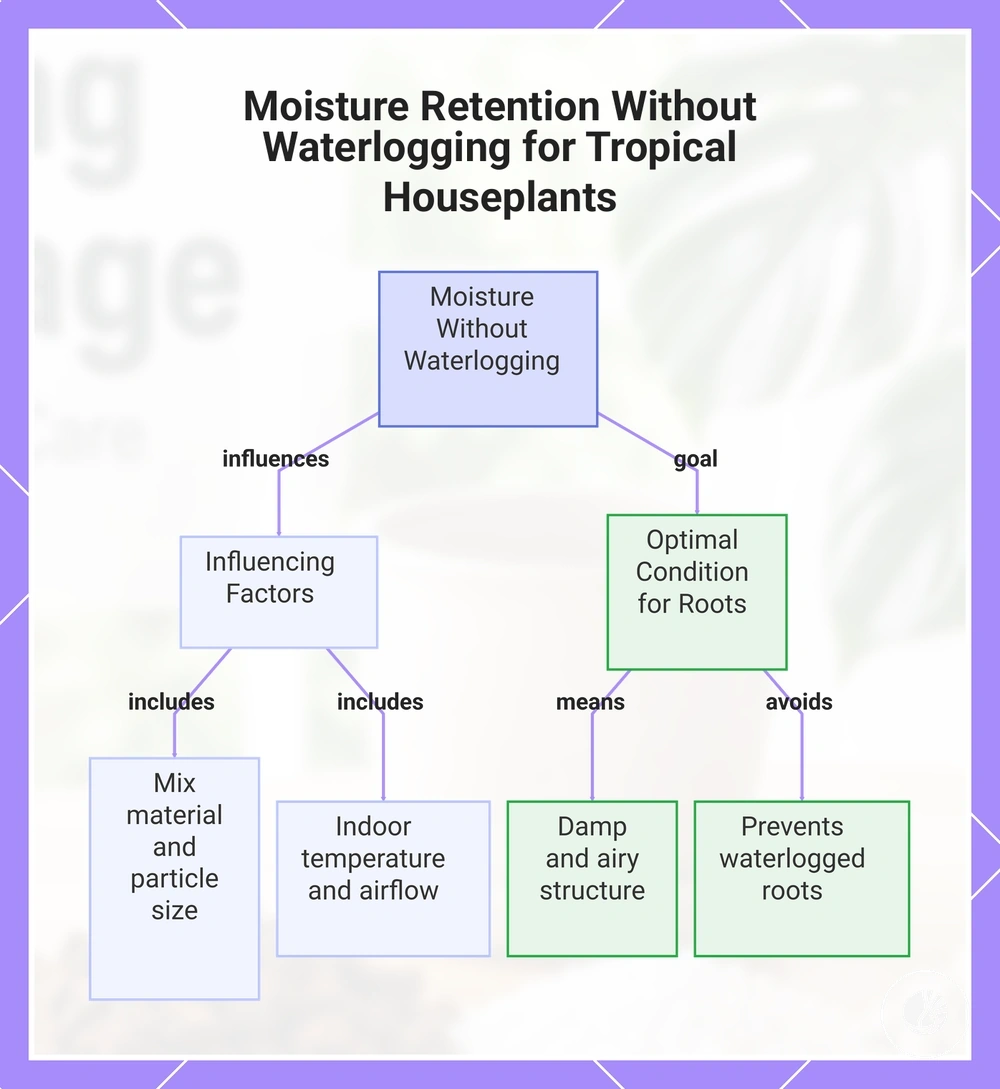
The mix’s material base, particle size, and water-holding capacity influence local moisture balance. Fine particles retain more water, while larger particles promote faster drying and better aeration. The base material contributes to overall water retention, and indoor drying conditions such as temperature and airflow affect how quickly excess moisture dissipates. These factors collectively determine safe moisture retention without creating waterlogged conditions for roots.:contentReference[oaicite:0]{index=0}
This chart shows the key factors influencing moisture balance and the ideal condition to avoid waterlogging while keeping roots healthy.
Airflow, Root Oxygen, and Drying Speed
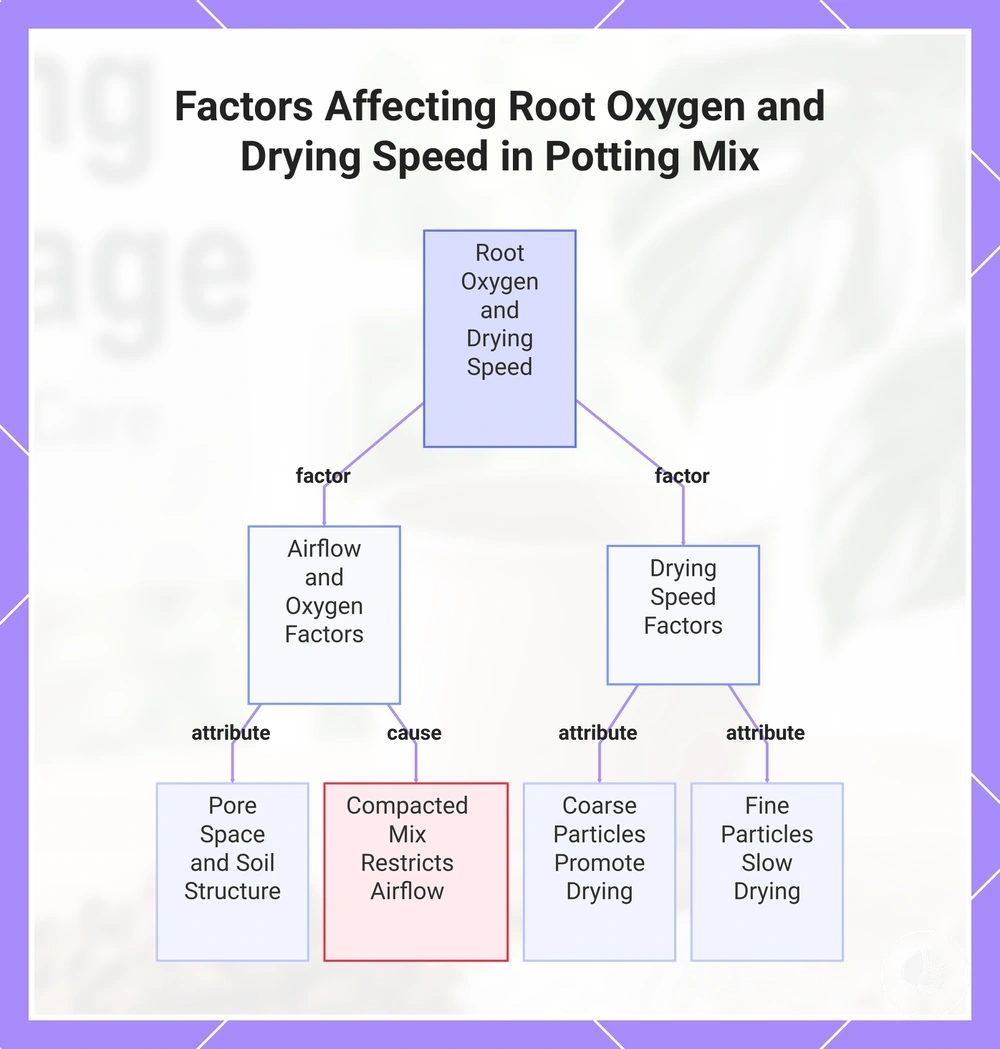
Airflow in the potting mix ensures root oxygen access, supporting healthy root function while preventing stagnant conditions. Adequate root oxygen depends on pore space and soil structure, and compacted mixes can restrict airflow, reducing oxygen availability. Indoor conditions and pot depth influence how much airflow and oxygen roots actually receive, so maintaining sufficient aeration requires context-based assessment.
Drying speed is determined by soil texture, coarse particle content, pot depth, and indoor evaporation rate. Coarse and well-aerated particles promote moderate drying and maintain oxygen access, whereas fine or compacted textures can slow moisture release. Pot depth affects how water moves through the mix, and indoor evaporation modulates drying rates. Faster drying helps when soil is dense, but slower drying can be suitable for tropical houseplants if root oxygen remains adequate.:contentReference[oaicite:0]{index=0}
This chart explains the key factors that influence root oxygen access and drying speed in potting mix, based on soil texture, structure, and particle composition.
Tropical Potting Mix Compared With Regular Indoor Potting Soil
Tropical potting mix and regular indoor potting soil differ mainly in structure, drainage behavior, and amendment level. Tropical potting mix typically includes adjustments that create a more open structure, while regular indoor potting soil may have greater density and moisture retention depending on its base material. These differences influence aeration and suitability, but the most suitable option still depends on plant need, pot size, and indoor conditions. This comparison is intended to guide soil choice rather than rank products.
Tropical potting mix generally provides a more open structure than regular indoor potting soil, which can become denser over time depending on its composition. Higher density may reduce aeration and increase compaction risk in some situations, but regular indoor potting soil is not unsuitable in every case. Its suitability depends on the plant, the pot environment, and whether the existing structure supports appropriate moisture and oxygen movement.
Amendments can make a general potting mix more suitable when the base material retains more moisture or develops excess density for a particular use case. Adjusting structure through amendments may improve aeration and drainage behavior without requiring complete replacement of the mix. The table below organizes tropical potting mix compared with regular indoor potting soil by functional characteristics rather than product categories.
| Mix type | Typical structure | Drainage behavior | When it may fit | When to adjust |
|---|---|---|---|---|
| Tropical potting mix | More open with added amendments | Usually allows easier water movement | When greater aeration is beneficial | When moisture retention becomes too limited |
| Regular indoor potting soil | Often denser, depending on base material | May retain moisture for longer periods | When moisture retention matches plant need | When density or compaction reduces aeration |
| Amended mix | Modified structure with added materials | Varies according to amendment level | When a general mix needs structural adjustment | When plant need or indoor conditions change |
Potting Mix Materials and Ingredient Roles
Potting mix materials are selected for specific functions rather than as a generic ingredient list. Potting mix materials and ingredient roles help explain how each material group contributes to moisture holding, aeration, structure, and root-zone performance. The purpose of the mix is shaped by how these materials work together, not by the presence of any single ingredient.
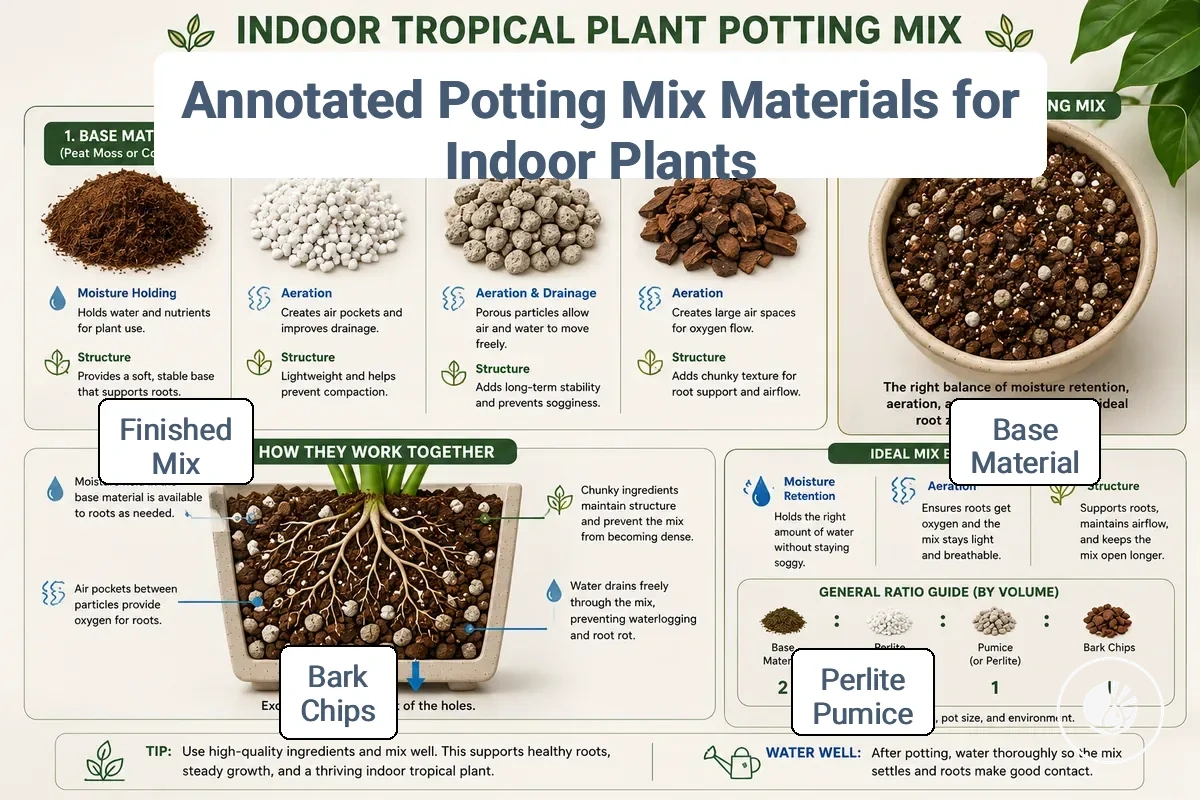
Material groups include bases, mineral amendments, chunky additions, and organic components. Bases provide the primary structure and moisture-holding capacity of the mix. Mineral amendments such as perlite or pumice increase aeration and drainage by creating additional pore space. Chunky additions such as bark can support airflow and root oxygen through a more open structure, while organic components influence moisture behavior and may change over time through decomposition. The effect of each material group depends on particle size, proportion, and overall mix context.
Potting mix materials and ingredient roles can vary according to plant need, pot size, and indoor conditions. A material that improves structure in one mix may have a different effect when used in a different proportion or combined with other soil components. The table below connects each material group to its main attribute, useful condition, and potential effect or risk. :contentReference[oaicite:0]{index=0}
| Material group | Main attribute | Useful condition | Effect or risk |
|---|---|---|---|
| Base materials | Moisture holding and foundational structure | When a mix needs water retention and stability | Higher density may increase compaction risk |
| Mineral drainage amendments | Aeration and pore space | When drainage and airflow need improvement | Performance varies by particle size and proportion |
| Chunky structure additions | Open structure and root-zone airflow | When root oxygen and structural separation are needed | Excessive coarse texture may reduce moisture uniformity |
| Organic components | Moisture behavior and material cycling | When additional water-holding capacity is useful | Decomposition may gradually alter structure |
Coco Coir, Peat, and Moisture-Holding Bases
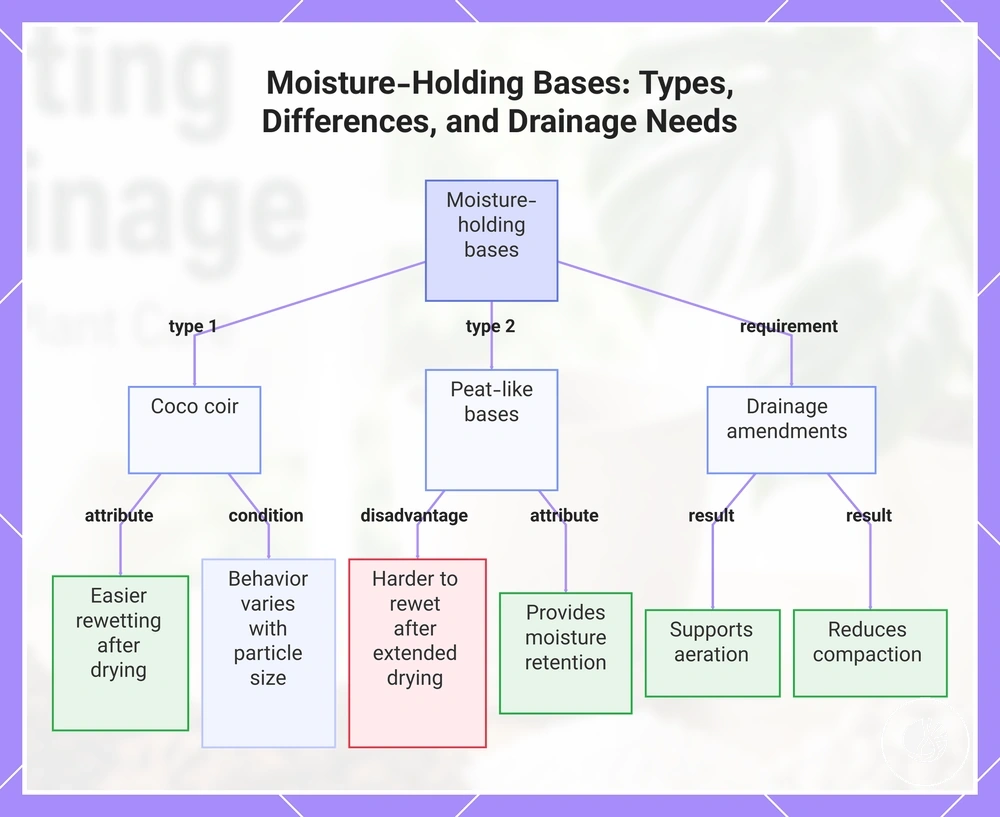
Moisture-holding bases are foundation materials that help a potting mix retain usable moisture while supporting mix balance for indoor tropical plants. Coco coir and peat-like bases are common moisture-holding bases because they function as the primary base material around which other components are combined. These base materials support water retention, but they usually need drainage amendments to help maintain aeration and reduce excess compaction within the mix.
Coco coir and peat-like bases differ in water retention, rewetting behavior, and compaction tendency. Coco coir may rewet more easily after drying, although its behavior can vary with particle size and overall mix composition. Peat-like bases can provide moisture retention but may become more difficult to rewet after extended drying in some conditions. Both base materials can develop compaction tendency over time, which is why indoor tropical plant mixes often include drainage amendments to support aeration and mix balance. :contentReference[oaicite:0]{index=0}
This chart shows the two common types of moisture-holding bases for potting mixes, their key differences in rewetting and compaction, and why drainage amendments are necessary.
Perlite, Pumice, and Mineral Drainage Amendments
Mineral amendments improve drainage and aeration in potting mixes, creating pore space and reducing slow drying in dense substrates. They also influence particle stability and weight, supporting root oxygen access while limiting compaction risk in indoor tropical plant mixes.
Perlite and pumice differ in stability, pore space, and weight. Perlite is lightweight and increases aeration efficiently, although it may compress depending on mix proportion. Pumice is heavier and more stable, maintaining persistent pore space but providing slightly slower aeration improvement. Both can be useful in dense or slow-drying mixes to enhance drainage and maintain root-zone balance. :contentReference[oaicite:0]{index=0}
| Property | Perlite | Pumice |
|---|---|---|
| Weight | Lightweight | Heavier |
| Pore Space | Rapid aeration increase | Persistent aeration |
| Particle Stability | Can compress | Stable |
Bark, Compost, and Chunky Structure Additions
Chunky structure additions are materials that enhance potting mix structure, water movement, and airflow for indoor tropical plants. Bark and compost-like organic matter are common examples that contribute to the physical matrix and affect moisture behavior within the root zone.
Structurally, bark provides chunky particles that maintain pore space and reduce compaction risk, while compost-like organic matter can influence moisture behavior and slowly decompose over time. Decomposition may alter local water retention and mix density depending on the amount and mix context. These additions improve aeration and drainage while supporting stable mix behavior without focusing on fertilizer routines or nutrient programs. :contentReference[oaicite:0]{index=0}
Potting Mix Ratios for Indoor Tropical Plants
Potting mix ratios are adjustable starting points that organize base materials, drainage amendments, and chunky additions according to plant need rather than following a universal formula. The most suitable mix proportions depend on drying speed, pot size, root-zone conditions, and indoor growing conditions. Potting mix ratios work best as flexible criteria that can be adjusted when conditions change. :contentReference[oaicite:0]{index=0}
Base materials, drainage amendments, and chunky additions act as ratio levers within a potting mix. A denser mix direction generally emphasizes base materials, while a chunkier mix direction increases the influence of drainage amendments and structural additions. A balanced direction sits between these approaches and may suit a broader range of indoor conditions. The effect of any amendment balance depends on plant need, pot size, and the surrounding environment rather than a fixed formula.
Potting Mix Ratios for Indoor Tropical Plants can be evaluated through common growing scenarios. The table below compares dense, balanced, and chunky mix directions using decision variables such as drying speed, watering frequency, and setup conditions. Each direction includes a reason and a watch-out because mix adjustment depends on conditions rather than a single ratio.
| Plant or setup condition | Ratio direction | Why it helps | Watch-out |
|---|---|---|---|
| Slower drying conditions, larger pot size, or frequent watering | Chunky mix direction | Can support faster drying speed through a more open structure | May dry more quickly in lower-humidity environments |
| Moderate indoor humidity and average watering frequency | Balanced mix direction | Provides a middle ground between material groups | May require adjustment when conditions change |
| Smaller pots, lower watering frequency, or finer roots | Denser mix direction | Can maintain moisture for longer between watering events | Drying speed may slow if the mix becomes too compact |
Plant type, root thickness, pot size, indoor humidity, watering frequency, and drying speed all influence ratio choice. Thicker-rooted and finer-rooted plants may respond differently to the same mix proportions, and a ratio that works in one indoor environment may need adjustment in another. For that reason, potting mix ratios are usually more useful as a ratio guide than as a fixed formula. :contentReference[oaicite:1]{index=1}
Balanced Mixes for General Tropical Houseplants
A balanced mix is a starting-point soil blend for general tropical houseplants, providing moderate moisture retention, a suitable share of drainage amendments, and stable structure for typical indoor conditions. This starter mix can help align drying time with average indoor humidity and medium pot sizes, offering a practical reference rather than a fixed formula. :contentReference[oaicite:0]{index=0}
Moisture retention ensures roots maintain steady water access without saturation, while the proportion of drainage amendments supports aeration and prevents compaction. Structure is maintained through the base material combined with chunky additions, supporting root expansion and oxygen flow. Drying time should suit the example indoor condition, allowing water to drain at a manageable pace. A mini-checklist can verify balanced mix behavior: moderate moisture retention, appropriate drainage amendment, stable structure, and consistent drying time. :contentReference[oaicite:1]{index=1}
Chunkier Mixes for Aroids and Fast-Draining Roots
Chunkier mixes may suit aroids and other plants with fast-draining roots when root structure benefits from coarser, more open media that reduces dense, wet root-zone conditions. This setup can improve aeration and drainage but usually requires more frequent moisture monitoring indoors. :contentReference[oaicite:0]{index=0}
Chunky particles create pore space that promotes aeration and supports oxygen access around roots. Fast-draining mixes allow water to move quickly, lowering the risk of waterlogging, while watering frequency may need adjustment to maintain suitable moisture levels. Compatibility signals for chunkier mixes include: root structure favors open medium, fast-draining roots perform better, aeration is enhanced, and moisture monitoring is practical due to quicker drying. :contentReference[oaicite:1]{index=1}
Pots, Drainage Holes, and Indoor Drainage Trays
Pots, drainage holes, and indoor drainage trays control where excess water exits the potting mix and how it is contained within an indoor setup. Drainage holes allow water to leave the root zone, while pots, cachepots, saucers, and trays manage collection and surface protection. Proper hardware supports watering control, but it cannot fully compensate for a mix that retains excessive moisture or inappropriate watering behavior. :contentReference[oaicite:0]{index=0}
Key parts of pot and drainage hardware include drainage holes, inner pots, cachepots, saucers, and trays. Drainage holes provide a primary exit path for water, and inner nursery pots hold the root zone while allowing drainage. Cachepots or outer pots may catch excess water that drains from the inner pot. Saucers and indoor drainage trays protect surfaces by collecting runoff. Trapped water in cachepots or trays can create standing water if not emptied regularly. :contentReference[oaicite:1]{index=1}
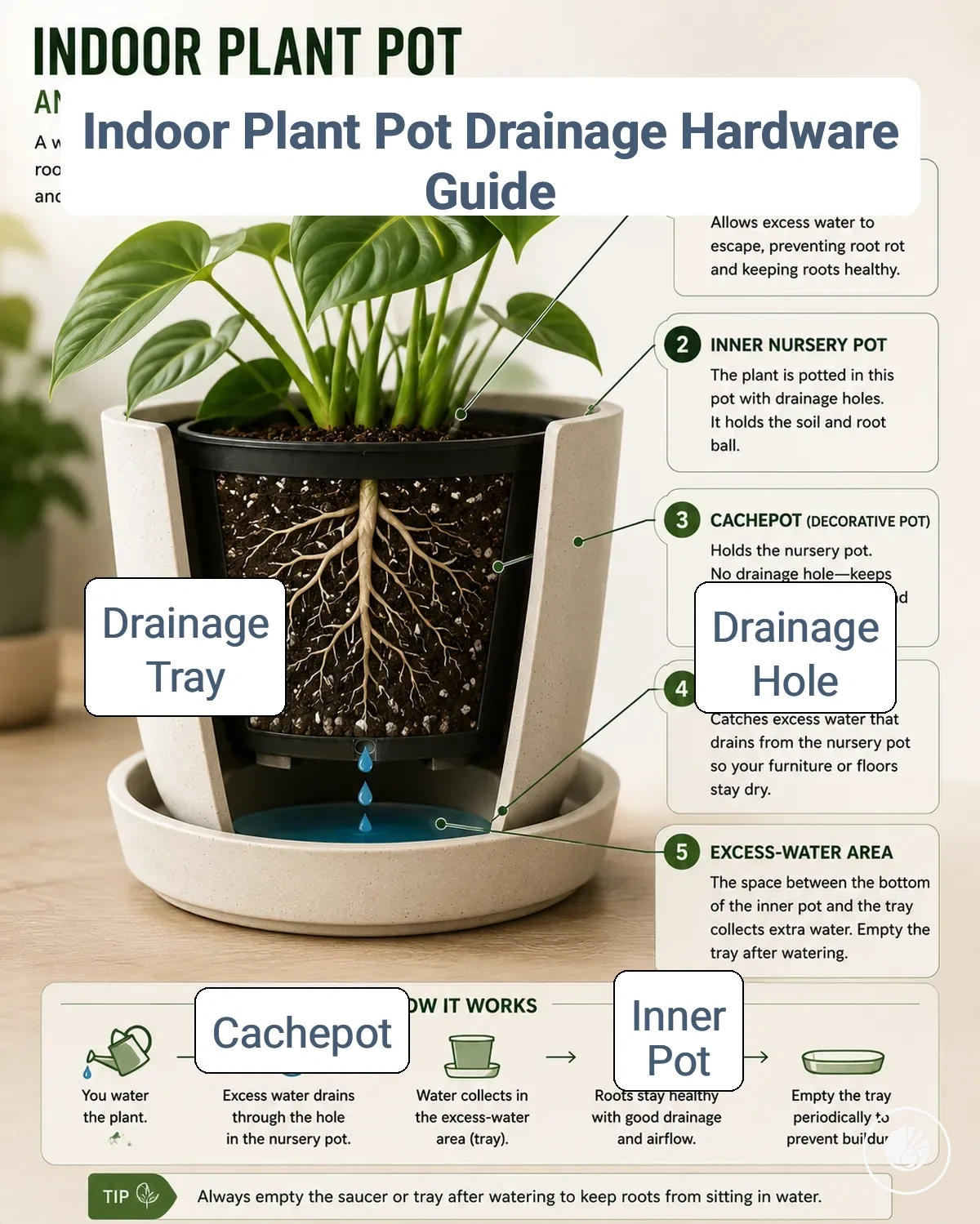
Pots, Drainage Holes, and Indoor Drainage Trays can be verified with this hardware checklist that shows how excess water exits or collects:
- Drainage holes allow water exit from the root zone.
- Inner pots support root containment and drainage.
- Cachepots or outer pots collect drained water safely.
- Saucers and trays protect surfaces from runoff.
- Check for standing water in bottom collection areas after watering.
Hardware can improve drainage control and water containment, but overall effectiveness depends on the potting mix and watering routine. Even well-equipped pots may not prevent waterlogging if the mix retains too much moisture or if watering practices are inconsistent. :contentReference[oaicite:2]{index=2}
Drainage Holes, Nursery Pots, and Cachepots
Drainage holes, nursery pots, and cachepots coordinate to manage water exit and containment in an indoor potting setup. Drainage holes provide an exit path for excess water, nursery pots function as removable inner pots holding the root zone, and cachepots act as outer containers surrounding the nursery pot. This configuration ensures that excess water can leave the root zone while keeping the overall setup suitable for indoor placement. :contentReference[oaicite:0]{index=0}
Trapped water can occur when a nursery pot sits in a cachepot and collected water accumulates around the base. The risk of trapped water depends on the volume of water, duration of standing water, and the configuration of the drainage setup. A practical check is to confirm that water can flow freely through the drainage holes and exit from the root zone, ensuring the inner pot is not left sitting in excess water. Cachepots do not inherently prevent proper drainage, but water should not remain stagnant long enough to affect root health. :contentReference[oaicite:1]{index=1}
Saucers, Trays, and Standing Water Control
Saucers and trays protect indoor surfaces by collecting excess water that drains from pots, but standing water in these containers can increase root-zone saturation if left for extended periods. Pot elevation and timely emptied water help balance surface protection with safe moisture levels, reducing potential harm from retained water. :contentReference[oaicite:0]{index=0}
After watering, a mini-checklist can verify standing water control: ensure the saucer or tray has collected any excess water, confirm the pot is elevated above the collected water, empty the tray promptly to prevent prolonged standing water, inspect the root zone for signs of saturation, and maintain a clear drainage path from the pot. These steps help manage surface protection while minimizing root-zone saturation risk. :contentReference[oaicite:1]{index=1}
Bottom-of-Pot Drainage Materials and Their Limits
Bottom-of-pot drainage materials address drainage perception but cannot replace a suitable potting mix or functional drainage holes. Gravel, mesh, and crock pieces are commonly used, yet the true root-zone behavior and water movement still depend on the soil profile and drainage exit. This distinction prevents misinterpreting bottom layers as a solution for overall pot drainage. :contentReference[oaicite:0]{index=0}
Gravel, pot mesh, and crock shards may improve hole coverage and reduce soil loss through drainage holes. However, they do not eliminate perched water risk and cannot change how the soil profile retains or moves water. Hole coverage helps protect the drainage exit from blockage, but root-zone saturation remains contingent on soil structure, layer continuity, and watering conditions. :contentReference[oaicite:1]{index=1}
Bottom-of-Pot Drainage Materials and Their Limits can be summarized in this contrast:
| Can help with | Cannot replace |
|---|---|
| Hole coverage, limiting soil loss, improving local drainage perception | Proper potting mix, functional drainage holes, root-zone water movement |
Choosing a Soil and Pot Setup by Plant Need
Choosing a soil and pot setup depends on plant need, soil behavior, pot features, and indoor conditions. Selection requires matching plant moisture preference, root sensitivity, pot size, drainage exits, indoor climate, and watering habits to ensure the setup supports healthy root-zone behavior. :contentReference[oaicite:0]{index=0}
Moisture preference guides how frequently a plant requires watering, while root sensitivity affects tolerance to compact or dense mixes. Pot size influences drying speed and root expansion, and drainage exits help control water movement from the root zone. Indoor climate affects evaporation and soil moisture retention, while watering habits interact with all these factors to shape effective potting behavior. Each criterion informs how a soil and pot setup should be selected for indoor tropical plants. :contentReference[oaicite:1]{index=1}
Choosing a Soil and Pot Setup by Plant Need can be summarized in this decision table, which organizes plant need, mix attributes, pot features, and expected care effect for practical selection scenarios:
| Plant need | Mix attribute | Pot feature | Decision / Watch-out |
|---|---|---|---|
| High moisture preference, sensitive roots | Moderate water retention, airy mix | Medium pot, sufficient drainage exits | Monitor drying rate; adjust watering as needed |
| Low moisture preference, robust roots | Faster-draining, coarser mix | Small pot, standard drainage | Watch for rapid drying; check root moisture |
| Moderate moisture preference, delicate roots | Balanced retention and aeration | Medium pot, multiple drainage exits | Observe soil surface; adjust frequency accordingly |
Use this table by evaluating each plant’s criteria against the soil and pot features, adjusting watering and placement based on indoor climate and observed drying. This ensures a closer match between plant need and setup behavior.:contentReference[oaicite:2]{index=2}
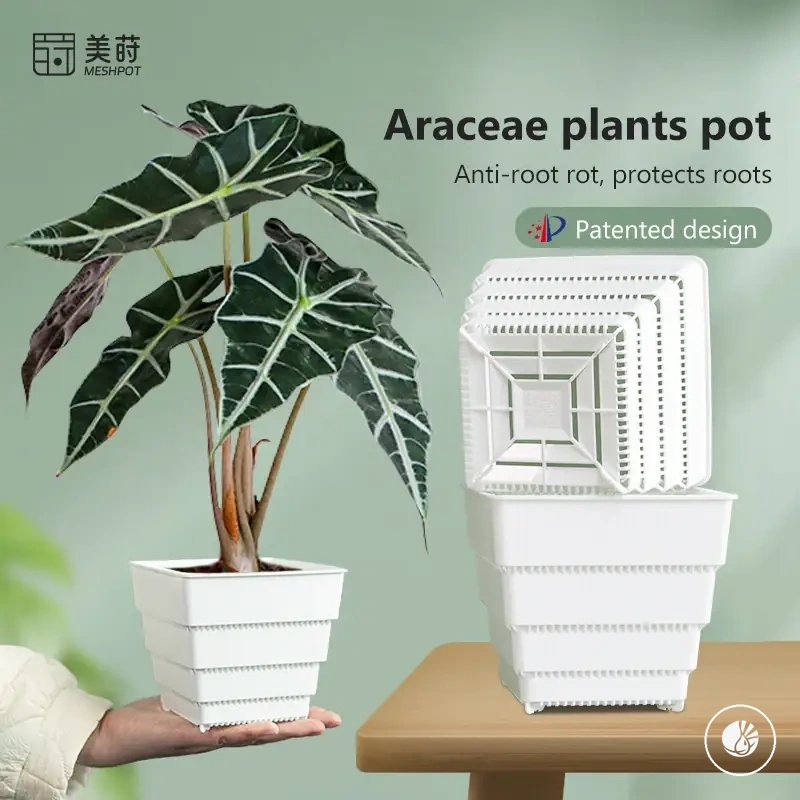
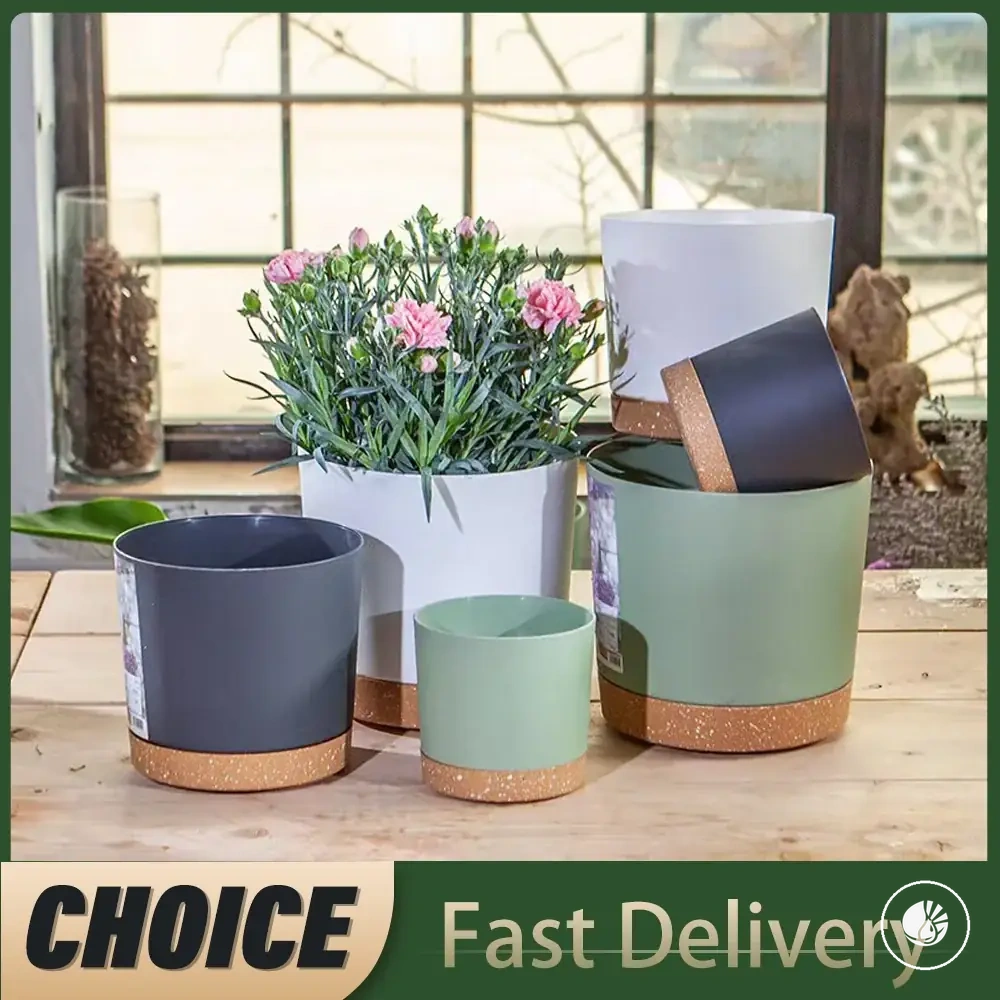
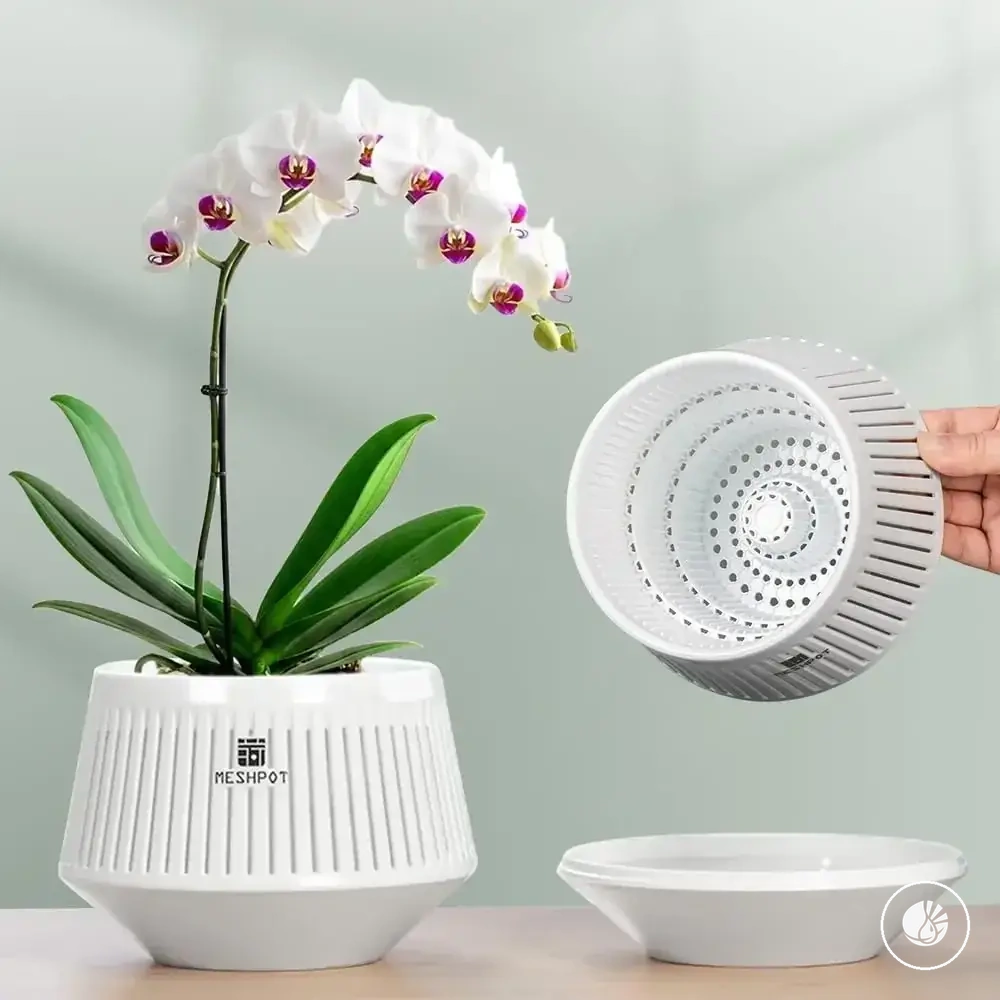
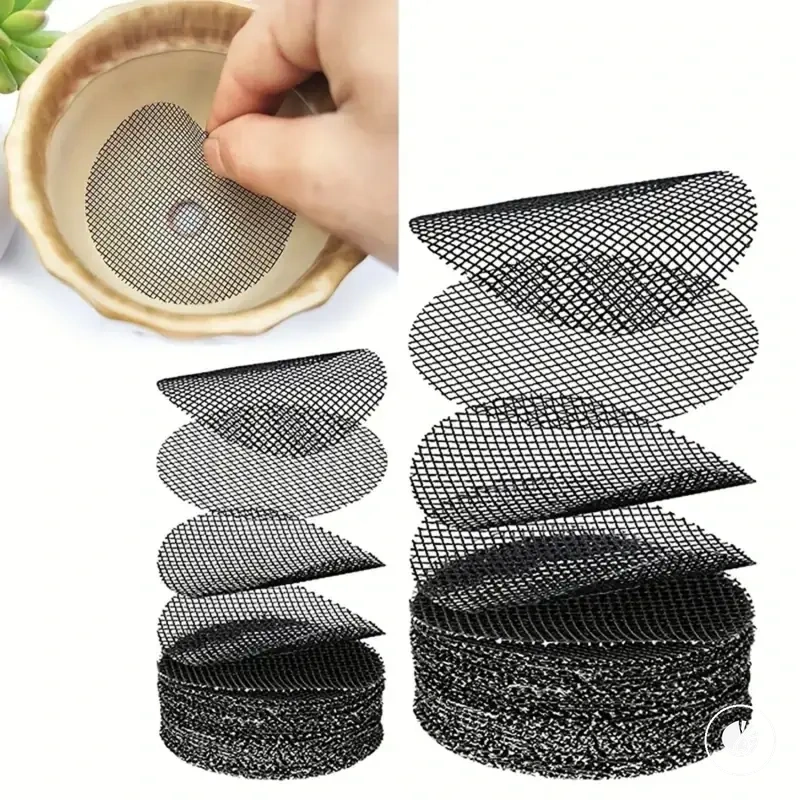
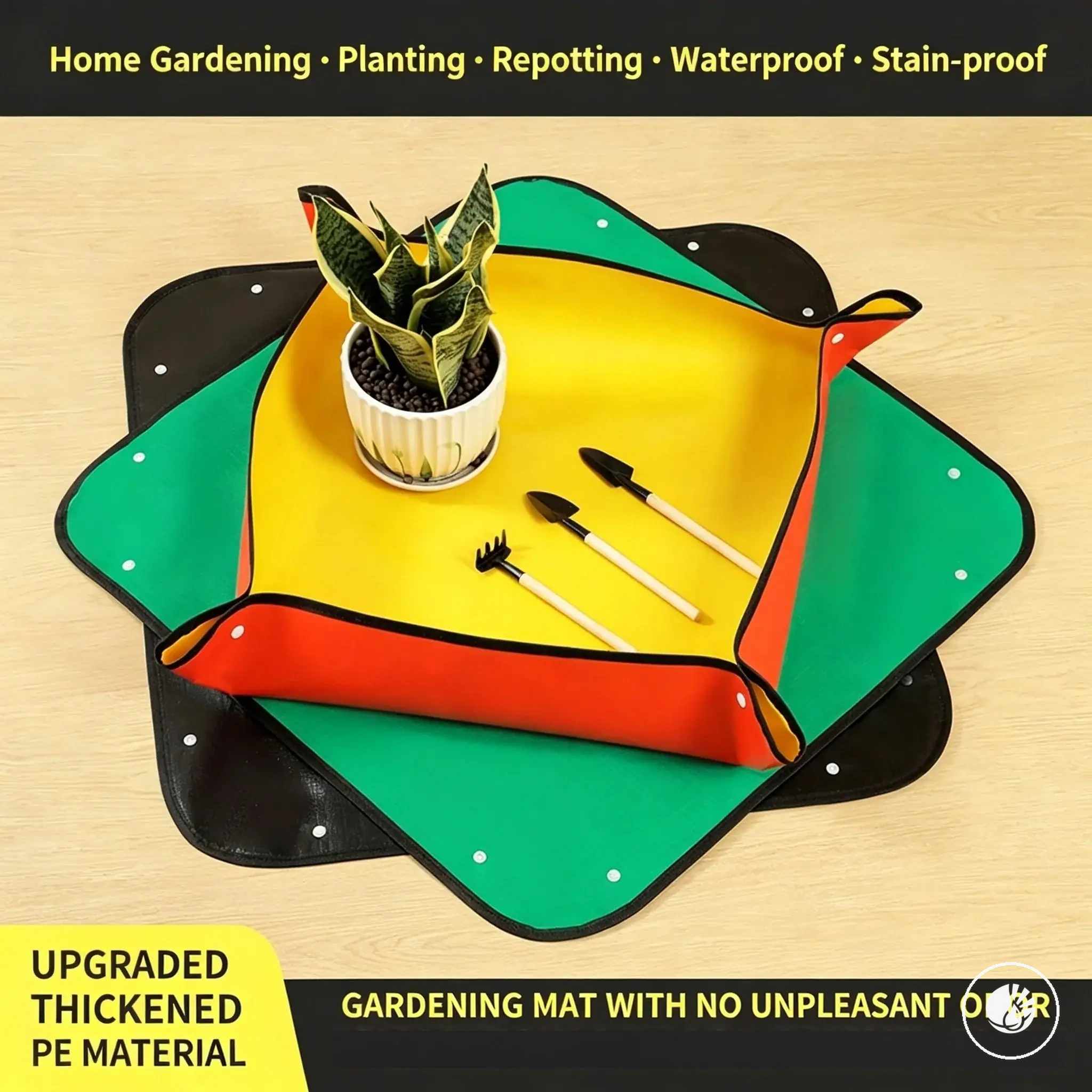
Here are product examples that may make comparison easier. Before buying, always review the compatibility criteria, essential features, and product details.
Moisture-Loving Tropical Plants
Moisture-loving tropical plants depend on consistently moist media that still provides oxygen and drainage around the root zone. These plants may prefer damp media for longer periods than other tropical plants, but moisture-loving does not mean waterlogged. Root oxygen remains important even when moisture retention is a selection priority. :contentReference[oaicite:0]{index=0}
Fine roots can be sensitive to reduced oxygen when moisture retention, pot size, and humidity combine to slow drying. A larger pot size or higher humidity may increase slow-drying risk, depending on indoor conditions and media behavior. Compatibility conditions include:
- Consistently moist media should still allow oxygen movement through the root zone.
- Pot size should match plant need and expected drying behavior.
- Humidity and drainage should be considered together when evaluating slow-drying risk.
These conditions help align moisture-loving tropical plants with a moist mix that balances moisture retention and drainage without relying on prolonged saturation. :contentReference[oaicite:1]{index=1}
Plants That Need Faster Drainage or Chunkier Media
Plants That Need Faster Drainage or Chunkier Media depend on root structure, moisture behavior, and indoor conditions that make faster drainage more suitable. Compatibility may be stronger when thick roots, epiphytic tendencies, and a preference for greater aeration align with a chunkier media or fast-draining setup. :contentReference[oaicite:0]{index=0}
Thick roots and epiphytic tendencies can indicate a preference for a more open root environment where large particles support airflow and drainage. Indoor airflow and watering frequency also influence whether a coarse medium remains appropriate, since faster drainage may increase the need for moisture monitoring. Use this checklist to verify whether faster drainage or chunkier media may be suitable:
- Thick roots may benefit from increased aeration around the root zone.
- Epiphytic tendencies suggest compatibility with a more open growing medium.
- Large particles can improve airflow through the media.
- Indoor airflow contributes to faster drying and may require closer moisture monitoring.
- Watering frequency can be adjusted when drying behavior changes.
Fit depends on root type, indoor airflow, and watering behavior, especially when faster drainage increases monitoring needs. :contentReference[oaicite:1]{index=1}
Soil and Drainage Problems That Affect Watering Control
When watering behavior is difficult to interpret, soil problems and drainage problems are often a root cause. Uneven moisture, compaction, and water retention irregularities can make it unclear whether a plant needs more or less water, affecting overall watering control. :contentReference[oaicite:0]{index=0}
Compaction, waterlogging, runoff, dry pockets, limited drainage exits, and variable drying speed each contribute to observable issues. Compacted soil can slow moisture movement, while waterlogged areas keep roots saturated. Runoff and dry pockets create uneven wetting, and inadequate drainage exits may trap water. Differences in drying speed across the pot can make watering decisions less predictable. Monitoring these factors helps identify the likely soil or drainage problem impacting watering control. :contentReference[oaicite:1]{index=1}
Visible symptoms may also stem from adjacent causes beyond soil, so assessment should include the pot setup and environmental factors. For example, yellow leaves from soil or drainage issues or drooping plants and root-zone problems can involve multiple contributing factors. The following diagnostic checklist organizes symptoms by likely soil or drainage issue and helps interpret watering signals. :contentReference[oaicite:2]{index=2}
| Symptom | Likely soil or drainage issue | Check | What it means |
|---|---|---|---|
| Slow soil drying, persistently wet surface | Compaction or waterlogging | Probe soil moisture at multiple depths | Roots may be oxygen-limited; adjust watering |
| Runoff during watering | Uneven wetting or dry pockets | Observe water movement and wetting pattern | Water may bypass root zones; consider mixing or amending soil |
| Dry patches in the pot | Poor water retention, channeling | Inspect media texture and root distribution | Roots may not access moisture evenly; adjust mix or watering technique |
| Standing water at pot base | Insufficient drainage exits or waterlogging | Check drainage holes and pot setup | Excess water may stress roots; improve drainage hardware |
| Variable drying speed across pot | Mix inconsistency, uneven particle size | Monitor drying at multiple locations | Root access to water may be uneven; consider remixing or amending soil |
Compacted Mix, Waterlogged Roots, and Slow Drying
When a compacted mix stays wet for long periods, low oxygen around the roots is often a likely cause of root stress. Compacted mix, waterlogged roots, and slow drying can make moisture conditions harder to interpret because excess water may remain in the root zone longer than expected. A cautious correction direction usually focuses on improving root-zone conditions rather than expecting immediate symptom changes. :contentReference[oaicite:0]{index=0}
Dense particles can reduce air space and contribute to slow drying, while standing water may signal waterlogged roots and stagnant moisture. A sour smell can be a sensory sign that low oxygen conditions have persisted, and prolonged saturation may increase yellowing risk depending on plant condition, duration of saturation, and root state. Check roots only when visible or sensory signs justify disturbance, since unnecessary inspection can create additional stress. Soil and root conditions should be evaluated together before drawing stronger conclusions. :contentReference[oaicite:1]{index=1}
Compacted Mix, Waterlogged Roots, and Slow Drying can be assessed with the following cause-effect guide that connects condition, sign, and likely correction direction:
| Condition | Visible or sensory sign | Likely root-zone issue | Correction direction |
|---|---|---|---|
| Compacted mix | Dense surface, slow drying | Low oxygen around roots | Improve aeration cautiously |
| Waterlogged roots | Standing water | Root stress from saturation | Review drainage conditions |
| Slow drying | Wet mix for extended periods | Limited airflow in root zone | Assess moisture movement |
| Stagnant moisture | Sour smell | Prolonged low oxygen conditions | Check root-zone condition carefully |
| Persistent wet conditions | Yellowing risk | Moisture-related root stress | Evaluate soil structure and drying pattern |
Dry Pockets, Runoff, and Uneven Moisture
Dry pockets and runoff indicate uneven moisture distribution inside the potting setup. Dry pockets leave parts of the root zone with limited water access, while runoff may cause water to bypass the media before it can be absorbed, creating areas of partial wetting. Understanding these patterns helps assess where water reaches the roots and where moisture is lacking. :contentReference[oaicite:0]{index=0}
Hydrophobic media, channeling, pot edge gaps, and fast runoff can contribute to uneven wetting and partial root access. Water may move through channels in the media or along pot edges, leaving some roots drier than others. For example, quick runoff immediately after watering may reflect limited soil absorption, whereas healthy drainage allows the soil to absorb water before it exits. A small checklist can verify uneven moisture inside the potting setup:
- Check for dry pockets beneath a visibly wet surface.
- Observe whether fast runoff occurs during initial watering.
- Inspect pot edge gaps that may bypass media.
- Monitor for water channels or partial wetting patterns.
- Confirm whether moisture reaches all root areas consistently.
When Soil or Pot Conditions Point to Repotting
Repotting is typically indicated when soil or pot conditions begin to limit root-zone function through soil breakdown, root confinement, or drainage failure. Repotting signals are most useful when they identify a material or container problem that affects moisture movement, aeration, or root development rather than a routine schedule. :contentReference[oaicite:0]{index=0}
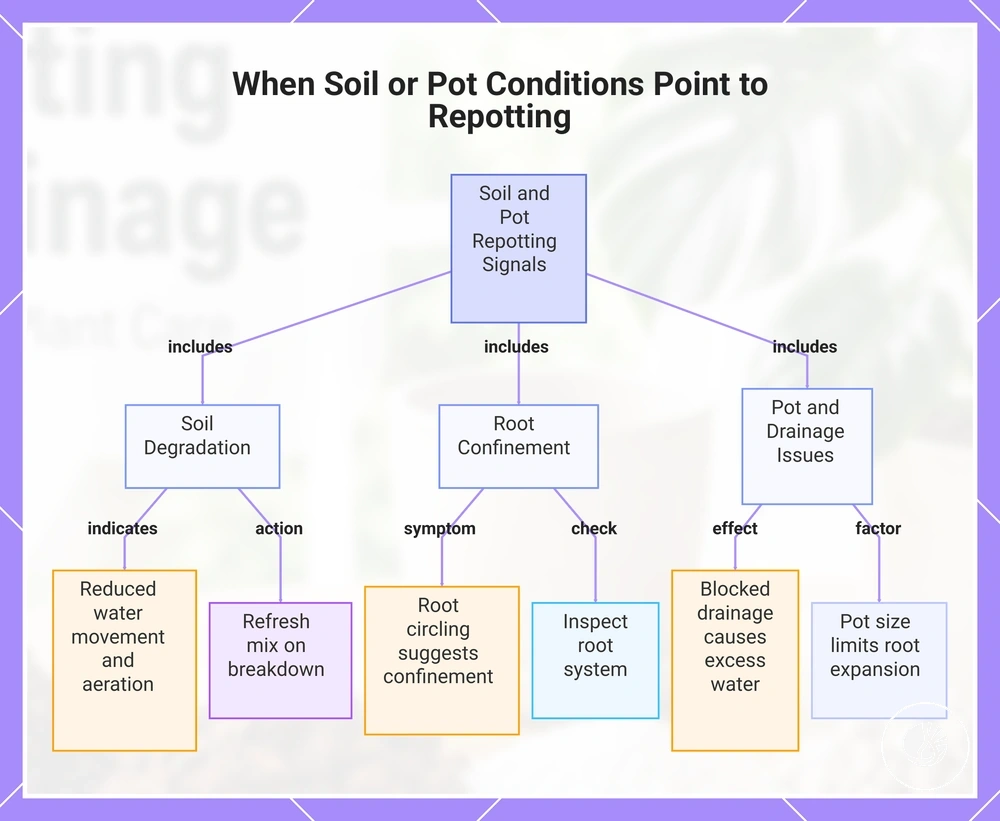
Degraded mix can contribute to compaction and reduced water distribution within the container. Root circling may suggest root confinement, while blocked drainage holes can contribute to drainage failure and excess water retention. Pot size can influence how effectively roots use available space and how the media behaves over time. These conditions may indicate a repotting need when root-zone performance declines, but the appropriate response depends on the specific condition present. :contentReference[oaicite:1]{index=1}
When Soil or Pot Conditions Point to Repotting can be assessed with the following timing-and-condition checklist, which separates material problems from routine repotting:
Here are product examples that may make comparison easier. Before buying, always review the compatibility criteria, essential features, and product details.
- Refresh mix when soil breakdown, degraded mix, or compacted media reduces water movement or aeration.
- Inspect roots when root confinement or root circling is suspected.
- Check blocked drainage holes when drainage failure or excess water persists.
- Consider whether pot size is limiting root expansion or affecting media performance.
- Account for post-repot stress risk by evaluating plant condition and timing before intervention.
Decision signals should remain conditional and tied to observed soil, root, and drainage conditions. For broader guidance on repotting indoor tropical plants, a dedicated resource can help evaluate the next step when a closer assessment is needed. A decision to refresh mix, change pot size, or inspect roots depends on which repotting signal is present. :contentReference[oaicite:2]{index=2}
This chart shows the main soil, root, and pot conditions that indicate a need for repotting, along with the specific signs and recommended actions.
Common Soil, Potting, and Drainage Questions
What is regular potting soil, and is it suitable for indoor tropical plants?
Regular potting soil can be suitable when its drainage and moisture behavior match the plant’s needs. If the soil remains dense or retains excess moisture indoors, an amendment may improve suitability. The decision depends on the condition of the potting mix and the growing environment. :contentReference[oaicite:0]{index=0}
Does perlite improve drainage in a potting mix?
Yes, perlite can improve drainage and aeration when a potting mix is too dense. The effect depends on the existing mix structure and how much amendment is used. Perlite is commonly included to create more air space within the media. :contentReference[oaicite:1]{index=1}
Should a drainage tray hold standing water?
No, a drainage tray is usually intended to collect excess water temporarily. If standing water remains for long periods, root risk may increase depending on the pot setup and drainage conditions. Emptied water can reduce prolonged contact with moisture beneath the pot. :contentReference[oaicite:2]{index=2}
Can coco coir be used in a tropical potting mix?
Yes, coco coir can be used as a base material or amendment in a tropical mix. Its contribution often relates to moisture retention, although the overall result depends on the complete potting mix. Coco coir is typically combined with materials that support balanced drainage. :contentReference[oaicite:3]{index=3}
When are drainage holes necessary?
Drainage holes are necessary when excess water needs a path out of the container. If drainage holes are blocked or missing, water movement may be restricted and drainage conditions can change. Their role is to support water exit from the potting setup. :contentReference[oaicite:4]{index=4}
Why can a potting mix drain too quickly?
A potting mix can drain too quickly when water moves through the media faster than expected. The condition may depend on particle size, mix structure, and how evenly the soil absorbs water. Fast drainage alone does not automatically indicate a problem. :contentReference[oaicite:5]{index=5}
Can regular potting soil be amended for better drainage?
Yes, regular potting soil can often be amended when drainage or aeration needs adjustment. The amendment depends on the condition of the existing soil and the desired balance between moisture retention and drainage. The goal is to improve suitability rather than change the purpose of the mix entirely. :contentReference[oaicite:6]{index=6}
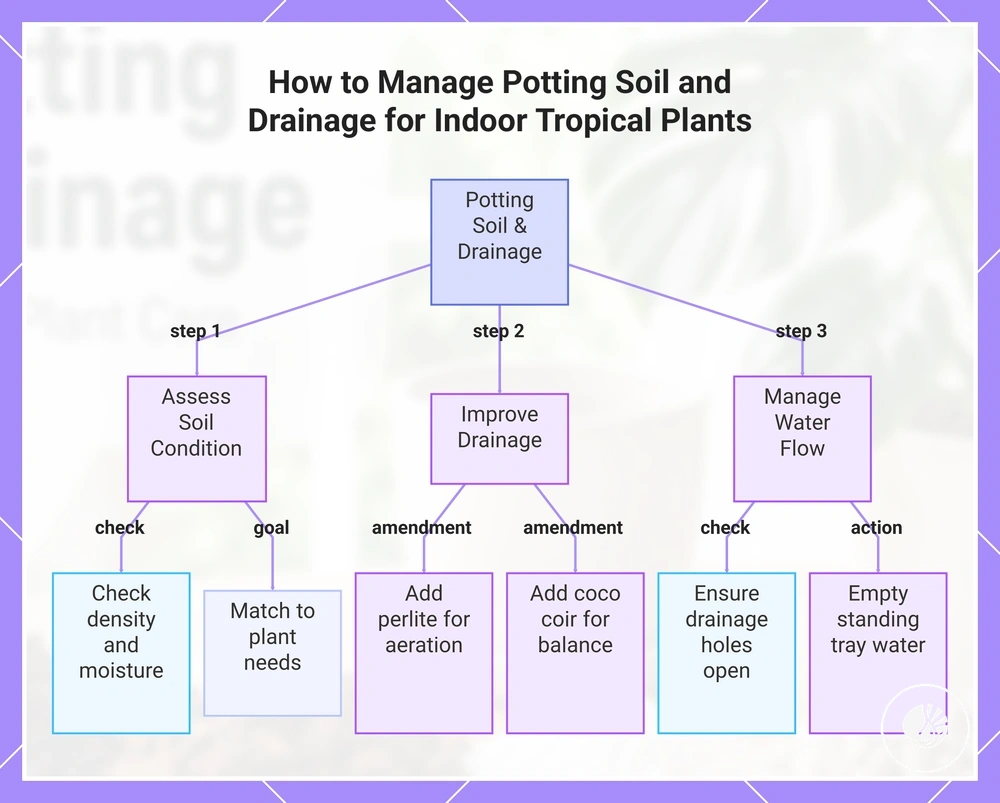
This chart shows the main steps to assess, improve, and manage potting soil and drainage for indoor tropical plants.