Indoor Tropical Plant Care Solutions: Meaning, Core Parts, and Basic Requirements
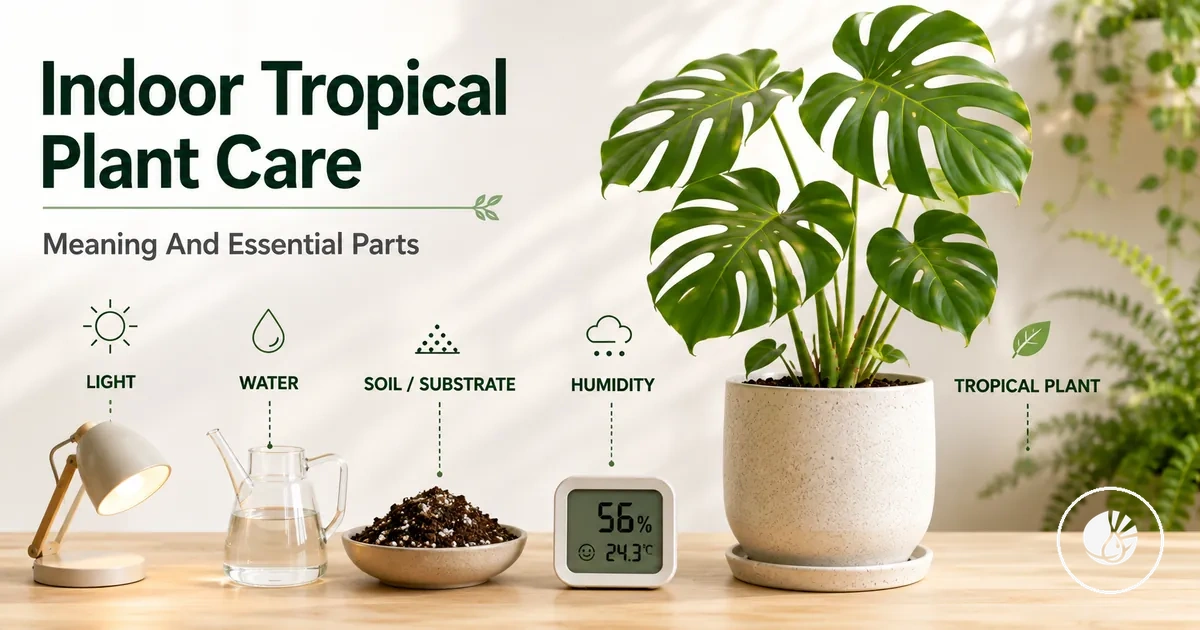
Indoor tropical plant care solutions are the combined care conditions, supportive routines, and basic tools used to help tropical houseplants adapt to an indoor environment. Their purpose is to connect plant needs with light, water, soil, humidity, and observation so indoor plant health can be managed more clearly.
Indoor conditions change tropical plant care because rooms, pots, airflow, and daily routines do not behave like natural growing conditions. Tropical houseplants may respond differently depending on room condition, plant type, and care consistency, so the care setup has to focus on practical care conditions rather than one fixed formula.
The essential parts include plant-facing needs first, then supportive routines and basic tools that help observe moisture, humidity, and visible plant response. For broader page context, the indoor tropical plant care solutions hub connects this definition to the wider care system.
Specialized guidance for light, watering, soil, and humidity belongs in related care sections, while this page keeps the meaning, core parts, and basic requirements clear before those narrower details.
What Indoor Tropical Plant Care Solutions Mean
Indoor tropical plant care solutions are the combined conditions, routines, and supportive items used to keep tropical plants healthy indoors. The phrase includes both the growing environment and the care support that helps tropical plants adapt to indoor spaces. The purpose of indoor tropical plant care solutions is to align plant requirements with practical care support.
Indoor environments can differ from the conditions tropical plants experience in their native habitats. Light, moisture, and other growing factors may vary by room, plant type, and daily care habits. Because of these differences, indoor tropical plant care solutions focus on balancing plant requirements with observation and ongoing routines rather than relying on a single care setup. Effective care support connects conditions to routines that can be adjusted as indoor conditions change.
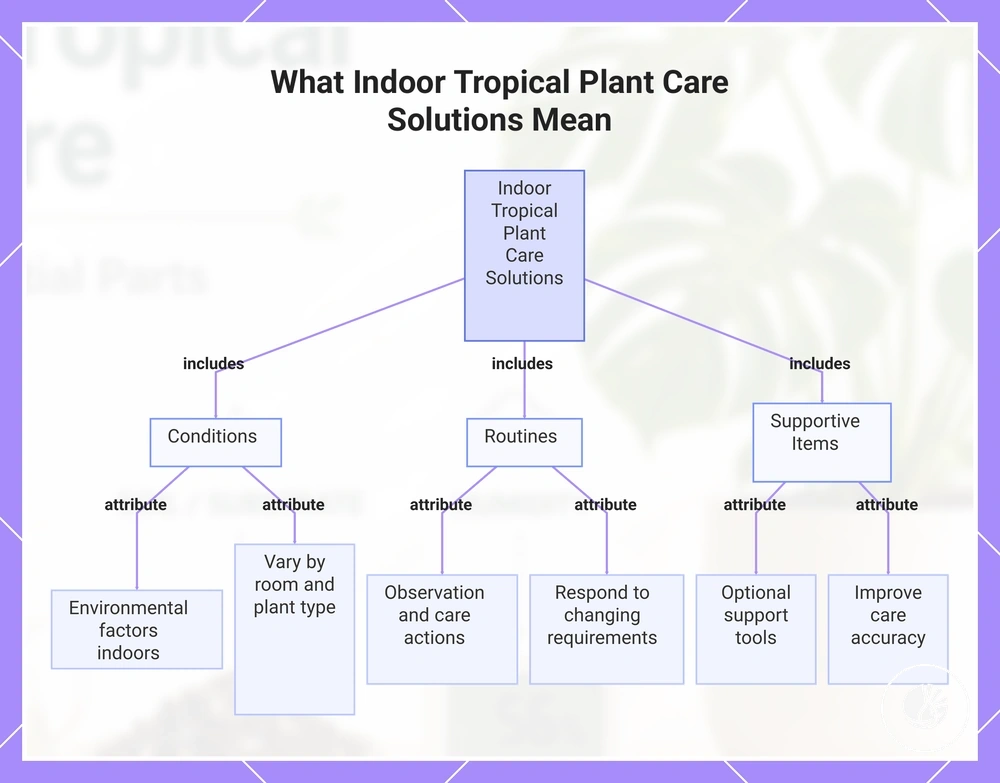
What Indoor Tropical Plant Care Solutions Mean becomes clearer when separating plant requirements from supportive items that assist care.
- Conditions refer to the environmental factors that influence tropical plants indoors.
- Routines involve observation and care actions that respond to changing plant requirements.
- Supportive items and tools provide optional support that may improve care accuracy.
- The meaning includes conditions, routines, and supportive items, not only tools or kits.
This chart shows the meaning of indoor tropical plant care solutions and their three main components: conditions, routines, and supportive items.
Care Conditions Versus Care Products
Care conditions are plant-facing requirements that influence how tropical plants function indoors, while care products are optional support mechanisms used to assist observation and management. Care conditions relate to factors such as light, water, and humidity, whereas care products support monitoring and care accuracy. In this distinction, conditions come before products.
Care Conditions Versus Care Products separates plant needs from support items by focusing on scope and function.
| Care conditions | Care products |
|---|---|
| Plant-facing requirements | Optional support |
| Moisture needs or humidity needs | Watering tools or gauges |
| Define what the plant may require | Support monitoring and observation |
| Depend on plant needs and room context | Usefulness depends on context and observation |
For example, moisture needs may lead to the use of watering tools, while humidity needs may lead to the use of gauges. These support items can assist observation, but they do not replace the underlying care conditions or plant-facing requirements.
Basic Scope for Indoor Tropical Plants
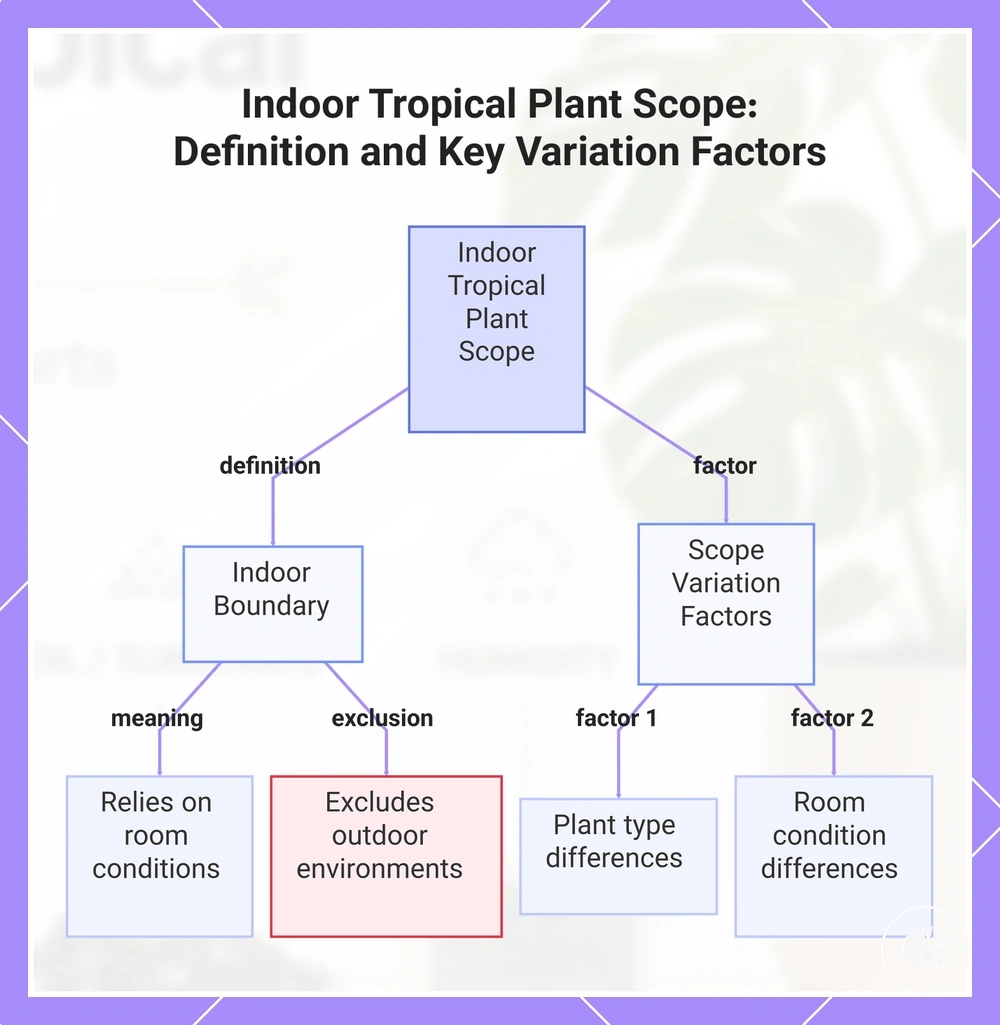
Basic Scope for Indoor Tropical Plants refers to tropical houseplants grown in rooms, pots, and controlled home environments. The focus is limited to the indoor growing context where indoor tropical plants depend on room conditions rather than outdoor environments. This defines the indoor boundary for the page.
Basic Scope for Indoor Tropical Plants is shaped by the room and pot context in which tropical houseplants are maintained.
- Room light
- Potting context
- Moisture control
- Humidity
- Temperature stability
- Airflow
These variables help frame the indoor environment without extending into outdoor gardening or plant-specific profiles. For example, two indoor tropical plants may respond differently when room condition, plant type, or airflow differs. The practical scope can vary by plant type and room condition within controlled home environments.
This chart defines the indoor growing boundary for tropical houseplants and the key factors that cause the scope to vary.
Essential Care Conditions for Indoor Tropical Plants
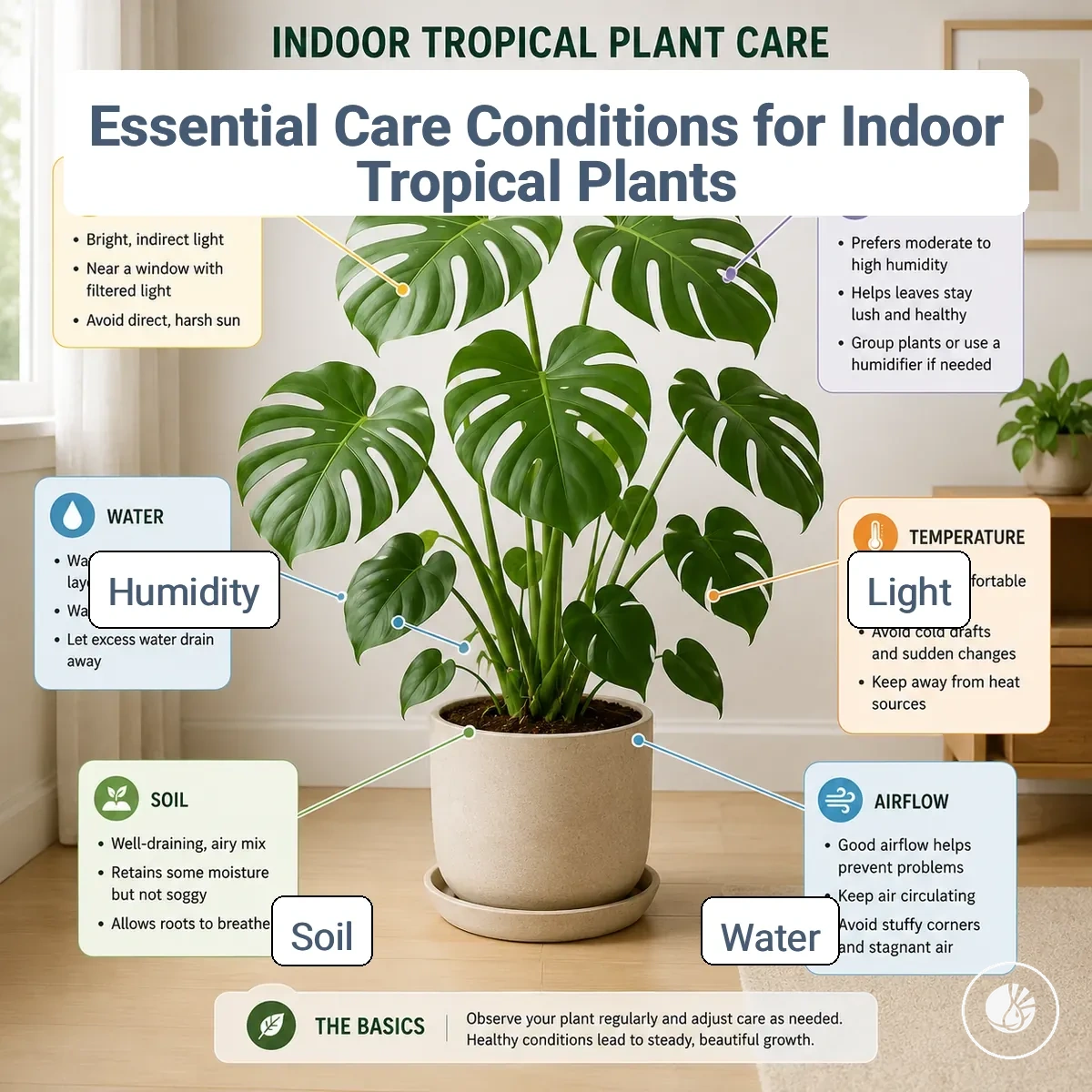
Essential care conditions for indoor tropical plants are the core environmental conditions that influence plant health indoors. Light, water, soil, humidity, temperature, and airflow form the primary condition set because each condition affects how other plant requirements function. Together, these essential care conditions create the basic care system for indoor tropical plants.
Essential Care Conditions for Indoor Tropical Plants depend on connected plant needs rather than isolated actions. Light can influence water use, while soil condition may affect both soil moisture and root oxygen. Humidity, temperature, and airflow also interact with growing conditions and can influence plant response over time. This relationship can be organized through condition, required attribute, practical signal, and likely effect.
Essential Care Conditions for Indoor Tropical Plants can be easier to understand when viewed as connected attributes around the plant. The image below highlights the main care-condition categories before the table organizes their relationships.
| Care condition | Required attribute | Practical signal | Likely effect or decision |
|---|---|---|---|
| Light | Appropriate light availability | Growth and foliage appear consistent with plant requirements | May support normal growth patterns |
| Water | Suitable moisture availability | Soil moisture remains aligned with plant needs | Can influence hydration and plant health |
| Soil | Drainage and root oxygen | Moisture retention without prolonged saturation | May support healthier root conditions |
| Humidity | Appropriate air moisture | Plant response remains stable within room conditions | Can help reduce environmental stress in some situations |
| Temperature | Reasonable stability | Limited exposure to abrupt changes | May support steady plant function |
| Airflow | Air movement around the plant | Air circulates through the growing area | Can support a balanced growing environment |
Acceptable signals and likely effects can vary by plant type, room, pot, season, and surrounding environmental conditions. The table organizes relationships between conditions, attributes, and plant health rather than presenting a universal schedule or exact formula.
Light, Water, Soil, Humidity, Temperature, and Airflow
Light, water, soil, humidity, temperature, and airflow are connected plant requirements that influence indoor tropical plant response through both the growing environment and the root-zone. A change in one condition may influence another, such as light affecting watering demand or soil affecting moisture retention. These parts should be read together rather than as isolated requirements.
Plant response can vary by species, pot size, room exposure, and season, so the relationship between conditions is usually contextual rather than fixed. Light, Water, Soil, Humidity, Temperature, and Airflow work as connected requirements that influence both above-ground growth and root-zone conditions. For more detail on light as a core care part, the dedicated topic expands on this relationship.
Light, Water, Soil, Humidity, Temperature, and Airflow can be viewed as linked care zones around the plant. The image below labels how each care part connects to plant requirements. Additional context for watering as a core care part is available in the related topic.
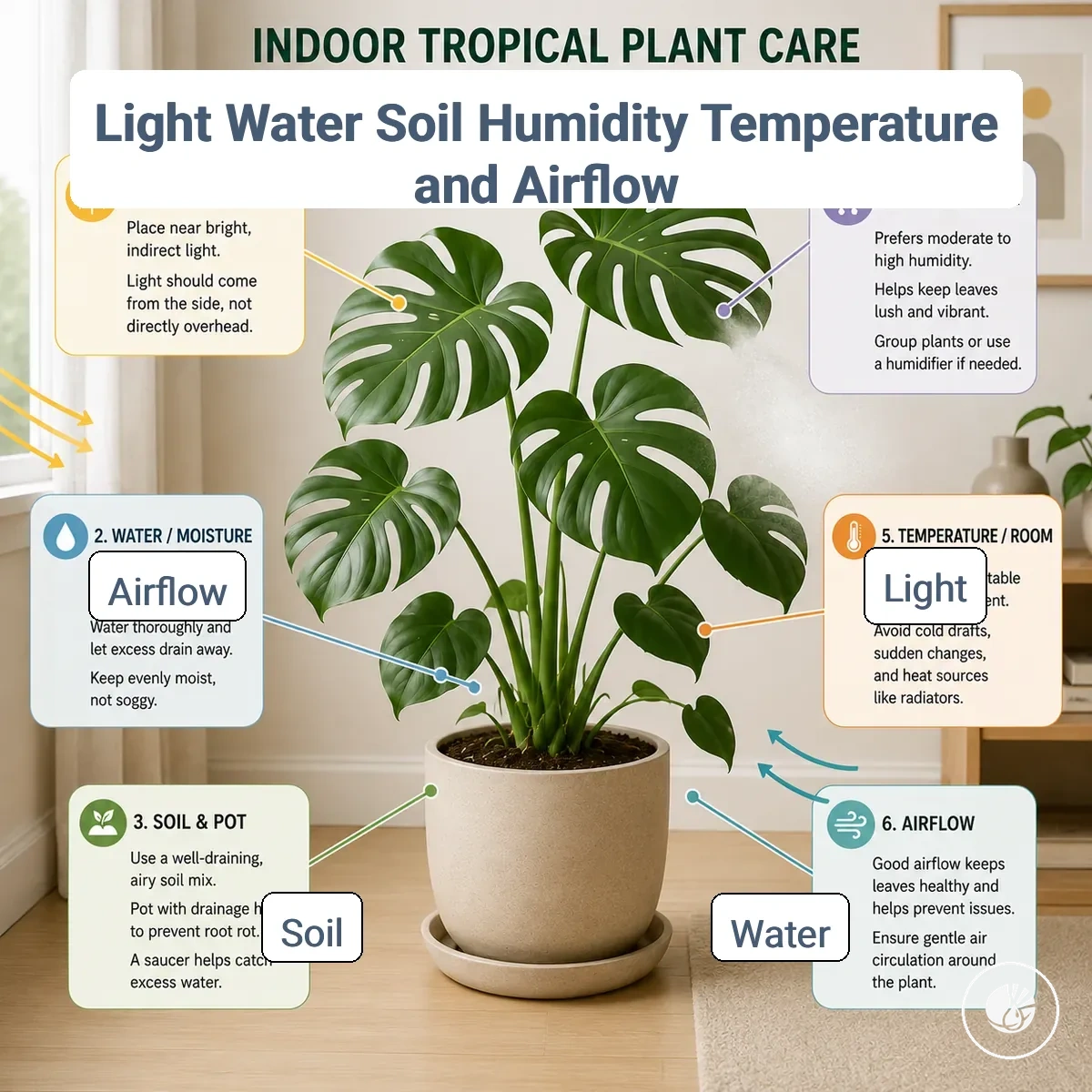
The list below organizes Light, Water, Soil, Humidity, Temperature, and Airflow as connected requirements. Further explanation is available in humidity, temperature and airflow basics.
- Light: Light controls energy availability, and changes in lighting may influence watering demand and plant response.
- Water: Water controls soil moisture, and moisture conditions may vary with pot size, room exposure, and season.
- Soil: Soil controls drainage and root oxygen, and balanced root-zone conditions may support healthier root function.
- Humidity: Humidity controls moisture in the surrounding air, and plant response may vary across indoor climate conditions.
- Temperature: Temperature controls environmental stability, and changing conditions may influence plant stress.
- Airflow: Airflow controls air movement around the plant, and its effect may vary with room exposure and season.
Root-zone conditions are also influenced by soil structure and drainage characteristics. Further explanation is available in soil and drainage essentials.
Feeding, Cleaning, Pruning, and Inspection as Supporting Routines
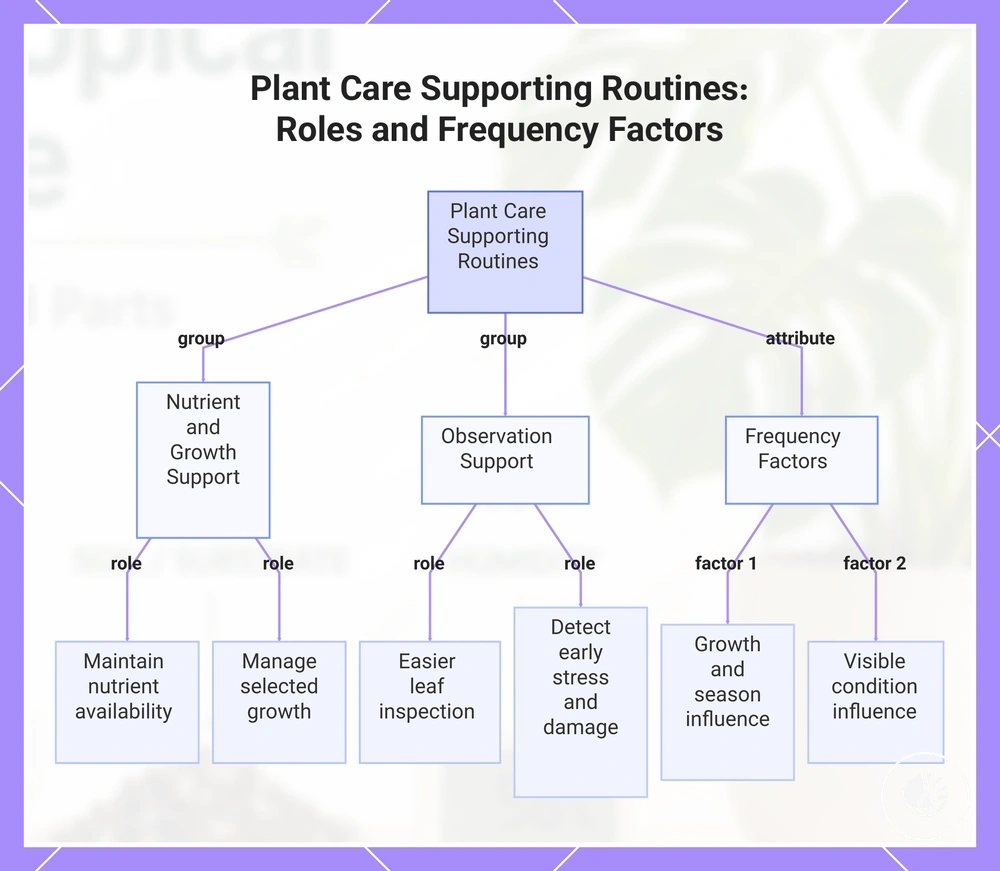
Feeding, cleaning, pruning, and inspection are supporting routines that help maintain plant care conditions over time. These maintenance actions support observation, upkeep, and care adjustment, but they remain secondary to the core conditions that influence growth.
Routine frequency depends on growth, season, and visible plant condition rather than a fixed schedule. A plant may need more frequent attention during active growth and less frequent attention when conditions remain stable. Feeding, Cleaning, Pruning, and Inspection as Supporting Routines can be understood through the support roles listed below.
Feeding, Cleaning, Pruning, and Inspection as Supporting Routines separate supportive actions from core conditions by focusing on purpose, condition support, and observation.
- Feeding: Supports growth by helping maintain nutrient availability when visible plant condition suggests additional support may be useful.
- Cleaning: Supports leaf condition and observation by helping leaves remain easier to inspect for changes.
- Pruning: Supports plant condition by helping manage selected growth when maintenance needs become visible.
- Inspection: Supports care adjustment by helping notice early signs of moisture stress, damage, or changing plant condition.
This chart shows how feeding, cleaning, pruning, and inspection act as secondary support routines, with frequency adapting to plant growth, season, and condition.
Basic Tools and Accessories That Support Care Conditions
Basic tools and accessories are support items that help monitor, maintain, or assist indoor tropical plant care conditions. Their role is to improve observation, care accuracy, and consistency while keeping care conditions as the primary focus. Basic tools and accessories support conditions rather than replace them.
Tool usefulness depends on how effectively a tool helps track a condition or support a care decision. A moisture meter may assist soil moisture observation, while a humidity gauge may help monitor room humidity and relate environmental changes to plant response. Tools are often most useful when they improve care accuracy and consistency while still relying on observation.
Basic Tools and Accessories That Support Care Conditions should be viewed as aids rather than solutions. The image below shows support tools beside an indoor tropical plant and reinforces that observation remains necessary when evaluating care conditions.
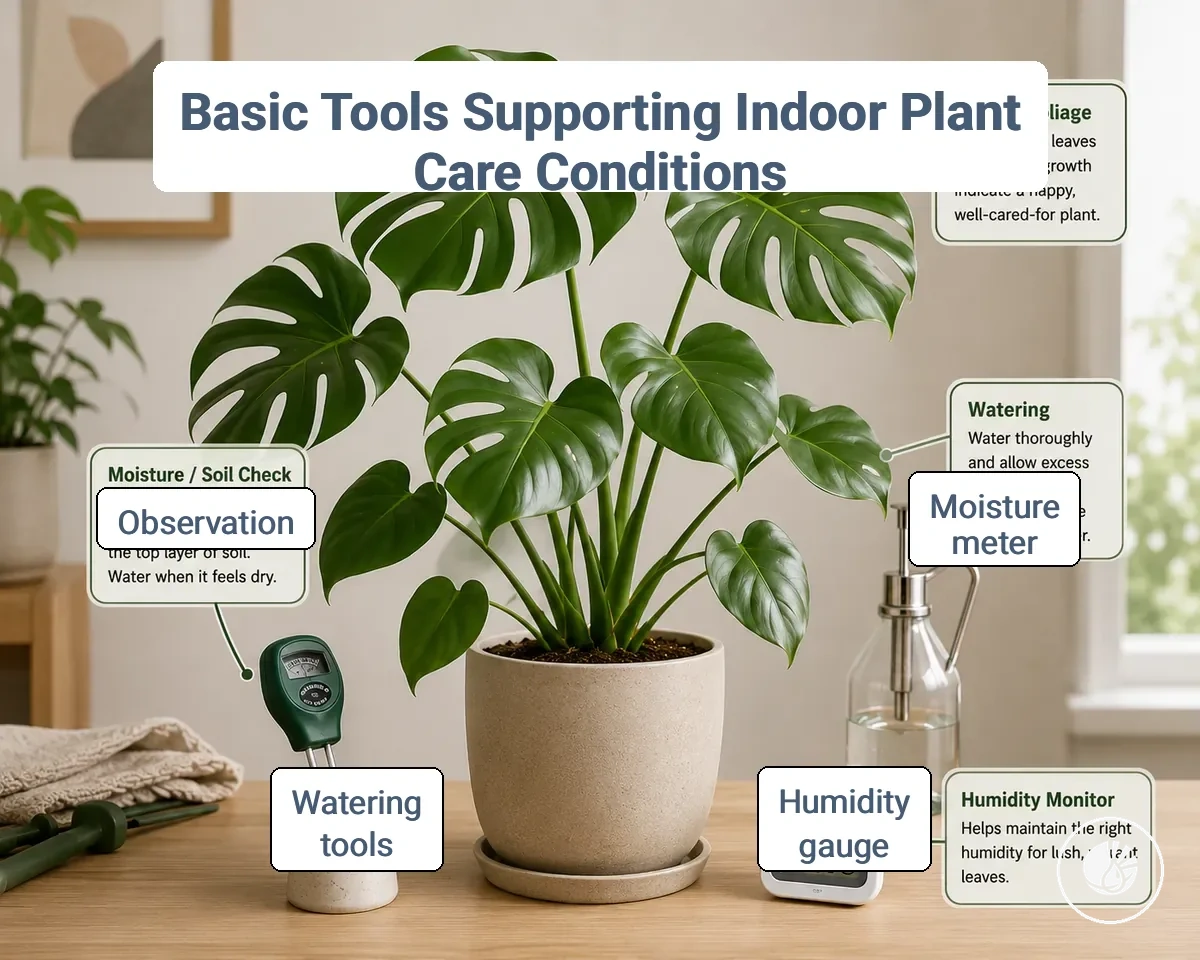
Basic Tools and Accessories That Support Care Conditions can be organized by the condition they support and the decisions they help inform.
- Moisture meter: Supports soil moisture observation and may help assess moisture conditions, but results should still be considered alongside visible plant condition.
- Humidity gauge: Supports room humidity monitoring and may help relate environmental changes to plant response, but usefulness depends on context and observation.
- Watering tools: Support water control and soil condition management, but they do not determine plant needs by themselves.
- Starter tools: Support beginner care through basic monitoring and maintenance actions, but they have limitations when used without observation.
- Plant care accessories: Support care accuracy and consistency by assisting routine checks, but they remain care aids rather than replacements for plant assessment.
Moisture Meters, Humidity Gauges, Watering Tools, and Starter Kits
Moisture meters, humidity gauges, watering tools, and starter kits are common support items used for monitoring and applying basic care conditions. These items can assist observation and routine care decisions, and they remain support items rather than replacements for plant observation.
Tool readings and usefulness depend on room context, soil condition, and visible plant response. A moisture meter or humidity gauge is often most useful when its readings are interpreted alongside plant condition rather than in isolation.
Moisture Meters, Humidity Gauges, Watering Tools, and Starter Kits can be organized by the attribute they support and their practical use.
- Moisture meters: Support soil moisture monitoring and care decisions, but soil moisture readings should be considered together with plant observation and soil condition.
- Humidity gauges: Support room humidity monitoring and may help relate environmental conditions to leaf response, but usefulness varies by room context.
- Watering tools: Support controlled watering and water application for soil condition management, but they do not determine plant needs by themselves.
- Starter kits: Support basic monitoring and care routines through starter tools, but their usefulness depends on observation and has limitations based on plant and room conditions.
When Tools Help and When Plant Observation Still Matters
Tool usefulness depends on the care question being answered. Tools can support care decisions by providing readings or helping monitor conditions, while plant observation, visual plant cues, soil feel, and room context help interpret those readings. Tools and observation work together.
A beginner may focus on meter readings or starter kits and miss visible signs from the plant or changes in room context. When tool readings do not match plant cues, checking soil feel, leaf response, and surrounding conditions can support a more balanced care judgment and a safer decision outcome.
When Tools Help and When Plant Observation Still Matters becomes clearer when tool value is separated from observation cues.
| Care question | Tool support | Observation cue | Decision caution |
|---|---|---|---|
| Soil moisture | Tool readings may support soil moisture checks | Soil feel and visual plant cues | A reading alone may not reflect overall plant condition |
| Humidity | Tools may support room humidity monitoring | Leaf response and room context | Room humidity readings may still require observation for interpretation |
| Watering control | Tools may support controlled watering | Soil condition and plant cues | Controlled application does not remove the need for observation |
| General plant stress | Tools may provide supporting information | Visible signs and plant observation | No single tool reading may fully explain plant stress |
How the Core Care Parts Work Together
Core care parts function as a connected system because a change in one condition can influence how another condition behaves. Light exposure, water use, soil moisture, humidity, temperature, and airflow interact through plant response and room condition rather than operating independently. Indoor tropical plant care works most effectively when these relationships are viewed as a connected system.
Light exposure can influence water use, which may affect soil moisture risk when growing conditions change. Humidity can also influence leaf moisture stress, while airflow may affect how moisture conditions are experienced around foliage. Soil moisture, drainage, and root oxygen are similarly connected, making interaction patterns more useful than viewing each care part separately. These common interactions help explain the relationships shown below.
Room condition, pot size, soil characteristics, season, and plant response can influence how strongly one care part affects another. Increasing attention to one care part without considering connected care conditions may create imbalance, so adjustments are often most useful when guided by overall balance.
How the Core Care Parts Work Together can be organized by showing how one care part may influence another and how those interactions can be interpreted safely.
| Care part that changes | Related care part | What may change | Safe interpretation |
|---|---|---|---|
| Light exposure | Water use | Soil moisture risk may increase or decrease | Effects depend on room condition and plant response |
| Soil moisture | Water use | Drainage and root oxygen conditions may change | Soil characteristics influence the relationship |
| Humidity | Airflow | Leaf moisture stress may change | Observation helps interpret environmental effects |
| Temperature | Water use | Moisture demand may vary | Season and growing conditions can influence outcomes |
| Airflow | Humidity | Moisture conditions around foliage may change | Balance depends on plant response and environment |
How Light Changes Watering and Soil Moisture
Light level affects water use and soil drying speed because light intensity can influence evaporation and plant use of available moisture. As light intensity changes, soil moisture conditions may change as well, which can affect a watering decision. This relationship connects light level directly to moisture behavior.
A brighter position may increase watering demand and speed soil drying speed, although the effect can vary with pot size, soil, season, and plant type. A lower-light position may support greater moisture retention under similar conditions, but results still depend on room conditions and plant response. Because soil moisture is influenced by multiple factors, a watering decision should be based on current conditions rather than a fixed schedule or exact frequency.
How Humidity, Temperature, and Airflow Affect Plant Stress
Humidity, temperature, and airflow influence plant stress because they affect moisture balance, transpiration, leaf comfort, and drying speed around the plant. Changes in room air conditions may alter how efficiently a tropical plant manages moisture, which can affect overall plant response. Together, these air conditions act as plant stress modifiers.
Humidity, temperature, and airflow do not affect every plant in the same way because room size, ventilation, season, and plant sensitivity can change the outcome. A condition that supports moisture balance in one room may influence drying speed or plant stress differently in another. The effects below remain dependent on context.
How Humidity, Temperature, and Airflow Affect Plant Stress can be understood by separating the main air-related effects.
- Humidity: Humidity may influence transpiration and leaf comfort, and its effect on moisture balance can vary with room air conditions and plant sensitivity.
- Temperature: Temperature may affect drying speed and moisture balance, although outcomes often depend on season, room size, and surrounding conditions.
- Airflow: Airflow and ventilation may influence moisture movement around foliage and can affect disease risk, but the effect depends on the broader growing environment.
Basic Indoor Tropical Plant Requirements
Basic requirements for an indoor tropical plant depend on plant need and room condition rather than a fixed rule. A workable minimum requirement set usually includes light, water access, drainage, humidity support, stable temperature, and monitoring. Together, these elements form the minimum requirement set.
An observable condition and an acceptable signal help identify whether a requirement is being met and support a care decision. These practical signals help distinguish essential requirements from optional supports without relying on an exact threshold. Basic Indoor Tropical Plant Requirements can be organized by signals and decisions in the table below.
| Requirement | Observable condition | Acceptable signal | Care decision |
|---|---|---|---|
| Light | Plant receives regular light exposure | Growth and foliage appear responsive to available light | Adjust placement if light conditions appear unsuitable |
| Water access | Moisture can be provided when needed | Soil moisture appears aligned with plant need | Review watering conditions based on current observation |
| Drainage | Excess water can leave the root area | Soil does not remain saturated for prolonged periods | Assess drainage if moisture conditions appear excessive |
| Humidity support | Room air supports moisture balance | Plant response remains reasonably consistent | Consider environmental adjustment when conditions change |
| Temperature stability | Growing conditions remain relatively stable | Limited exposure to abrupt environmental changes | Reduce avoidable fluctuations when practical |
| Monitoring | Plant and room conditions are observed regularly | Changes are noticed before they become significant | Use observation to guide care decisions |
Plant type and room condition can influence how each requirement is expressed and interpreted. A practical signal that supports one indoor tropical plant may require a different care decision in another setting. When conditions are uncertain, observation usually provides a safer decision cue than relying on optional accessories alone.
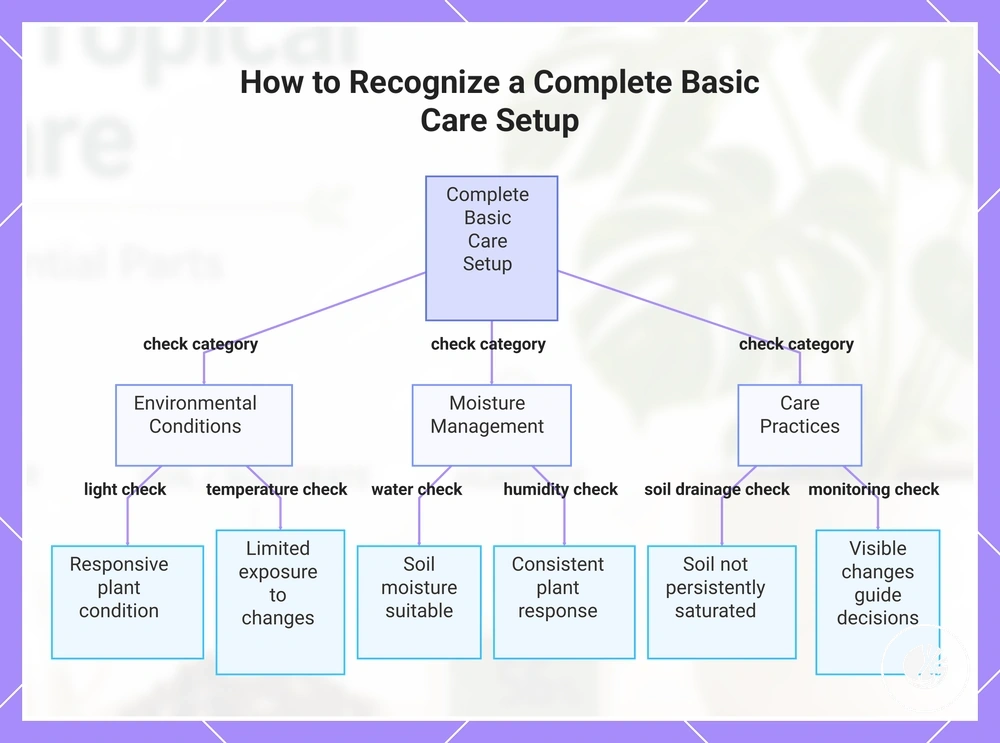
How to Recognize a Complete Basic Care Setup
A complete basic care setup depends on whether plant needs, room conditions, and care support align well enough to support ongoing care decisions. The goal is not to add more items but to verify that the essential conditions are covered and observable. Completeness is defined by alignment.
A beginner with a few plants or limited space may still have a complete basic care setup when the support method matches plant needs and available room conditions. How to Recognize a Complete Basic Care Setup becomes easier when the checklist is used to verify alignment rather than purchases. The checklist below provides a practical verification cue.
- Light: The plant need, room condition, and support method appear aligned, and the sign of adequacy is a generally responsive plant condition.
- Water access: Moisture can be provided when needed, and the sign of adequacy is soil moisture that appears suitable for the plant need.
- Soil and drainage: The support method allows excess moisture to leave the root area, and the sign of adequacy is soil that does not remain persistently saturated.
- Humidity support: Room conditions and support method help maintain moisture balance, and the sign of adequacy is a reasonably consistent plant response.
- Stable temperature: The growing area remains relatively stable, and the sign of adequacy is limited exposure to abrupt environmental changes.
- Monitoring and observation: Care support includes regular observation, and the sign of adequacy is that visible changes help guide a care decision.
This chart shows the key criteria to verify whether a basic care setup is complete, based on alignment of plant needs, room conditions, and care support.
Plant Needs, Room Conditions, and Care Tools Aligned
Plant needs, room conditions, and care tools are aligned when the support method fits the growing environment and helps guide a practical care decision. A practical setup depends on how well plant needs match room conditions and whether care tools or routine support address a real room limitation. This alignment is conditional.
The same tool may be useful in one room and unnecessary in another. For example, a humidity-monitoring tool may support decisions when room conditions change frequently, while routine support and observation may be sufficient in a more stable environment. Plant response remains an important decision cue.
Plant Needs, Room Conditions, and Care Tools Aligned can be verified through the checks below to confirm practical fit.
- Plant need: A plant requirement is identified, a room limitation is recognized, and tool support or routine support helps address that condition.
- Light fit: Available light aligns with plant needs, and the decision outcome is guided by visible plant response rather than care tools alone.
- Water support: Water access matches room conditions, and the decision outcome reflects current moisture conditions rather than a fixed routine.
- Environmental support: Care tools may support monitoring when room limitations affect growing conditions, but usefulness depends on the condition and plant response.
- Verification: Plant needs, room conditions, and care tools remain aligned when support choices continue to fit the environment and inform appropriate decisions.
Where Essential Parts End and Specialized Care Begins
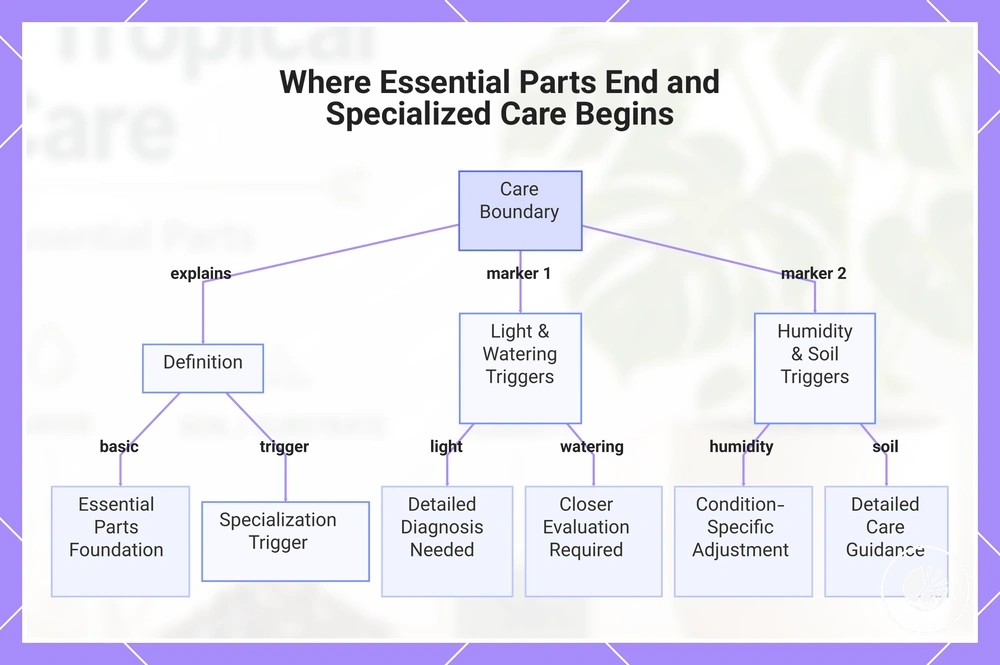
Essential parts are the core conditions that support routine plant care, while specialized care begins when a basic part requires detailed diagnosis or adjustment beyond a general care check. Essential parts establish the foundation for basic care, and specialized care focuses on condition-specific evaluation. This distinction defines the contextual border.
A specialization trigger may occur when light, watering, humidity, or soil conditions require closer assessment than a basic care review can provide. When a condition depends on detailed diagnosis, repeated adjustment, or dedicated guidance, it may move into next-level care without changing the role of the essential parts. This boundary helps maintain scope control and prevents expansion into separate care topics.
Where Essential Parts End and Specialized Care Begins can be understood through the boundary markers below, which separate basic care from specialized care.
- Light: The basic part focuses on general light suitability, while a specialization trigger begins when detailed diagnosis or adjustment is needed.
- Watering: The basic part covers routine moisture management, while specialized care may begin when watering conditions require closer evaluation.
- Humidity: The basic part addresses environmental support, while next-level care may involve condition-specific adjustment that is not expanded here.
- Soil: The basic part explains soil as a core condition, while specialized care begins when detailed diagnosis or care-specific guidance becomes necessary.
This contextual border closes the scope of essential parts and connects broader care context through the indoor tropical plant care solutions hub.
This chart shows the boundary between essential parts (basic care) and specialized care, including the definition and the trigger conditions for light, watering, humidity, and soil.