Drooping and Wilting Indoor Tropical Plants
When drooping or wilting happens in indoor tropical plants, the visible symptom is often a sign of stress rather than a diagnosis on its own. Drooping leaves, soft stems, or a wilted plant can develop under different conditions, and indoor tropical plant care depends on identifying the cause before taking corrective action.
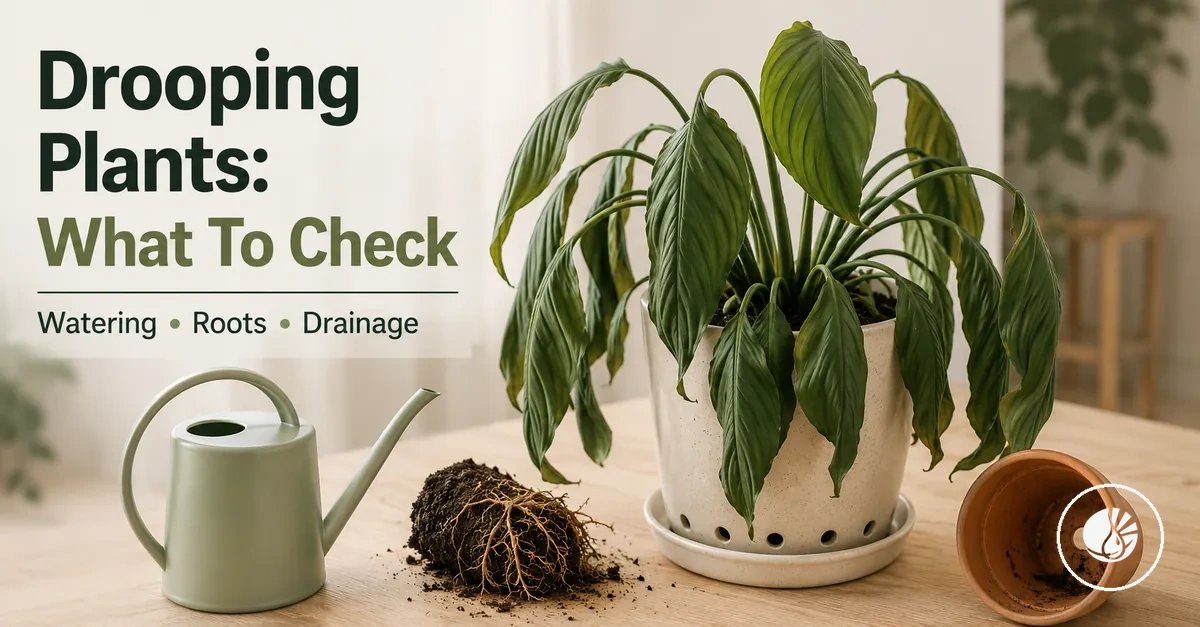
Drooping and Wilting Indoor Tropical Plants: the visual appearance shown below helps clarify common symptoms before diagnosis, including drooping leaves, stem posture, and overall plant firmness.
Drooping and wilting may be linked to soil moisture imbalance, drainage problems, root-zone stress, repotting stress, or environmental conditions that affect water loss. A tropical houseplant with dry soil may show limp leaves for different reasons than a plant sitting in saturated soil. In many cases, underwatering, overwatering, and root problems can produce similar outward symptoms, which is why visible decline should be connected to recent watering, soil condition, and root health before conclusions are made.
When an indoor tropical plant begins showing sagging growth, the condition of the leaves and stems can provide useful clues. Leaf firmness, stem posture, soil moisture, and the overall appearance of the plant often help separate a temporary response from a more persistent problem. Observing these visible signals first reduces the risk of responding to the wrong cause.
Caution: Recovery depends on the underlying condition. A plant affected by recent repotting stress, root disturbance, poor drainage, low humidity, temperature changes, airflow differences, or other room-related stress may require a different diagnostic path than a plant responding to a simple watering issue. The next step is to move from visible drooping and wilting toward cause isolation through careful symptom reading.
What Drooping Means in Indoor Tropical Plants
Indoor tropical plant drooping is a visible loss of turgor, which is the firmness that helps leaves and stems maintain their normal position. Indoor tropical plants show drooping and wilting when leaves, stems, or growing points lose firmness and begin to sag, bend, or hang lower than usual.
What Drooping Means in Indoor Tropical Plants is easier to understand when the symptom is viewed before causes are considered. The image below clarifies leaf angle, stem firmness, and symptom severity so visible drooping can be recognized before diagnosis begins.
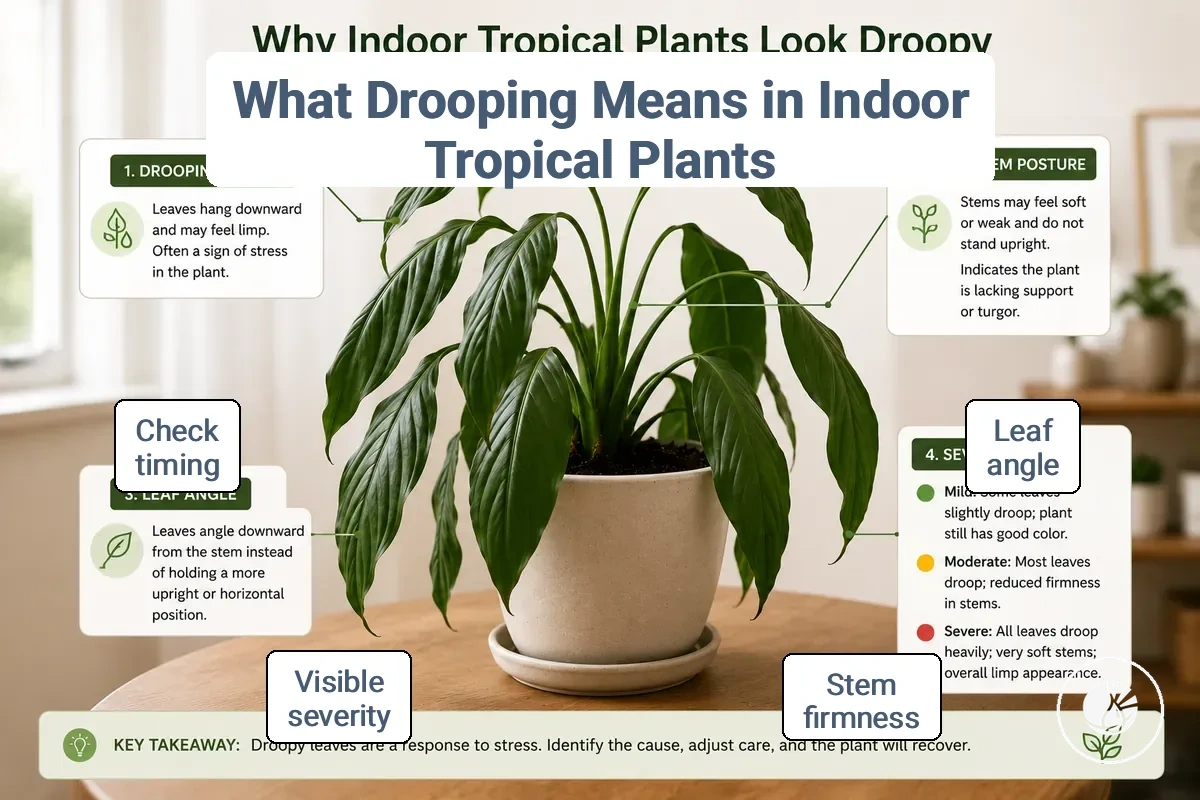
Drooping is a symptom that requires context before any response is chosen. The timing of drooping, recent care conditions, and the recovery pattern can help indicate the level of stress affecting the plant. Limp leaves, sagging leaves, soft stems, and wilted growth may appear similar even when the underlying condition differs, so drooping should not be treated as proof of an exact cause. Leaf firmness and stem angle provide useful visual cues, but they gain meaning only when considered alongside timing and plant condition.
A temporary wilt may improve when the stress is brief, while a progressive wilt or severe collapse can signal a higher diagnostic priority. Recovery potential, visible turgor loss, and changes in firmness over time help clarify whether indoor tropical plant drooping appears temporary, progressive, or more serious within its recent care context.
Temporary Wilt, Limp Leaves, and Long-Term Collapse
Temporary wilt, limp leaves, and long-term collapse are separated by duration, stem firmness, and recovery patterns. Temporary wilt may show a short-lived change in leaf posture, while long-term collapse is identified by persistent droop, reduced stem firmness, and limited signs of recovery.
When sagging leaves appear briefly and leaf posture improves afterward, the pattern may reflect temporary wilt. When limp leaves persist, stem firmness decreases, or collapsed growth affects larger sections of the plant, the visible condition can indicate greater urgency. Temporary Wilt, Limp Leaves, and Long-Term Collapse should be assessed through severity signals rather than cause correction.
Temporary Wilt, Limp Leaves, and Long-Term Collapse can be organized by visible severity signals to support further assessment.
| Visible state | Typical signal | What to check next |
|---|---|---|
| Temporary wilt | Reduced leaf posture with later recovery | Duration and recovery pattern |
| Limp leaves | Loss of leaf firmness and texture | Leaf posture and stem firmness |
| Collapse | Collapsed growth with stem weakness | Severity and urgency signals |
Watering Conditions Behind Drooping
When drooping occurs, watering is a likely factor when the soil moisture pattern and leaf response match the plant’s condition. Watering Conditions Behind Drooping are most useful when diagnosed through soil moisture, watering interval, and leaf recovery signals rather than a fixed schedule or a single assumption.
Dry soil stress and saturated soil stress can both lead to drooping, but their signals often differ. A dry root zone may coincide with dry soil, light pot weight, and limp leaves that show recovery after watering. Saturated soil may remain wet, show limited drainage response, and keep leaves drooping despite recent watering. Soil moisture, drainage, pot weight, and leaf response should be evaluated together because no single indicator confirms underwatering or overwatering.
Watering Conditions Behind Drooping become easier to assess when visible plant symptoms are compared with soil and pot responses. The image below highlights practical moisture-related signals that can help organize the diagnosis before any watering routine is changed.
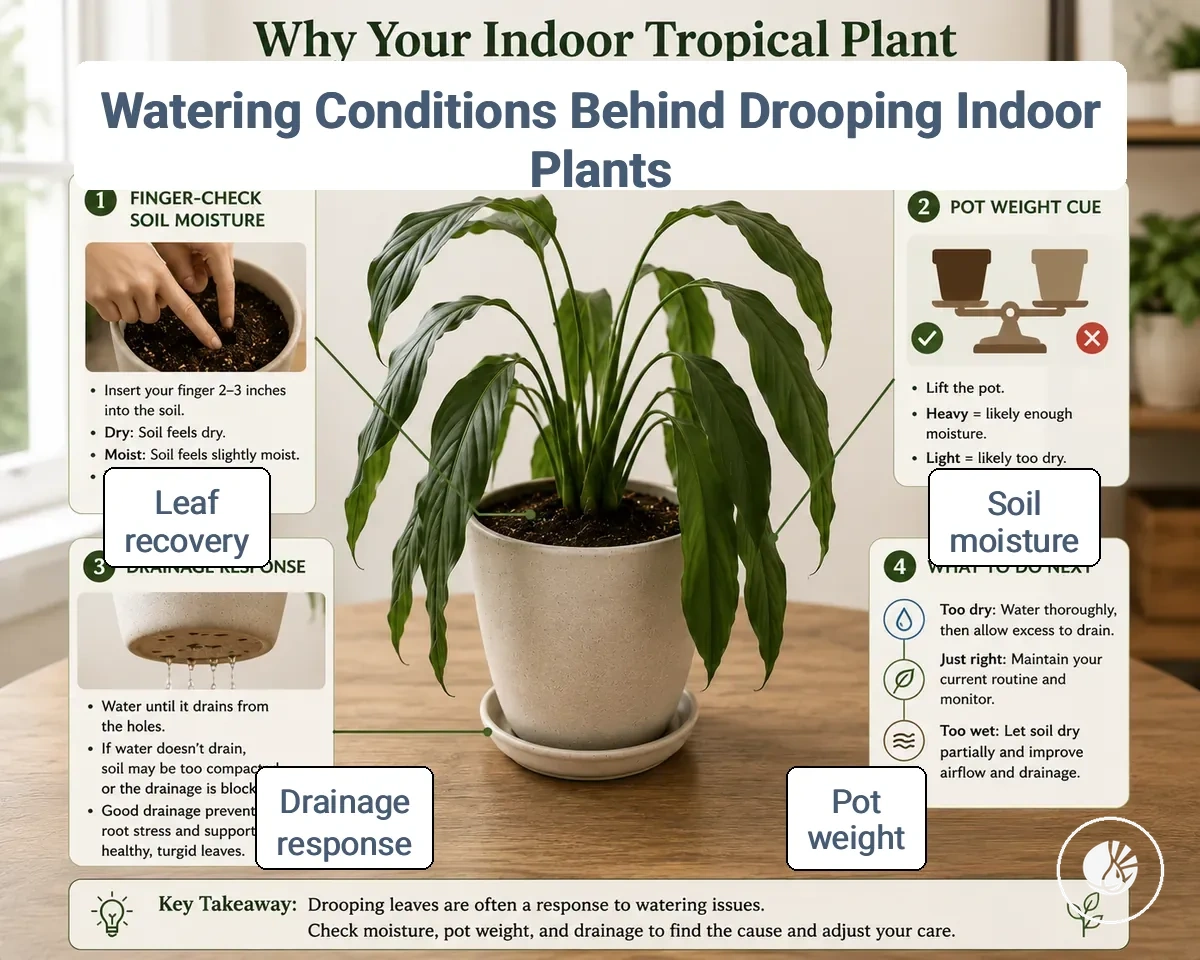
When leaf recovery does not align with recent watering behavior, comparing soil and pot responses can help narrow the diagnosis. Watering Conditions Behind Drooping can be assessed through the checklist below before changing the watering interval or routine.
- Check soil depth for signs of dry soil or persistent moisture below the surface.
- Compare current pot weight with its typical weight after watering and after drying.
- Observe whether water exits through the drainage openings.
- Review any recent change in watering volume or watering interval.
- Assess leaf texture and leaf posture for limp leaves or persistent drooping.
- Note whether leaf recovery follows watering or remains limited afterward.
- If an unusual smell is present, treat it as an additional signal rather than a conclusion.
For broader context on watering and drooping, compare these local diagnosis signals with overall watering practices.
Underwatered vs Overwatered Drooping
Underwatered and overwatered drooping can appear similar, but soil feel, pot weight, and recovery signals often help differentiate them. Underwatered drooping may occur alongside dry soil and a lighter pot, while overwatered drooping may occur alongside wet soil and a heavier pot. These observations should be compared together because no single signal is conclusive.
Leaf softness alone is not a reliable way to distinguish underwatered from overwatered drooping. Leaf texture, stem firmness, smell, and recovery speed provide more useful context when evaluated with soil conditions. If repeated watering does not improve recovery, the broader watering diagnosis may need to be reassessed rather than relying on surface moisture alone.
The comparison below clarifies how underwatered versus overwatered drooping can be interpreted through multiple criteria. Each signal should be viewed as part of a pattern rather than proof of a specific cause.
| Signal | Underwatered drooping | Overwatered drooping | What to check |
|---|---|---|---|
| Soil feel | May feel dry | May feel wet | Compare surface and deeper soil moisture |
| Pot weight | Often lighter | Often heavier | Assess weight relative to recent watering |
| Leaf texture | May appear limp | May appear soft or limp | Compare texture with soil conditions |
| Stem firmness | May remain relatively firm | May show reduced firmness | Check stem firmness alongside moisture signals |
| Smell | Usually minimal odor | May develop a sour smell | Treat smell as one signal only |
| Recovery response | May improve after watering | May show limited improvement after watering | Observe recovery speed and pattern |
Drooping After Watering
When drooping after watering happens, the cause may be delayed recovery or a warning sign that water movement through the pot is not matching plant needs. Drooping after watering does not automatically indicate severe root problems, because recovery timing can vary with soil condition and recent watering patterns.
If post-watering droop persists, evaluate recent watering volume, drainage exit, and pot response before drawing conclusions. Limited drainage, soil compaction, or a waterlogged mix may reduce root oxygen and keep wilting visible even after moisture is added. Observations such as water remaining in the mix for extended periods or compacted soil that resists airflow may justify closer attention to root oxygen and drainage conditions.
Edge cases can also affect interpretation. Hydrophobic soil may contain dry pockets that absorb water poorly, while a saturated mix may keep roots under stress despite repeated watering. Recovery timing should be considered alongside these conditions, especially when a sudden correction follows a prolonged dry period and visible improvement is not immediate.
Root-Zone and Drainage Problems Behind Wilting
When wilting continues even though soil is wet, roots may not be taking up water effectively from the root-zone. Root-Zone and Drainage Problems Behind Wilting can develop when water is present but oxygen access, root condition, or soil structure limits normal water uptake.
Drainage, oxygen access, and soil structure influence how the root system functions. A drainage problem that creates standing water may reduce oxygen access around roots, while compacted soil can contribute to poor aeration and root stress. When waterlogged soil or poor soil structure affects the root-zone, wilting may continue because roots are not functioning normally despite available moisture.
When surface watering clues do not explain persistent wilting, root-zone checks become more justified. Observations such as root color, smell, firmness, standing water, or compacted soil can help qualify whether hidden root-area conditions may be contributing to the symptom. This section focuses on diagnosis and does not replace a full soil and drainage guide.
Root-Zone and Drainage Problems Behind Wilting often involve hidden conditions that are difficult to visualize from the soil surface. The image below clarifies how the root-zone, drainage pathways, and standing water can influence wilting even when moisture is present in the pot.
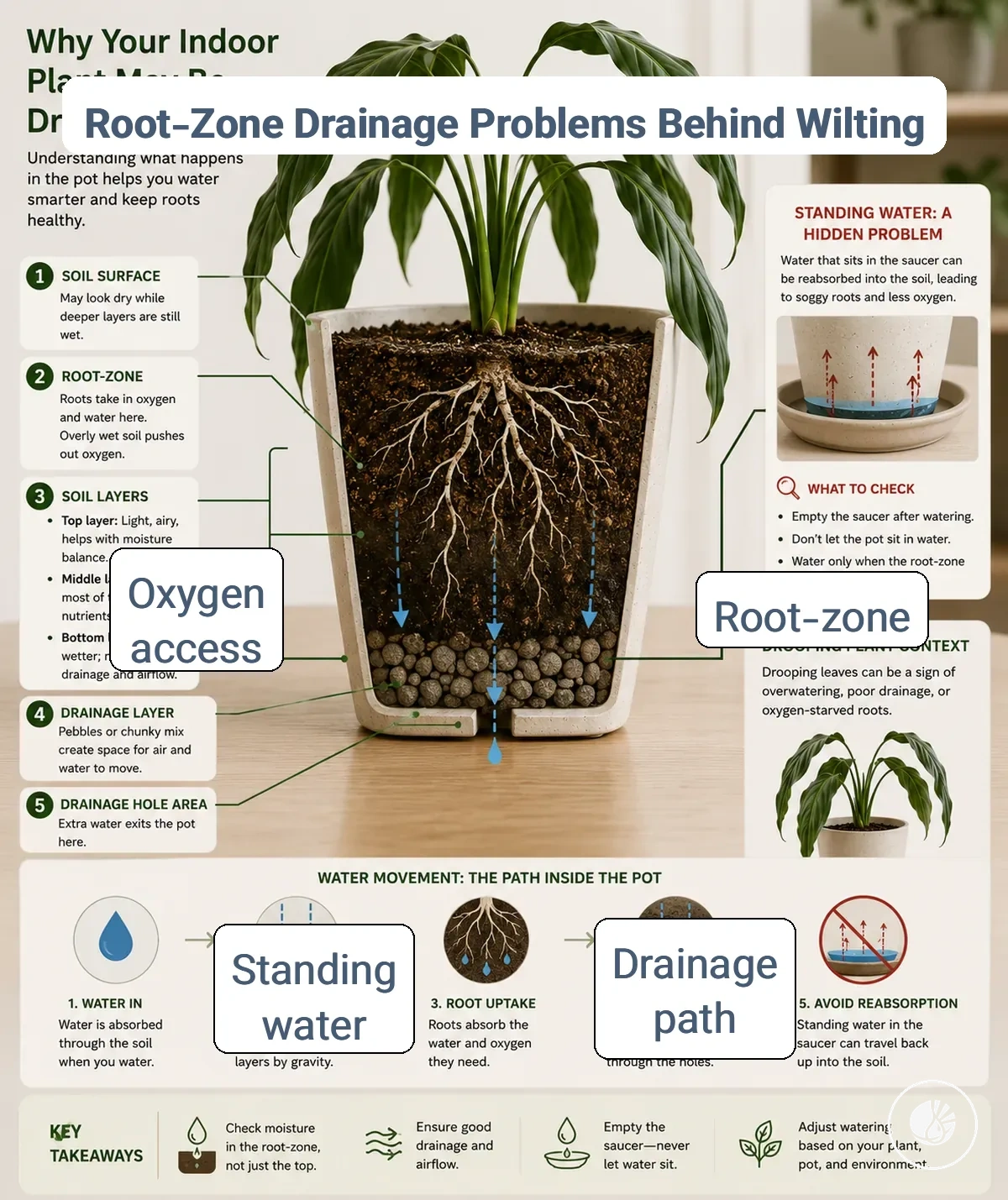
Root-Zone and Drainage Problems Behind Wilting can be evaluated through condition-based criteria that help verify whether hidden root-area factors are affecting plant function. For broader soil, potting, and drainage context, use root-zone and drainage checks after reviewing the indicators below.
- Check whether drainage holes allow water to exit after watering.
- Look for standing water in the pot or tray that may persist around the root area.
- Assess whether lower soil layers remain unusually wet while wilting continues.
- Observe root smell for signs that may indicate root-zone stress.
- Check root firmness and root color when inspection is appropriate.
- Look for compacted soil that may limit oxygen access and water movement.
- Review whether recent overwatering coincides with persistent moisture and wilting.
Root Rot, Root Damage, and Compacted Soil
Root rot, root damage, and compacted soil are three local root-zone conditions that can contribute to drooping and persistent wilt. Root rot may be associated with changes in root color, texture, or smell, while root damage is linked to physical disturbance of roots and recovery-related stress. Compacted soil differs because reduced aeration and restricted water uptake can affect root function even when roots do not show obvious decay.
Safe observable clues should be evaluated before any invasive inspection. Persistent wilt, changes in soil density, unusual smell, reduced aeration, or continued decline can help indicate whether closer root-zone evaluation is justified. Root rot, root damage, and compacted soil should be differentiated through observable conditions rather than assumptions, and any inspection of roots should remain cautious when evidence is limited.
- Root rot: Observable clues may include darker root color, soft root texture, unusual smell, or signs that affected roots are spreading through part of the root system. Safer next check: compare these clues with persistent wilt and moisture conditions before further inspection.
- Root damage: Observable clues may follow root disturbance, handling stress, or recently damaged roots. Safer next check: assess recovery patterns and plant response before assuming ongoing root decline.
- Compacted soil: Observable clues may include dense soil, poor aeration, restricted water movement, or reduced water uptake. Safer next check: evaluate soil structure and aeration conditions before considering a closer root inspection.
Pot Drainage and Soil Oxygen Checks
Pot drainage and soil oxygen checks verify whether roots can function by allowing water movement and oxygen access within the root-zone. When drainage holes do not provide adequate drainage exit or when soil oxygen is limited, wilting may continue even though moisture remains in the pot.
Poor drainage and reduced aeration may increase the risk of root stress when standing water, a saturated lower soil layer, or a compacted mix restrict normal root function. Pot Drainage and Soil Oxygen Checks help qualify whether these conditions are contributing to wilting before additional action is taken. If multiple criteria indicate poor drainage, correcting the drainage condition may be more appropriate than adding more water.
Pot Drainage and Soil Oxygen Checks can be verified through the following criteria:
- Check whether drainage holes allow water movement and drainage exit after watering.
- Look for standing water around the base of the pot or in the saucer after excess water should have drained.
- Assess whether saturated lower soil remains wet while wilting persists.
- Check for a compacted mix that may reduce soil oxygen and aeration.
- Evaluate pot fit to determine whether root-zone conditions may be contributing to moisture retention and wilting risk.
- Observe whether a soggy base persists and may indicate restricted drainage.
Drooping After Repotting or Plant Stress
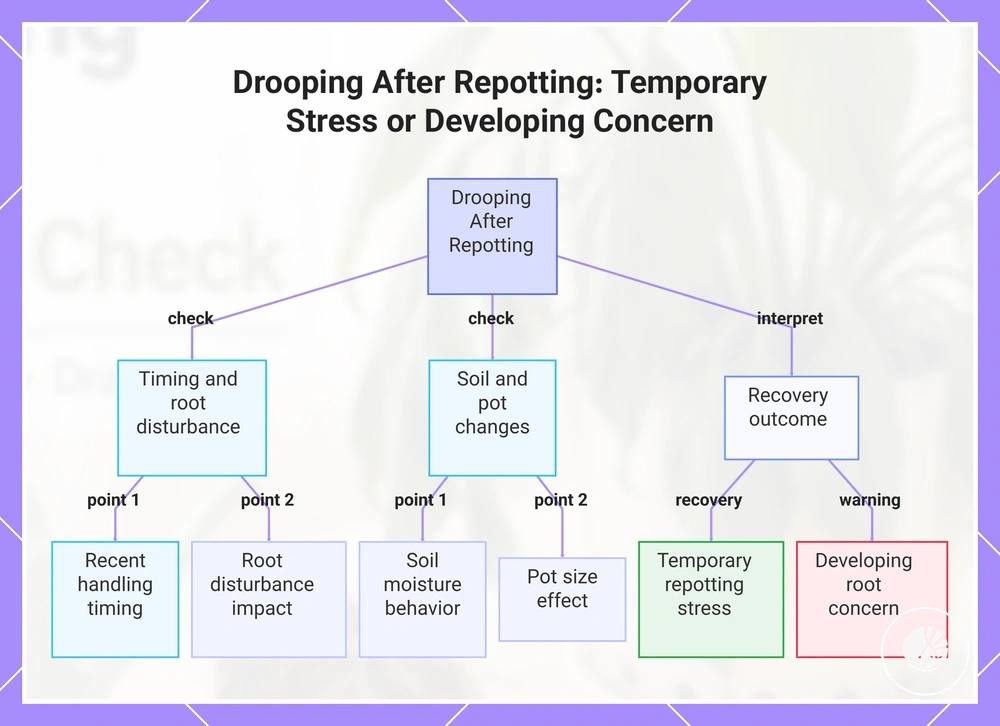
When drooping after repotting happens, repotting stress may be a contributing factor, but the symptom should be monitored rather than assumed to be harmless. Recent handling, root disturbance, and changes in growing conditions can affect plant stability and moisture behavior. Leaf recovery helps indicate whether drooping after repotting is improving or whether the condition may require closer attention.
When drooping begins after recent handling, timing provides an important diagnostic signal. Root disturbance, soil change, pot size changes, and watering after repotting can alter moisture behavior around the root-zone. Disturbed roots may need time to adjust to new conditions, while a different soil structure or pot size may change how moisture is retained or drained. These conditions are most useful when evaluated together rather than as isolated causes.
When leaf recovery improves and stem firmness remains stable, drooping after repotting may be consistent with temporary repotting stress. When wilting worsens, stem firmness declines, or recovery remains limited, the symptom may indicate a developing root or drainage concern. Timing-based observation helps separate adjustment-related stress from warning signs that justify further evaluation.
Drooping After Repotting or Plant Stress can be clarified through the timing-based checks below. For broader context about repotting stress, compare these local symptoms with the overall repotting situation before drawing conclusions.
- Consider how recently repotting occurred and whether drooping appeared after recent handling.
- Assess whether root disturbance occurred and whether disturbed roots may be contributing to stress.
- Check whether the new soil shows different moisture behavior than the previous soil.
- Review whether a pot size change may be influencing moisture retention or drainage patterns.
- Observe watering after repotting and whether leaf recovery improves, remains limited, or declines.
- Compare stem firmness and recovery trends to help distinguish temporary stress from a developing concern.
This chart shows the timing-based diagnostic approach to determine whether drooping after repotting indicates temporary repotting stress or a developing root or drainage concern.
Environmental Stress That Can Cause Wilting
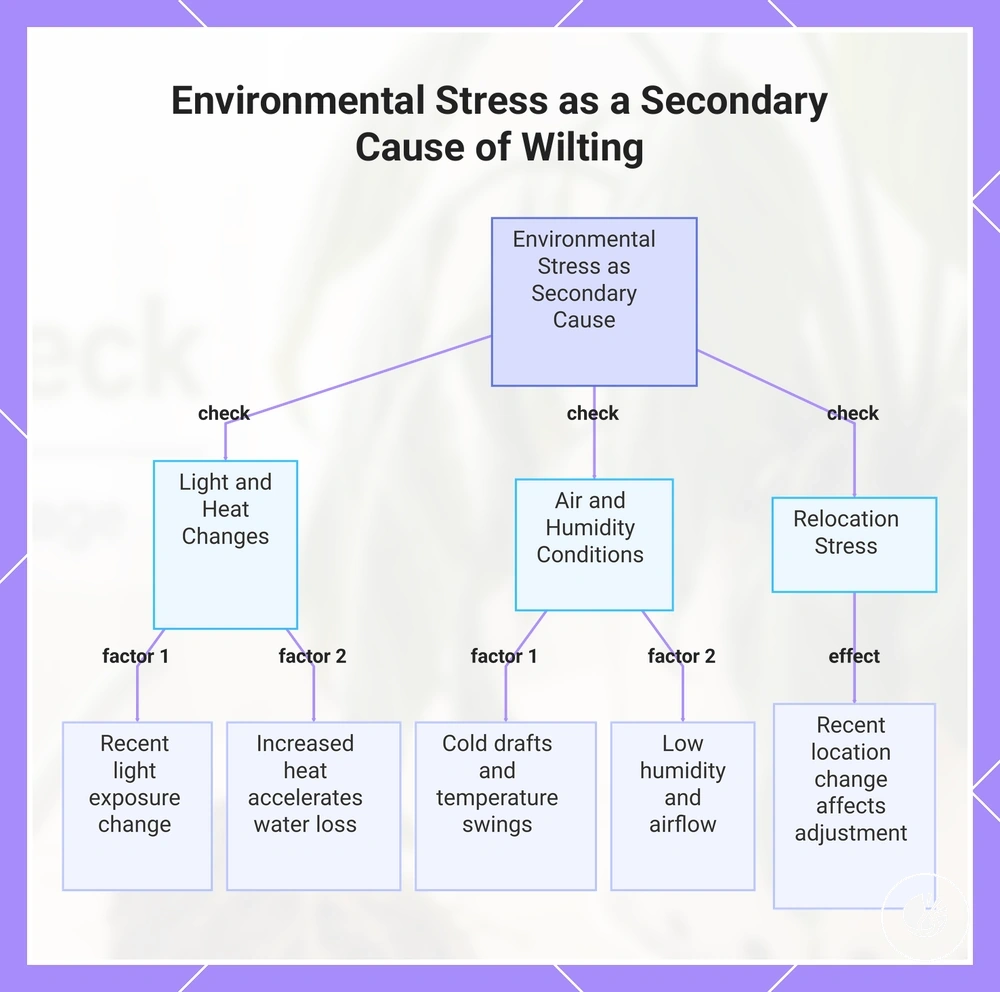
When wilting occurs, environmental stress may contribute to the symptom even when water and root conditions remain the primary checks. Environmental stress can increase water loss or reduce leaf firmness, so room conditions should be evaluated alongside moisture and root-zone observations rather than replacing them.
When wilting appears after a location change, seasonal shift, or exposure to direct heat, recent room conditions can help explain the change in plant response. Changes in light exposure, heat, cold drafts, humidity, or airflow may alter water loss and affect tissue firmness. Dry air and temperature swing conditions may coincide with limp leaves, while relocation stress can influence adjustment and recovery. These scenarios are most useful when connected to a recent environmental change rather than assumed from wilting alone.
Environmental stress can change wilting risk by altering water loss and leaf firmness. The checklist below helps identify room-condition changes that may be contributing to the symptom.
- Check whether recent light exposure changed and whether increased heat may be accelerating water loss.
- Look for cold drafts or temperature swing conditions that coincide with wilting or limp leaves.
- Assess whether low humidity or dry air may be affecting leaf firmness.
- Review airflow around the plant and whether stronger air movement may be increasing moisture loss.
- Consider whether a recent location change may be creating relocation stress and affecting adjustment.
- Compare current room conditions with recovery trends to determine whether environmental stress remains a contributing factor.
Environmental stress that can cause wilting is most useful as a secondary diagnostic filter. Visible symptoms should be interpreted together with recent room conditions, recovery patterns, and core water and root checks before conclusions are made.
This chart shows the environmental stress factors that can contribute to wilting and how they should be evaluated as secondary checks alongside water and root conditions.
Light, Temperature, and Humidity Stress
Light, temperature, and humidity stress can intensify wilting by affecting transpiration, water loss, leaf posture, and recovery. These room-condition factors may increase stress responses or change how quickly moisture is lost from plant tissues, especially when conditions shift suddenly.
When wilting appears after hot window exposure, a cold draft, or a period of dry indoor air, local room conditions may provide useful context. Light exposure, temperature swing, humidity, and airflow are most useful as diagnostic signals when they align with visible changes in leaf posture and recovery.
The following room-condition signals can help qualify light, temperature, and humidity stress:
- Light intensity: Strong light exposure combined with heat may increase transpiration and water loss. Temporary changes in leaf posture can help indicate whether light-related stress is contributing to wilting.
- Temperature swing: Rapid shifts in temperature or exposure to a cold draft may coincide with wilting. Recent room-condition changes provide useful context for interpretation.
- Humidity: Dry air and room dryness may reduce leaf firmness and affect recovery. Changes in leaf posture can help qualify humidity-related stress.
- Airflow: Strong airflow may increase moisture loss through transpiration. Wilting near vents or moving air is best evaluated alongside other environmental signals.
- Heat stress: Heat combined with light exposure may increase water loss. Recovery patterns can help determine whether heat-related stress remains a contributing factor.
Pest or Disease Clues That Need Separate Diagnosis
Pest clues and disease clues make drooping unsafe to treat as only a water or root issue when visible damage accompanies the symptom. Sticky residue, webbing, speckling, lesions, mushy stems, or unusual spotting can qualify a different diagnostic path because these signs extend beyond ordinary moisture-related wilting.
When visible damage appears alongside drooping, the safest next step is to evaluate warning signs before continuing routine revival measures. Pest clues and disease clues help separate simple stress responses from conditions that may require separate diagnosis. The checklist below highlights observable stop-signals that change the diagnostic focus.
Warning signs that may justify separate diagnosis include:
- Sticky residue on leaves or stems appearing with other pest clues.
- Webbing around foliage, stems, or growth points that may indicate pest signs.
- Speckling on leaves that coincides with declining plant condition or visible damage.
- Lesions, unusual spotting, or tissue changes that may indicate disease clues.
- Mushy stems or soft stem tissue that differ from ordinary wilting symptoms.
- Rapid spread of visible damage across leaves, stems, or nearby growth.
- Multiple warning signs occurring together, which may warrant separate diagnosis before routine recovery steps continue.
How to Check a Wilting Indoor Tropical Plant Safely
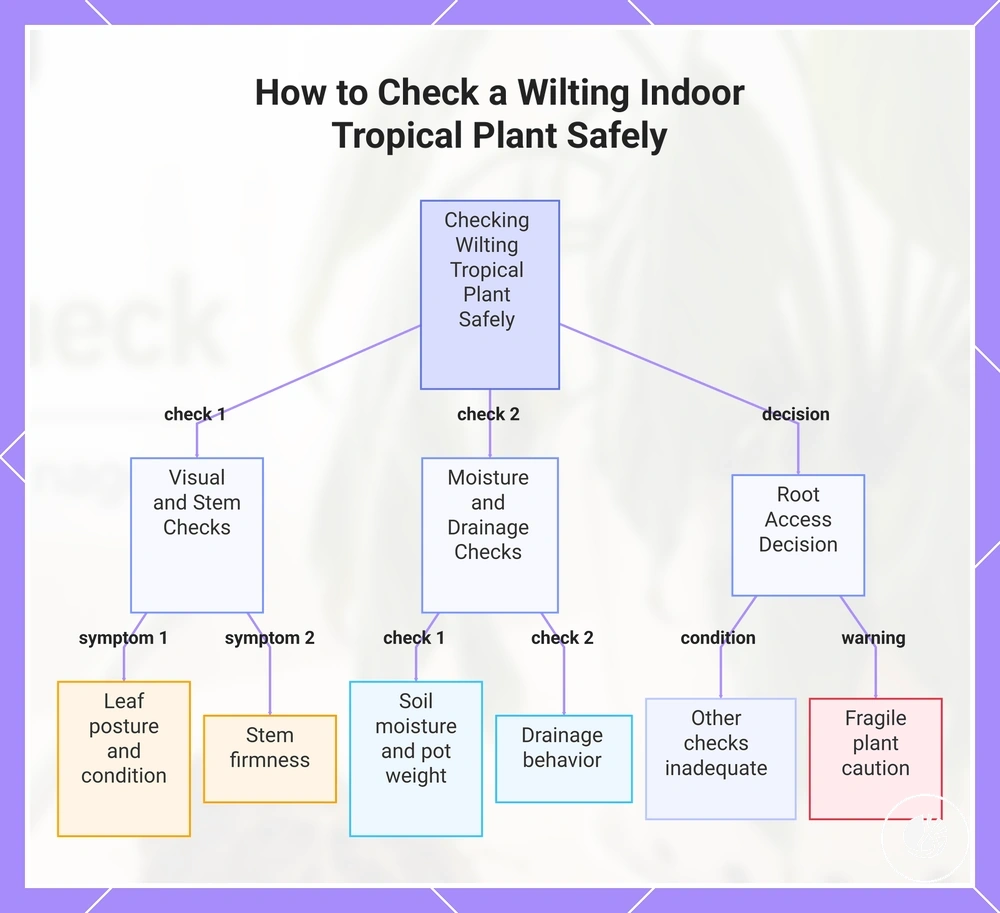
Checking a wilting indoor tropical plant safely starts with non-invasive signs before any root inspection is considered. Leaf posture, stem firmness, soil moisture, and pot conditions provide useful diagnostic clues and can help reduce unnecessary disturbance to a stressed plant.
When a wilting indoor tropical plant continues to decline, a safe inspection should escalate gradually from observation to closer checks. How to Check a Wilting Indoor Tropical Plant Safely relies on a sequence that prioritizes visible evidence before root access, especially for a fragile plant, a recently repotted plant, or a severely collapsed plant.
How to Check a Wilting Indoor Tropical Plant Safely uses a sequence that helps prevent avoidable root or stem damage while improving diagnostic clarity.
- Begin with a visual check of leaf posture and overall plant condition. Note whether leaves appear limp, collapsed, discolored, or unevenly affected.
- Check soil moisture without disturbing the root-zone. Compare surface conditions with deeper moisture where accessible through a non-invasive check.
- Evaluate pot weight and compare it with the pot's usual feel after watering or drying. Pot weight can help qualify soil moisture observations.
- Check stem firmness by gently assessing whether stems remain firm or show signs of softening, bending, or collapse.
- Observe drainage behavior after watering or recent moisture exposure. Standing water, limited drainage, or persistent wetness may help guide the next decision.
- Consider root access only when leaf posture, stem firmness, soil moisture, pot weight, and drainage behavior do not adequately explain the condition. Root inspection should remain cautious when the plant is fragile, recently repotted, or severely collapsed.
This chart shows the safe sequence of non-invasive checks and the decision point for root inspection when checking a wilting indoor tropical plant.
Soil Moisture, Stem Firmness, and Leaf Response
Soil moisture, stem firmness, and leaf response should be read together before deciding on a fix because these signals are more useful in combination than alone. Soil moisture, leaf texture, lower moisture conditions, pot weight, and short-term recovery can help differentiate possible causes, but each signal should be treated as suggestive rather than decisive.
A single observation rarely provides enough context for a reliable assessment. For example, wet soil with limp leaves may support a conditional diagnosis, but the observation becomes more meaningful when paired with stem firmness, lower moisture conditions, pot weight, and short-term recovery.
The checklist below helps verify these non-invasive criteria before selecting a response:
- Soil moisture: Compare surface moisture with lower moisture where accessible. Differences can help qualify how moisture is distributed through the soil.
- Pot weight: Observe whether the pot feels lighter or heavier than expected. Pot weight can support a moisture check and help verify soil moisture observations.
- Stem firmness: Check whether stems remain firm or show softening. Stem firmness can help differentiate temporary stress from a more persistent condition when combined with other signals.
- Leaf texture and leaf response: Observe whether leaves feel firm, limp, or unusually soft. Leaf texture and leaf response can help qualify plant condition when viewed alongside soil moisture and stem firmness.
- Short-term recovery: Observe whether leaf posture improves, remains unchanged, or declines after normal care conditions. A short-term recovery signal is most useful when verified against soil moisture, pot weight, and stem firmness.
When Root Inspection Is Needed
Root inspection becomes justified when safer checks fail to explain persistent drooping or repeated non-recovery. Root inspection should remain a conditional step rather than a default response because unnecessary invasive inspection can increase stress on an already weakened plant.
When soil moisture, pot weight, stem firmness, and drainage observations do not adequately explain wilting, escalation may be warranted. Conditions such as a sour smell, soggy soil, unstable stems, recent overwatering, or repeated non-recovery can help qualify when a root check is appropriate, while gentle handling remains important if inspection is attempted.
When Root Inspection Is Needed can be decided through the following escalation criteria:
- Persistent drooping continues despite safer checks that do not clarify the cause.
- A sour smell occurs alongside soggy soil, which may indicate a root concern that warrants closer evaluation.
- Repeated non-recovery follows recent overwatering or ongoing moisture-related concerns.
- Soggy soil persists while visible plant condition shows little improvement.
- Unstable stems suggest that closer inspection may be needed, but roots should be handled gently if the plant appears fragile.
- Stop the inspection and avoid further root disturbance if the plant is too unstable to inspect safely.
How to Revive a Drooping Indoor Tropical Plant
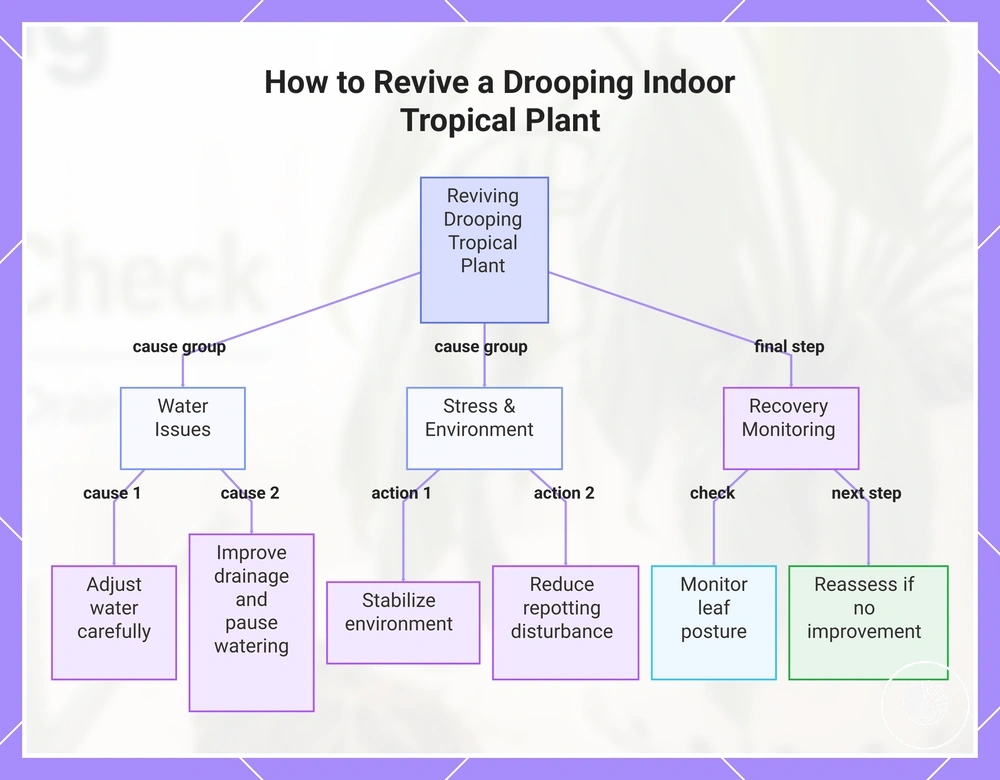
When a drooping indoor tropical plant needs revival, the correct response depends on whether the narrowed cause is dry soil, saturated roots, stress, or environmental pressure. Reviving a drooping indoor tropical plant starts after the likely cause has been identified because different causes often require different corrective actions.
Dry soil may call for careful watering that supports recovery without creating excess moisture. Saturated roots may require efforts to improve drainage and pause watering while moisture conditions stabilize. Environmental pressure may be reduced by stabilizing light, temperature, humidity, or airflow conditions, while repotting stress may respond better to reduced disturbance and continued monitoring. A cause-based recovery plan is usually more useful than applying the same response to every plant.
For example, a plant affected by dry soil may show recovery after careful watering, while a plant with saturated roots may depend more on drainage improvement and observation. A recently repotted plant may benefit from stability and monitoring, and weak stems may need support while the underlying cause is addressed. Recovery outcomes can vary, so it is important to monitor recovery rather than expect immediate results.
The revival path depends on the diagnosed cause and should follow the most appropriate corrective action for the observed condition.
- Confirm whether dry soil, saturated roots, stress, or environmental pressure is the most likely cause of the drooping.
- If dry soil is present, adjust water carefully and observe whether leaf posture and plant condition begin to improve.
- If saturated roots or waterlogged conditions are suspected, improve drainage and pause watering while moisture conditions become more balanced.
- Stabilize the environment by reducing abrupt changes in light, temperature, humidity, or airflow.
- Reduce stress for recently repotted plants by limiting unnecessary disturbance and continuing to monitor recovery.
- Support weak stems when additional support may help maintain stability while the underlying cause is being addressed.
- Monitor recovery and reassess the condition if drooping continues or plant condition does not improve.
When local revival actions do not adequately explain continued decline or recurring symptoms, broader troubleshooting plant symptoms can help identify additional contributing factors.
This chart shows the cause-based recovery plan for a drooping indoor tropical plant, grouping causes into water issues, stress and environment, and recovery monitoring.
When Drooping Needs Support or Escalation
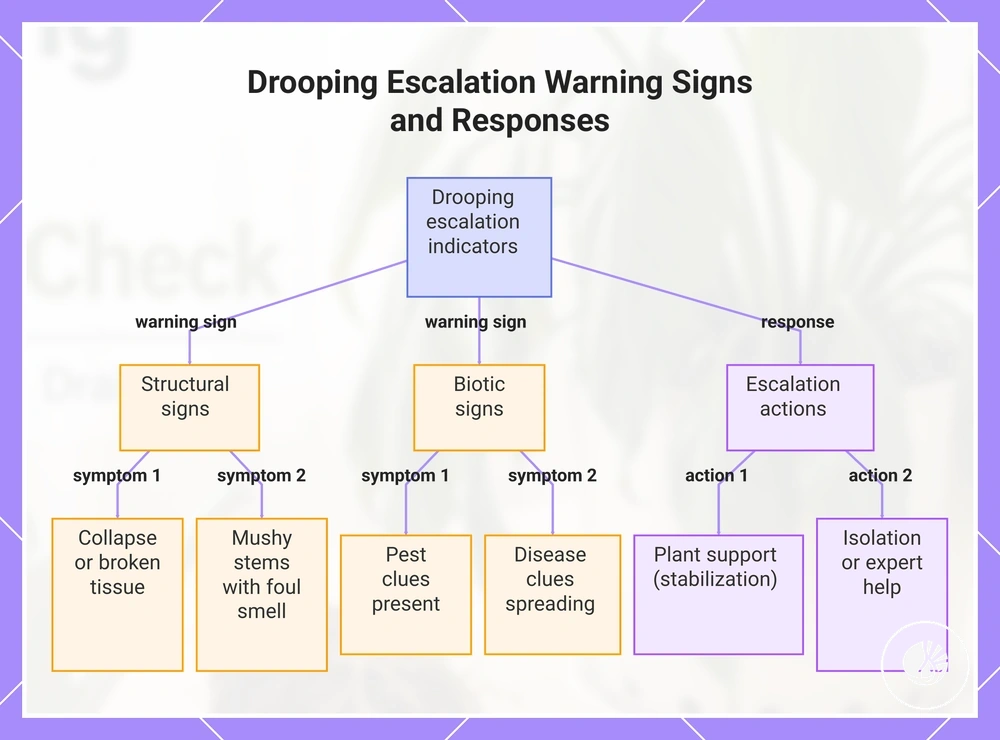
When drooping shows signs of structural, root, pest, or disease risk, escalation may be needed beyond routine monitoring. Collapse, mushy stems, foul smell, repeated wilting, or spreading damage can indicate conditions that may require plant support, isolation, root intervention, or expert help.
Plant support and cause correction serve different roles. Plant support, including support stakes, may help stabilize weak growth or broken support tissue, but plant support does not solve the underlying cause of drooping. When a root concern, pest clues, or disease clues are present, escalation may involve a separate diagnosis or more targeted corrective action.
When severe drooping continues despite earlier corrective efforts, isolation or expert help may be the safer response. Isolation can help limit exposure when pest clues or disease clues appear to be spreading, while expert help may be appropriate when repeated wilting continues and the cause remains unclear.
When Drooping Needs Support or Escalation can be evaluated through the warning signs below. The checklist helps determine when routine monitoring may no longer be sufficient.
- Collapse that prevents the plant from maintaining normal structure.
- Mushy stems combined with a foul smell that may indicate a root concern.
- Repeated wilting that continues after cause-based corrective actions.
- Broken support tissue or weak growth that may benefit from plant support while the underlying cause is addressed.
- Pest clues that suggest an infestation may be affecting plant condition.
- Disease clues that appear to be spreading across leaves, stems, or other plant tissue.
- Persistent decline that may justify root intervention or expert help when the cause remains uncertain.
For broader context beyond escalation decisions, explore related indoor tropical plant care solutions.
This chart shows the key warning signs that indicate drooping may require support or escalation, and the appropriate response actions.