Low-Light Room Care for Indoor Tropical Plants
Low-light room care for indoor tropical plants depends on matching the plant’s light tolerance with the room’s usable light, the plant’s growth goal, and the support the room can realistically provide. Low light can support selected indoor tropical plants, but it is not the same as darkness, and it often changes growth speed, watering need, and stress signals.
Low-light care means adapting indoor tropical plant care solutions to rooms with limited indirect daylight, shaded corners, blocked windows, or spaces where natural placement alone may not give the plant enough usable light. The main decision is not whether a plant is labeled “low light,” but whether the room, plant type, and care routine can work together without forcing weak growth or repeated decline.
Indoor tropical plants may tolerate lower light when they receive enough indirect brightness to maintain stable leaves and steady moisture use. If the room is far from a window, heavily obstructed, or dark enough that a lamp is needed throughout the day, plant response may become weaker unless supplemental light is added. A grow light can help in that situation, but its usefulness still depends on placement, coverage, consistency, and the plant’s visible response.
Low-light care also changes routine decisions. A plant growing slowly in dimmer conditions often uses water more slowly than a plant in stronger light, so fixed watering schedules can create problems. Humidity, airflow, temperature stability, and drainage still matter, but they support the low-light setup rather than replacing usable light.
Use these decision signals before choosing a plant, moving a pot, or adding a light:
- Usable room light: low indirect light is different from no natural light.
- Plant tolerance: some plants hold steady in lower light, while others may survive but lose growth quality.
- Placement limit: distance from the window, obstruction, and reflected light can change the outcome.
- Care adjustment: slower growth can mean slower moisture use and a higher risk of overwatering.
- Correction signal: stretching, leaning, pale growth, or persistent decline may show that the plant needs brighter support.
What Low Light Means for Indoor Tropical Plants
Low light for indoor tropical plants is a lighting condition where a plant receives limited usable light for growth while still receiving enough brightness to remain viable. Low light is defined by available brightness, the plant’s distance from that light source, the duration of light exposure, and any obstruction that reduces light before it reaches the plant.

Low light does not mean darkness. An indoor tropical plant may tolerate a dim room better than direct sun, but a space with little or no usable light can still contribute to weaker growth when limited light persists over time.
The comparison below clarifies how brightness, distance, duration, and obstruction can influence the amount of usable light available to indoor tropical plants and how plant response may differ across conditions.
| Light Condition | Main Characteristic | Possible Plant Response |
|---|---|---|
| Brighter indirect light | Consistent brightness without direct sun exposure | May support steadier growth and leaf development |
| Low light | Reduced brightness due to distance, duration, or obstruction | May support tolerant species with slower growth |
| Very dim conditions | Minimal usable light reaches the plant | May lead to stretching, weaker growth, or gradual decline |
Room exposure, window position, curtains, furniture, and nearby surfaces can influence how much usable light reaches an indoor tropical plant. Because these conditions vary, two rooms that appear similarly bright to people may provide different growing conditions for plants.
Plant response is also influenced by species tolerance. A tropical plant adapted to lower-light conditions may remain stable where another plant shows slower growth or visible stress, making low light a relationship between room conditions and plant response rather than a fixed room category.
Low Light Versus No Light in Indoor Rooms
Low light is a condition where indoor rooms still provide usable light for plants, while no usable light refers to conditions where plants receive little or no meaningful light for growth. Low light and darkness are not the same, and plant response can differ significantly between the two conditions.
The contrast below separates dim usable light from darkness and clarifies how indoor room conditions may influence plant response.
| Low Light | No Usable Light |
|---|---|
| Indirect daylight still reaches the plant | Little or no daylight reaches the plant |
| May occur in shaded rooms or farther from windows | Often occurs in enclosed spaces or persistently dark areas |
| Plants may remain stable with slower growth | Plants may show gradual decline over time |
| Light availability can change during the day | Light remains consistently insufficient |
| More tolerant species may adapt better | Adaptation may remain limited without usable light |
Blocked windows, deep interior corners, and rooms located far from natural light sources can create borderline conditions. In these situations, the distinction often depends on whether indirect daylight still reaches the plant for part of the day.
Artificial room lighting may improve visibility for people, but decorative indoor lighting does not automatically replace plant-usable light. When a plant shows stretching, reduced growth, or persistent decline, the room may be functioning closer to no usable light than to a true low-light environment.
How Limited Light Changes Plant Growth
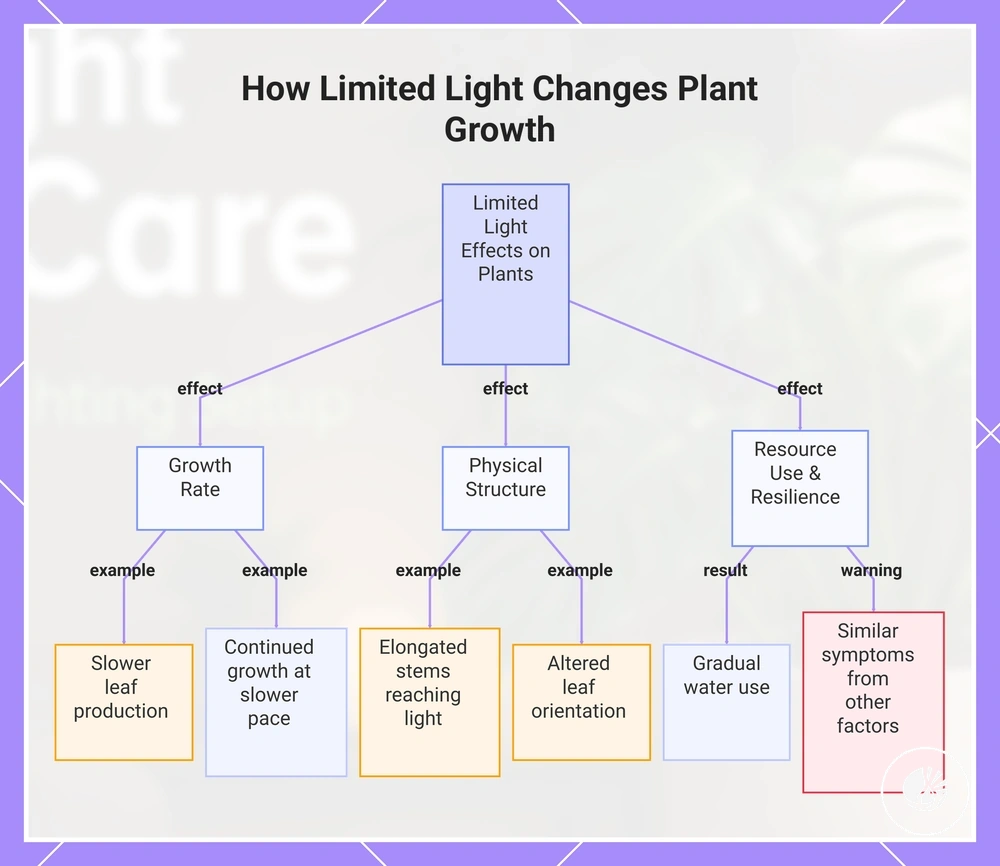
Plant growth often slows when light availability is reduced because lower light can limit the energy available for new leaves, stem development, and overall growth activity. When light intensity or duration decreases, growth may continue at a slower pace rather than stop entirely.
Limited light can influence plant structure, leaf behavior, and resource use. As growth becomes slower, plants may change how they develop and respond to their environment.
Visible effects of limited light may include:
- Slower production of new leaves
- Longer or stretched stems reaching toward light
- Smaller or less dense growth
- Reduced recovery after stress or damage
- Changes in leaf position or orientation
Plant water use may also change under reduced light. When growth slows, moisture is often used more gradually, which can affect how quickly the growing medium dries. The outcome may vary with plant type and surrounding conditions.
Limited light can also affect resilience. A plant may recover more slowly from environmental stress when growth is already constrained by reduced light availability. Similar symptoms, including slower growth or leaf decline, may also be associated with watering practices, humidity conditions, or a combination of factors rather than light alone.
This chart shows the main effects of reduced light on plant growth, including slower development, structural changes, resource use shifts, and a caution about other possible causes.
Tropical Plant Compatibility in Low-Light Rooms
Tropical plant compatibility in low-light rooms depends on species tolerance, growth goals, and available room brightness. A tropical plant that tolerates reduced light may remain viable with slower growth, while a tropical plant that relies on stronger light may require additional support to maintain growth quality.
Tropical plant compatibility is better judged by plant response than by a simple low-light label. Leaf type, growth expectations, and visible stress signals can help indicate whether a plant is likely to remain stable or may need brighter conditions.
The criteria below clarify how tolerance, growth behavior, and light requirements can influence compatibility in low-light rooms.
| Entity | Attribute | Possible Outcome |
|---|---|---|
| Higher-tolerance tropical plant | Adapted to lower light availability | May remain viable with slower growth |
| Lower-tolerance tropical plant | Requires stronger light for active growth | May need supplemental light support |
| Broader-leaved plant | Leaf structure suited to capturing available light | May maintain growth more consistently |
| Faster-growing plant | Higher growth expectation | May show stress sooner when light is limited |
| Plant under light stress | Stretching, weak growth, or leaf decline | May indicate insufficient light for current conditions |
Rooms with indirect window light may support a wider range of tropical plants because usable daylight still reaches the growing area. Rooms located far from windows may reduce compatibility for plants that require stronger light, even when the room appears bright to people. To compare care solutions by room need, evaluate both plant tolerance and available room brightness rather than relying on a single compatibility label.
Plants That Tolerate Lower Indoor Light
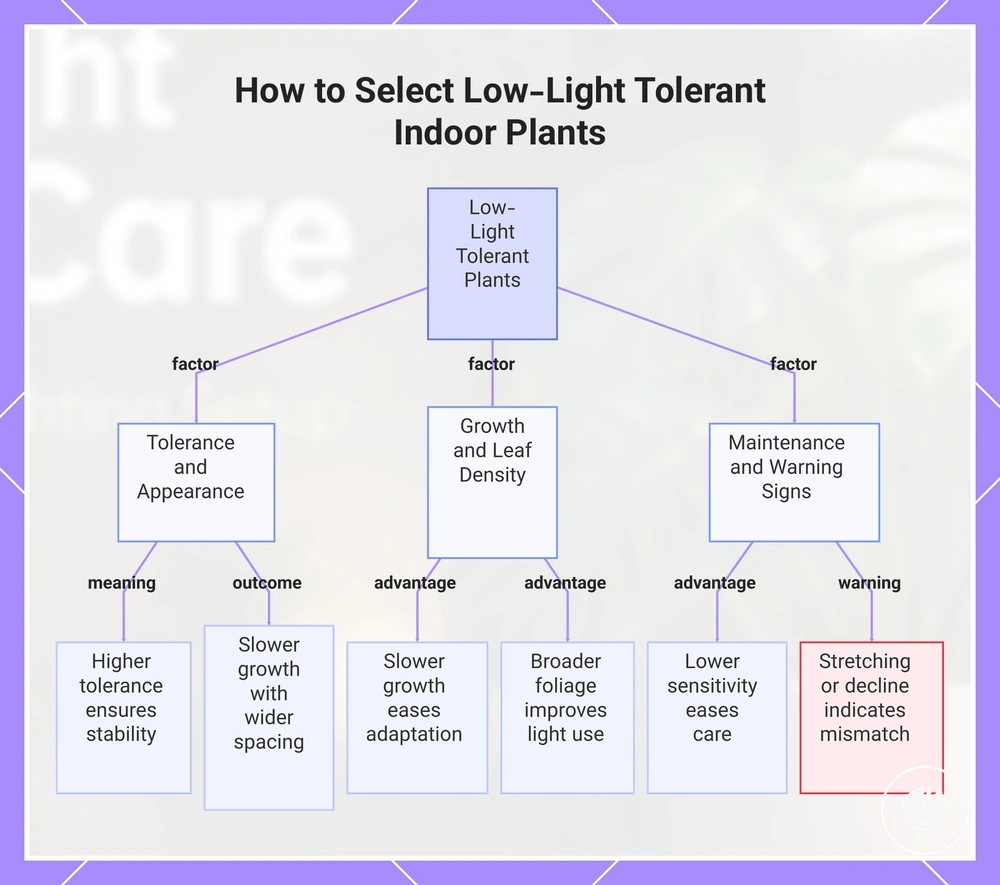
Plants that tolerate lower indoor light are typically selected by evaluating tolerance level, growth speed, maintenance sensitivity, and how well they maintain appearance when light availability is limited. A lower-light-tolerant plant may remain viable in dimmer conditions, but tolerance does not mean the plant will thrive in every low-light room.
- Tolerance level: Higher-tolerance plant types may remain stable under reduced light, while lower-tolerance types may show stress sooner.
- Growth speed: Slower-growing plant types may adapt more easily because growth demand is often lower.
- Leaf density: Broader or denser foliage may help a plant use available light more effectively.
- Maintenance sensitivity: Plant types that are less sensitive to environmental changes may be easier to maintain in lower-light conditions.
- Expected appearance: A tolerant plant may remain healthy while still showing slower growth, wider spacing between leaves, or less dense foliage than it would in brighter conditions.
Illustrative low-light-tolerant plant types are often identified by their ability to remain viable under reduced light rather than by a requirement for low light. When stretching, reduced density, or persistent decline appears, available room light may no longer match the plant's tolerance level.
This chart explains the key evaluation criteria for selecting indoor plants that tolerate lower light and the signs that light is insufficient.
Plants That Need Brighter Support Despite Low-Light Tolerance
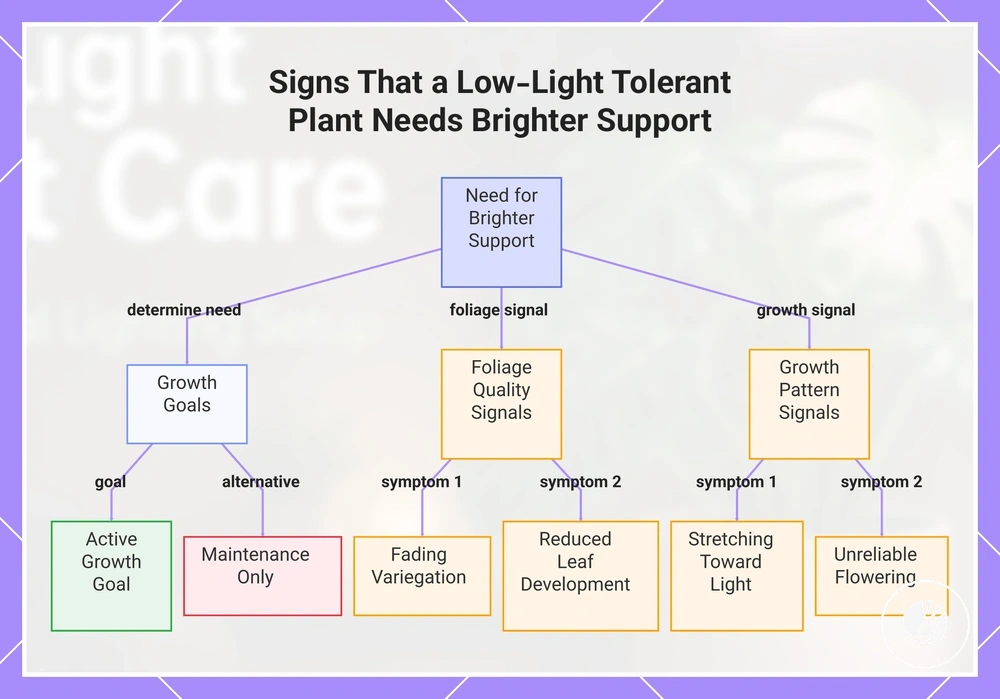
Plants that tolerate low light may still need brighter support when healthy growth, fuller foliage, or stronger visual quality is the goal. A low-light-tolerant plant can remain viable in reduced light, but weaker light may limit development even when the plant continues to survive.
Survival, maintenance, and active growth are different outcomes. A plant may maintain basic health in a dim room while producing smaller leaves, slower new growth, or less consistent appearance than it would under brighter conditions. These responses can vary with plant type and room exposure.
The checklist below highlights common signals that brighter support may help a low-light-tolerant plant maintain growth or appearance.
- Variegation: Variegated foliage may become less distinct when available light is limited.
- Flowering: Flower production may become less reliable under weaker light conditions.
- New growth: New leaves may emerge more slowly or develop with reduced size.
- Leaf size: Leaf development may become smaller or less dense than expected.
- Stretching: Extended growth toward a light source may indicate that available light is not supporting current growth needs.
Brighter support is not necessary for every low-light-tolerant plant in every room. The need for additional light is often determined by growth goals, visible plant response, and whether the plant is maintaining condition or showing signs that weak light is limiting development.
This chart explains the growth goals and visible signals that determine when a low-light-tolerant plant benefits from brighter light.
Natural Light Placement for Low-Light Rooms
Natural light placement starts with positioning the plant where available daylight can be used most effectively before artificial lighting is considered. A low-light room may still support plant care when window exposure, plant distance, and room layout allow usable light to reach the foliage during part of the day.
Natural light placement depends on window direction, distance from the light source, nearby obstructions, and reflected light within the room. The checklist below organizes the connected placement criteria that can improve light access in low-light conditions.

- Room position: Place the plant in the brightest practical area rather than in deep interior corners.
- Window access: Keep the plant where indirect daylight can reach the foliage with minimal obstruction.
- Plant distance: Moving a plant closer to a usable light source may improve available brightness.
- Surface reflection: Light-colored walls and reflective surfaces may help distribute available light more effectively.
- Light duration: Longer periods of indirect daylight may support more consistent plant maintenance.
Natural light placement can improve low-light care without changing the plant itself. When evaluating light solutions for tropical plants, adjust placement first and observe whether new growth, leaf appearance, or overall plant condition improves.
Natural placement may remain insufficient when stretching, reduced leaf development, persistent decline, or weak new growth continues after placement adjustments. Those signals may indicate that available room light is still below the plant’s current needs. This section focuses on placement decisions rather than a complete small-space care setup.
Window Direction, Distance, and Reflected Light
Window direction, distance, and reflected light affect usable plant light by changing how much daylight reaches the plant and how long that light remains available. A near-window placement may receive more usable light than an interior placement, while obstruction and surface reflection can increase or reduce the light that ultimately reaches the foliage.
The table below organizes placement conditions by likely light availability and highlights how exposure, obstruction, distance, and reflection can influence plant response.
| Placement Condition | Exposure and Obstruction | Reflection and Distance | Possible Plant Response |
|---|---|---|---|
| Near-window placement | More direct access to available daylight | Less light loss from distance | May support steadier growth and leaf development |
| Side-window placement | Receives light from an angle | Reflection may influence usable brightness | May remain suitable for tolerant plants |
| Interior placement | Light may be reduced by room depth or obstacles | Distance often lowers available brightness | May lead to slower growth or weaker development |
Window exposure can change throughout the day, and nearby curtains, furniture, walls, or other barriers may alter how much light reaches the plant. Light-colored surfaces may help distribute available brightness, while darker surroundings may absorb more of it.
When new growth becomes weaker, leaves become smaller, or stems begin reaching toward a light source, available placement may no longer provide enough usable light for current growth needs. Because room conditions vary, plant response is often a more reliable placement indicator than assumptions based on window location alone.
Window Direction, Distance, and Reflected Light
Window direction, distance, and reflected light affect usable plant light by changing how much daylight reaches the plant and how long that light remains available. A near-window placement may receive more usable light than an interior placement, while obstruction and surface reflection can increase or reduce the light that reaches the foliage.
The table below organizes placement conditions by likely light availability and shows how exposure, obstruction, distance, and reflection can influence plant response.
| Placement Condition | Exposure and Obstruction | Reflection and Distance | Possible Plant Response |
|---|---|---|---|
| Near-window placement | More direct access to available daylight | Less light loss from distance | May support steadier growth and leaf development |
| Side-window placement | Receives light from an angle | Reflection may influence usable brightness | May remain suitable for tolerant plants |
| Interior placement | Light may be reduced by room depth or obstacles | Distance often lowers available brightness | May lead to slower growth or weaker development |
Window exposure can change during the day, and curtains, furniture, walls, or other barriers may alter how much light reaches the plant. Light-colored surfaces may help distribute available brightness, while darker surroundings may absorb more of it.
When new growth becomes weaker, leaves become smaller, or stems begin reaching toward a light source, the current placement may not provide enough usable light for the plant’s growth needs. Because room conditions vary, plant response is often a more reliable placement indicator than assumptions based on window location alone.
Supplemental Grow Lights for Low-Light Plant Care
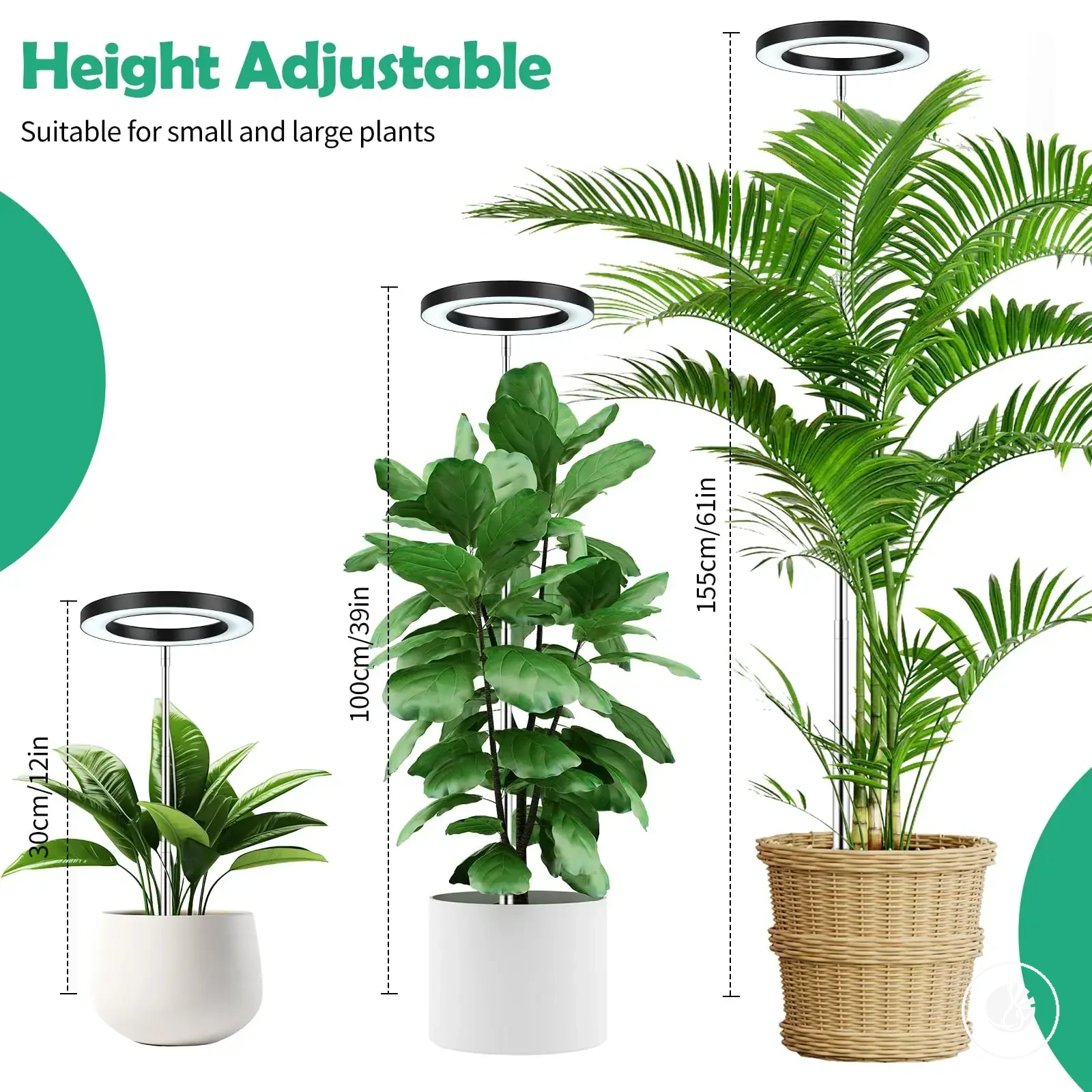
Supplemental grow lights can support indoor tropical plants when available room light is not enough to maintain stable growth or leaf development. Grow-light use is most relevant when natural placement has already been improved and the plant still shows signs that light availability may be limiting growth.

Grow-light usefulness depends on spectrum, brightness, distance, duration, and coverage rather than on the light source alone. The table below organizes the main setup criteria and how each factor may influence plant growth stability.
| Entity | Attribute | Possible Effect |
|---|---|---|
| Grow light | Spectrum | May provide plant-usable light when natural light is limited |
| Grow light | Brightness | May influence growth quality and plant response |
| Grow light | Distance | Light reaching the plant may change with placement |
| Grow light | Duration | Consistent timing may support more stable growth patterns |
| Grow light | Coverage | More even light distribution may reduce uneven growth |
Grow-light placement should keep the plant within the intended coverage area while avoiding abrupt environmental changes. When a plant has been growing in dim conditions, gradual adjustment may help reduce stress associated with a sudden increase in light exposure.
Consistent timing is often more useful than irregular lighting periods because indoor tropical plants may respond better to recurring light patterns. If weak new growth, leaning, or ongoing decline continues after placement adjustments, supplemental lighting may serve as the next local option to improve light availability.
For readers comparing broader lighting tools and kits, grow lights are one option within a larger plant-care setup and should be evaluated according to room conditions and plant response rather than product claims alone.
Full-Spectrum Light, Brightness, and Coverage Fit
Grow-light fit for low-light plant care is determined by how well spectrum, brightness, beam spread, coverage area, and plant size align with the growing space. A grow light that matches the plant and placement area may provide more consistent support than a light that delivers uneven coverage or reaches only part of the foliage.
Grow-light attributes influence plant fit in different ways. The table below connects key light features to plant fit and clarifies how each attribute may affect coverage and growth stability.
| Entity | Attribute | Plant Fit Consideration |
|---|---|---|
| Grow light | Spectrum | May support plant growth when natural light is limited |
| Grow light | Brightness | May influence how effectively light reaches the plant |
| Grow light | Beam spread | Wider spread may suit shelves or grouped plants |
| Grow light | Coverage area | Coverage should align with the growing space |
| Grow light | Plant size | Larger plants may require more complete light distribution |
A small plant in a single-pot setup may work well with a focused coverage area, while a shelf arrangement may benefit from broader light distribution. Coverage fit becomes more important when multiple plants share the same growing space.
Brightness and coverage should be considered together rather than separately. A light that appears bright may still provide uneven support if parts of the plant remain outside the effective coverage area. When new growth remains balanced across the plant, the light setup may be better aligned with the plant’s size and placement.
Distance, Duration, and Timer Consistency
Supplemental light usefulness depends on lamp distance, daily duration, and timer consistency because stable exposure may support plant growth more effectively than irregular lighting patterns. When lamp placement or lighting schedules change frequently, plant response may become harder to evaluate.
Distance, duration, and timer consistency matter as much as light type when assessing whether supplemental lighting is helping or creating stress. The checklist below organizes the main criteria that can guide lighting adjustments.
- Lamp distance: Light should reach the plant effectively without creating a sudden increase in exposure. Suitable placement may vary with the light source and plant size.
- Exposure duration: Consistent daily lighting may support more predictable plant response than uneven exposure periods.
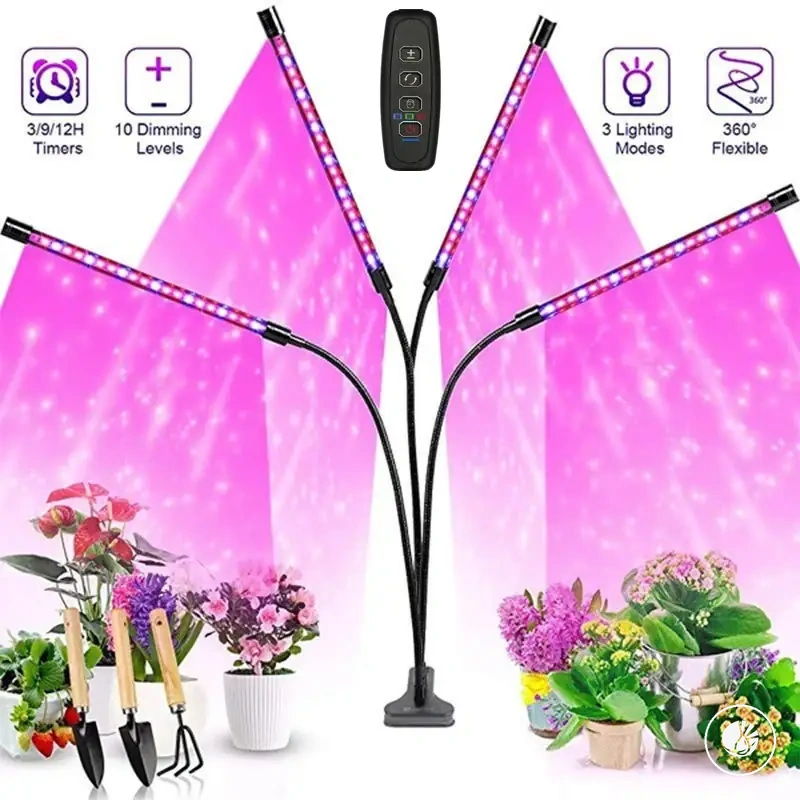
- Timer use: A timer may help maintain a repeatable schedule when daily routines are inconsistent.
- Leaf response: Balanced new growth may indicate that current exposure is suitable, while continued stretching or weak growth may suggest adjustment is needed.
- Adjustment period: Gradual changes in exposure may help plants adapt more comfortably than abrupt increases or reductions in light.
If new growth remains weak or stems continue reaching toward the light source, increasing exposure may be worth considering. If foliage appears stressed after a lighting adjustment, reducing exposure or changing lamp placement may be a safer response while monitoring plant condition.
Timer consistency can help separate lighting effects from other care variables because recurring light patterns may produce more predictable plant responses. A stable routine may make it easier to assess whether future changes in growth are related to lighting conditions.
Clip-On, Shelf, and Adjustable Light Placement
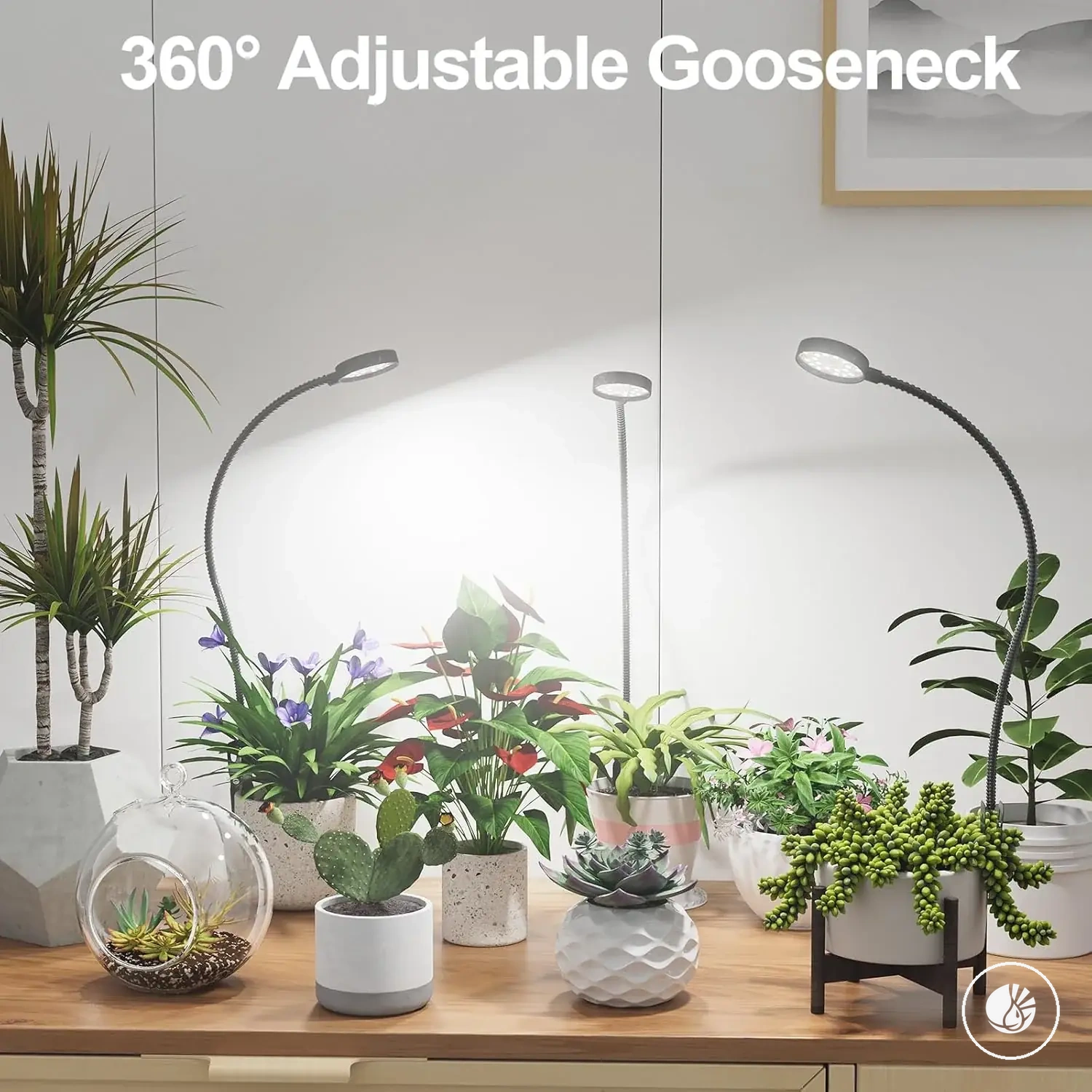
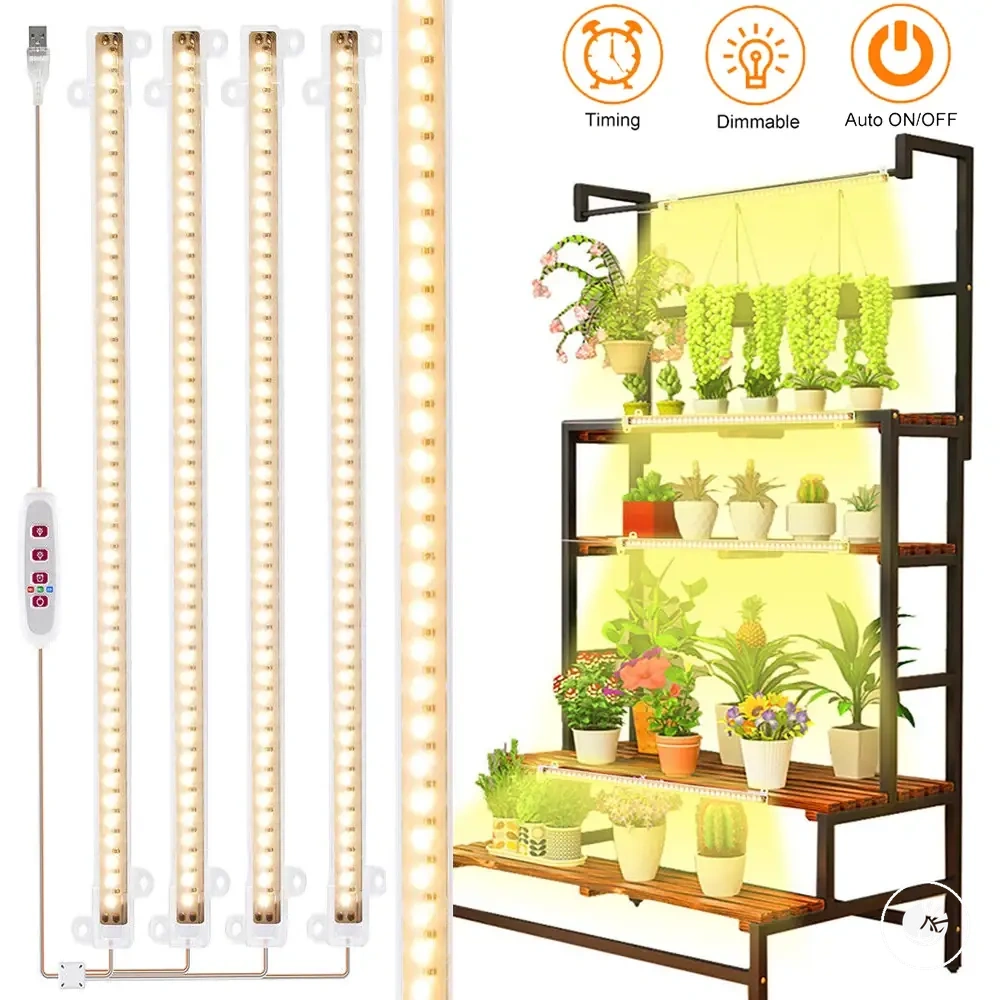
Grow-light placement compatibility depends on how the mounting style matches the room layout, plant location, and coverage needs. A clip-on setup may fit compact spaces, a shelf-mounted setup may suit fixed growing areas, and an adjustable placement may be more suitable when light direction or plant position changes over time.
Placement type affects coverage, stability, and convenience because the mounting method influences how light reaches the plant and how easily exposure can be adjusted. The comparison block below clarifies the main compatibility variables for different low-light room layouts.
| Placement Type | Compatibility Variables | Possible Fit Scenario |
|---|---|---|
| Clip-on placement | Flexible mounting and directional control | May suit desks, small tables, or limited growing areas |
| Shelf placement | Fixed position and broader shelf coverage | May suit plant shelves or organized growing spaces |
| Adjustable placement | Movable angle and distance control | May suit changing plant layouts or mixed-height plants |
Desk setups may benefit from targeted coverage when available space is limited. Shelf arrangements may benefit from a coverage shape that reaches multiple plants positioned along the same growing surface.
Corner locations and grouped plants can create uneven light distribution when coverage is narrow or difficult to direct. In these situations, adjustable placement may improve coverage control by allowing changes in angle, position, or distance as plant placement changes.
Care Adjustments Under Limited Indoor Light
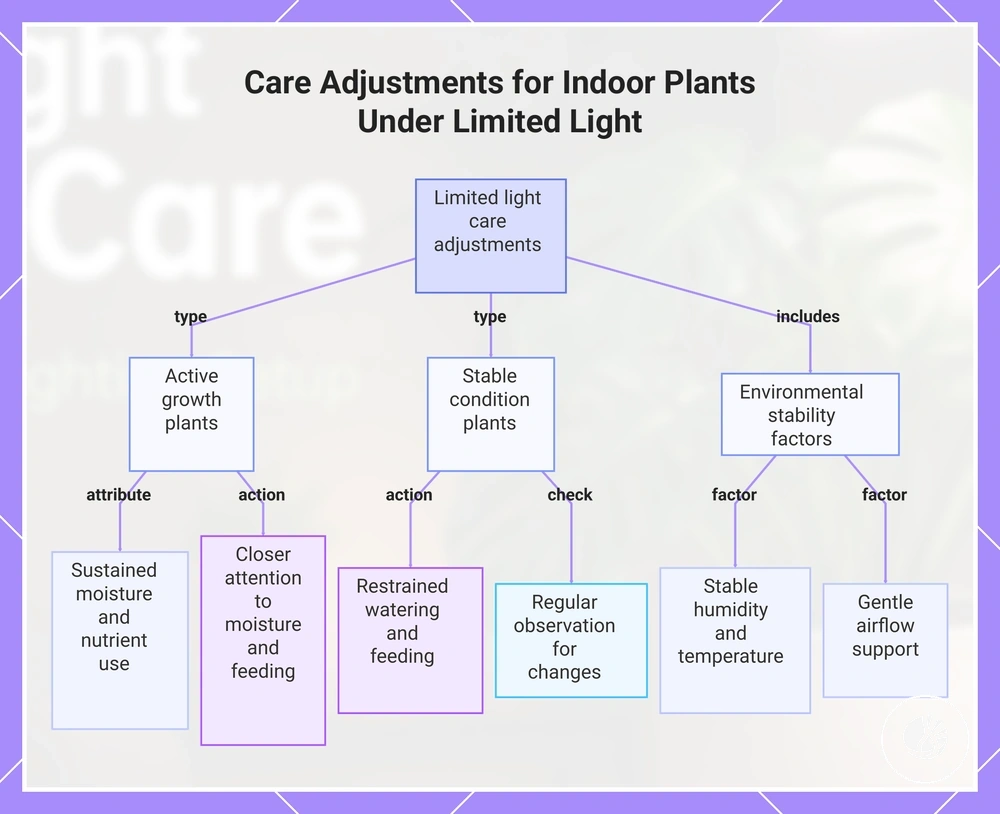
Indoor tropical plant care should change when light is limited because lower light can reduce water use, slow growth, and affect stress tolerance. A plant that is actively producing new growth may continue using moisture and nutrients more steadily, while a plant holding steady in a dim room may benefit from a more restrained care routine.
Lower light changes how watering, fertilizing, humidity, airflow, temperature, and observation work together. The adjustment checklist below highlights the connected care variables that may need attention when growth slows or remains minimal.
- Watering: Slower growth may lead to slower moisture use, so watering decisions may be more effective when based on growing-medium conditions rather than a fixed schedule.
- Fertilizing restraint: A plant with limited growth may not require the same feeding approach used during periods of active development.
- Humidity: Stable humidity may help support leaf condition when indoor air becomes dry.
- Airflow: Gentle airflow may help maintain a healthier growing environment without exposing plants to unnecessary stress.
- Temperature: Stable temperatures may support more predictable growth and recovery patterns.
- Observation frequency: Regular observation may help identify changes in growth, leaf condition, or moisture use before larger issues develop.
An actively growing plant in limited light may still require closer attention to moisture and nutrient use because growth continues even when light is reduced. A plant that is maintaining condition without producing much new growth may benefit from a more conservative approach to watering and feeding.
Care adjustments are often most effective when plant response guides future decisions. Changes in growth rate, leaf appearance, or moisture use may provide clearer signals for routine adjustments than a schedule designed for brighter growing conditions.
This chart explains how to adjust watering, fertilizing, and environmental care based on whether the plant is actively growing or maintaining condition in limited indoor light.
Watering Frequency and Slower Growth
Watering frequency often needs adjustment when indoor tropical plant growth slows because lower light can reduce moisture demand and slow how quickly the growing medium dries. When growth becomes less active, watering based on plant and soil conditions may be more reliable than using the same routine followed under brighter conditions.
Moisture demand changes with light and growth. The checklist below organizes the main criteria that can help guide watering adjustments in low-light rooms.
- Soil moisture: Moisture levels may remain higher for longer when growth and water use slow.
- Pot drainage: Containers with slower drainage may retain moisture longer, which can influence watering intervals.
- Plant size: Larger plants may continue using moisture more steadily than smaller plants under similar conditions.
- Growth pace: Active new growth may increase moisture demand compared with plants that are maintaining condition without noticeable growth.
- Watering interval: The time between watering events may need adjustment when moisture use changes.
A plant that is still producing new leaves in a dim room may require closer moisture monitoring than a plant that is largely holding steady. Growth pace can provide useful context when deciding whether watering needs have changed.
Low-light stress and thirst can sometimes appear similar because both may affect leaf appearance and overall vigor. Before increasing watering frequency, checking soil moisture and overall growing conditions may help avoid treating reduced light exposure as a watering problem.
Humidity, Temperature, and Airflow Balance
Humidity, temperature, and airflow balance support plant compatibility when light is limited because stable environmental conditions may reduce stress and help plants maintain condition more effectively. Environmental balance can support low-light care, but it cannot replace the light required for active plant growth, and it does not solve darkness.
Humidity, temperature, and airflow influence plant response together rather than as isolated factors. The checklist below clarifies how each condition may affect plant compatibility and growing conditions in low-light rooms.
- Humidity level: Stable humidity may help support leaf condition and reduce excessive moisture loss from foliage.
- Temperature stability: Consistent temperatures may help plants maintain more predictable growth and stress responses.
- Air movement: Gentle airflow may support a healthier growing environment by reducing stagnant conditions around foliage.
- Leaf moisture: Balanced humidity and airflow may help limit prolonged moisture accumulation on leaves.
- Fungal risk: Persistent moisture combined with limited air movement may increase the likelihood of moisture-related issues.
Environmental compatibility is often stronger when humidity, temperature, and airflow remain balanced together. A room with suitable humidity but poor airflow may create different growing conditions than a room where both conditions remain stable.
When light is limited, environmental balance may help reduce stress and support plant maintenance. However, improved humidity, temperature stability, or airflow cannot compensate for a complete lack of usable light.
Low-Light Plant Problems and Correction Signals
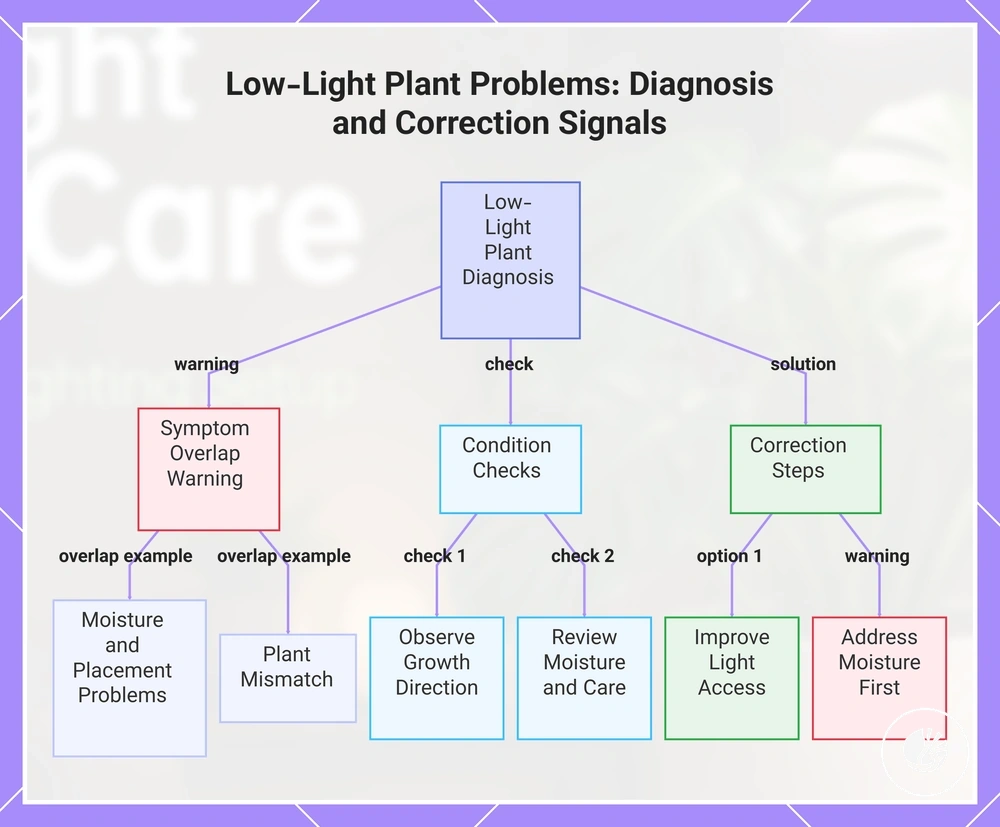
When weak growth, smaller leaves, stretching, or declining plant vigor appears, low-light conditions may be contributing to the problem, but watering practices, environmental conditions, or plant suitability can create similar symptoms. Low-light signals are most useful when they are evaluated alongside other growing conditions rather than treated as proof of a lighting issue.
Low-light symptoms can overlap with moisture stress, placement problems, and plant mismatch. The diagnostic checklist below organizes symptom, likely cause, condition check, correction option, and expected response to help distinguish low-light conditions from other plant-care concerns.
- Symptom: Stretched stems or leaning growth. Likely cause: Light may be insufficient for current growth needs. Condition check: Observe whether growth consistently reaches toward a light source. Correction option: Improve plant placement or consider supplemental lighting. Expected response: New growth may become more balanced over time.
- Symptom: Smaller or slower-developing leaves. Likely cause: Limited light may be reducing growth activity. Condition check: Compare recent growth with earlier leaf development. Correction option: Increase access to usable light when possible. Expected response: Future growth may appear stronger if light availability improves.
- Symptom: Yellowing or declining foliage. Likely cause: Low light may contribute, but watering conditions may also be involved. Condition check: Review soil moisture and recent care routines before changing light conditions. Correction option: Address moisture-related issues first when they appear more likely. Expected response: Plant condition may stabilize when the primary cause is corrected.
- Symptom: Limited new growth despite stable care. Likely cause: Light availability may be restricting development. Condition check: Confirm that watering and environmental conditions remain appropriate. Correction option: Reassess plant placement and light exposure. Expected response: New growth may increase if light was the limiting factor.
- Symptom: Repeated decline after placement changes. Likely cause: Plant requirements may not align with the available growing environment. Condition check: Compare plant performance across different locations and conditions. Correction option: Consider whether a different placement or a more suitable plant type is needed. Expected response: Long-term performance may improve when plant and environment are better aligned.
Correction signals are often more reliable than individual symptoms because multiple conditions can produce similar results. When new growth becomes stronger, growth direction becomes more balanced, or decline slows after a targeted adjustment, the original condition may have been identified correctly. If symptoms continue despite a correction, another factor such as watering, placement, or plant compatibility may require closer evaluation.
This chart shows how to distinguish low-light plant problems from other common issues using symptom overlap warnings, condition checks, and targeted correction steps.
Leggy Growth, Leaning, and Poor Flowering
When leggy growth, leaning stems, or weak flowering appears, insufficient usable light may be contributing to the problem, especially when these symptoms develop alongside slow growth or reduced vigor. These signals can indicate a light-related issue, but watering practices, seasonal growth patterns, and plant type should also be checked before drawing conclusions.
Leggy growth, leaning, and poor flowering are diagnostic signals rather than proof of low light. The symptom-to-cause pairs below help connect visible plant changes with likely light-related conditions and appropriate checks.
- Stem stretch: Long, elongated stems may indicate that the plant is extending growth toward a stronger light source when available light is limited.
- Wide leaf spacing: Increased distance between leaves may suggest that growth is becoming stretched under weak light conditions.
- Leaning direction: Consistent growth toward a window or light source may signal uneven light distribution across the plant.
- Weak flowering: Reduced flowering or fewer blooms may occur when available light does not fully support the plant's flowering needs.
- Slow recovery: Limited improvement after routine care adjustments may indicate that light availability remains a restricting factor.
New growth often provides a clearer correction signal than older foliage. Moving the plant closer to a suitable light source or increasing supplemental exposure gradually may help improve growth balance when insufficient light is contributing to the symptoms.
If watering conditions, seasonal changes, or plant suitability provide a stronger explanation for the symptoms, lighting adjustments alone may have limited effect. Observing how new growth responds after a targeted change can help distinguish a light-related issue from other care concerns.
Overwatering Risk in Dim Rooms
When low light slows plant growth and moisture use, overwatering risk may increase because the growing medium can stay wet longer than expected. A plant in a dim room may require less frequent watering than the same plant in brighter conditions, but overlapping symptoms make diagnosis important before adjusting care.
Overwatering signals can overlap with both light-related and drainage-related problems. The checklist below separates moisture, drainage, and light-related signals to help identify whether excess moisture may be contributing to plant stress.
- Light level: Reduced light may slow growth and lower moisture demand, allowing the growing medium to remain wet for longer periods.
- Growth pace: Slower growth may reduce water use, which can increase the likelihood of excess moisture remaining in the container.
- Soil moisture: Persistently damp soil may suggest that water use is slower than the current watering routine assumes.
- Pot drainage: Limited drainage may increase moisture retention and raise the risk of moisture-related stress in low-light conditions.
- Root stress: Excess moisture combined with slow drying conditions may contribute to root-related stress and reduced plant vigor.
Moisture conditions, drainage performance, and growth patterns are often more useful together than any single signal alone. If the growing medium remains wet for extended periods while growth remains slow, reducing watering frequency may be worth considering while monitoring plant response.
Underwatering and poor drainage can create symptoms that overlap with overwatering, including changes in leaf appearance and plant vigor. Checking soil moisture and drainage conditions before making major care adjustments may help distinguish a watering issue from a light-related problem.
When to Move the Plant, Add Light, or Change the Plant
The right decision depends on plant condition, room limitations, light availability, and your growth goals. Moving the plant may be enough when a brighter location is available, supplemental light may help when placement options are limited, and a different plant may be more compatible when available room light consistently falls below the current plant's tolerance.
Plant-care decisions become clearer when symptoms, room light, plant tolerance, and desired outcomes are evaluated together. The checklist below organizes the main decision variables and the trade-offs they may create.
- Plant condition: If growth remains stable and foliage appears healthy, a placement adjustment may be sufficient. If decline continues, additional light support or a different plant choice may deserve consideration.
- Room constraint: When windows, room layout, or obstructions limit usable light, relocating the plant may provide only a modest improvement.
- Light support: Supplemental lighting may help when the plant shows light-related stress and better natural placement is not available.
- Tolerance level: Plants with greater tolerance for lower light conditions may adapt more easily than plants that typically require brighter exposure.
- Desired growth outcome: Maintaining current condition may require a different strategy than encouraging stronger growth, denser foliage, or more active development.
Moving the plant is often the first decision point because it uses available natural light before introducing additional support. Supplemental lighting may become more relevant when room constraints limit placement options and the plant continues showing signs of insufficient light.
Changing the plant may be a practical option when the room environment and the plant's light requirements remain difficult to align despite reasonable adjustments. In that situation, long-term compatibility may have a greater influence on success than further changes to placement or lighting support.
The products below are useful examples for comparing available options. Before buying, check that the compatibility criteria, key features, and product details match your needs.