Fertilizer and nutrient care for indoor tropical plants
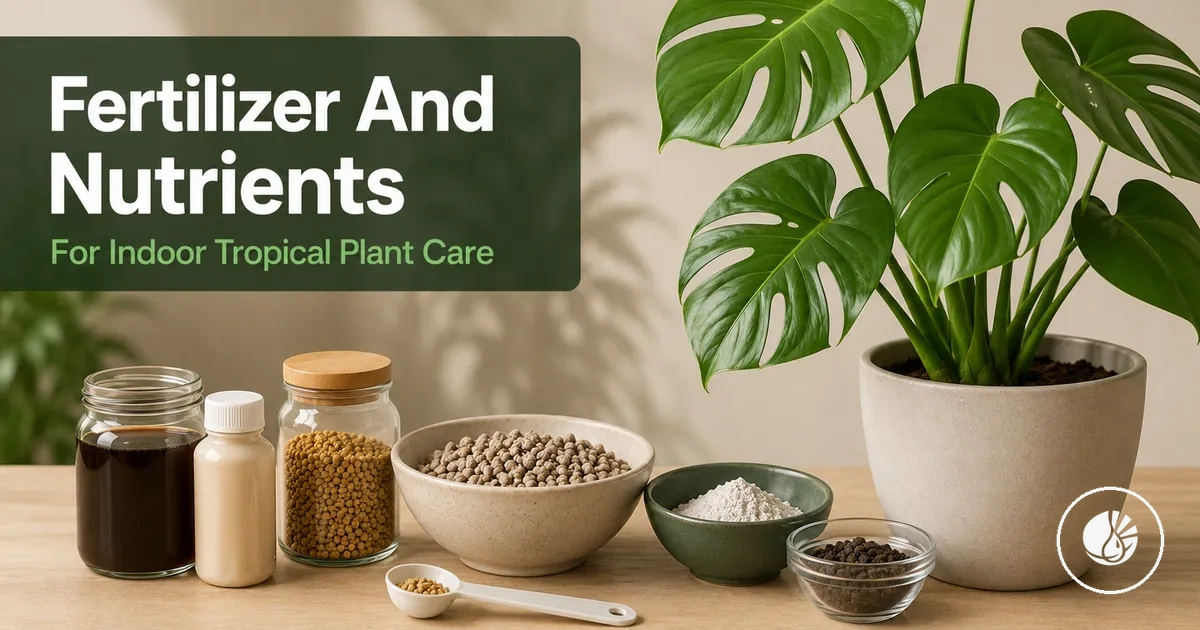
Fertilizer and nutrient care for indoor tropical plants is a maintenance practice focused on supplying nutrients that support healthy growth, foliage development, and root function. Fertilizer works alongside light, water, soil, and humidity rather than replacing them. Plant response can vary based on growing conditions and plant needs. In this context, fertilizer serves as support rather than an all-purpose fix.
Fertilizer and nutrient care for indoor tropical plants involves the care inputs used in safe feeding, as shown in the image below.
When indoor tropical plants are actively growing, a feeding routine may support nutrient availability if light, soil conditions, and watering practices are already suitable. Plants experiencing stress, seasonal changes, or low light may respond differently to feeding decisions. Fertilizer type, feeding schedule, dosage, and observation of plant response should be considered together. The most relevant variables are plant condition, season, light, and fertilizer type.
Fertilizer and nutrient care for indoor tropical plants includes feeding decisions, timing, dosage, schedule planning, and observation of plant response. Nutrient needs can change with growth stage, season, and indoor conditions. A feeding routine often works best when adjusted according to plant condition rather than following a fixed assumption. These factors help place fertilizer within the broader maintenance system for indoor tropical plants.
How fertilizer fits indoor tropical plant maintenance
Fertilizer is a nutrient support within indoor tropical plant maintenance, providing essential nutrients that help promote growth response, foliage development, and root function. Its role complements, rather than replaces, primary care factors such as light, water, soil, and humidity. Fertilizing is generally safest when core indoor conditions are reasonably stable, ensuring that nutrient absorption aligns with the plant's maintenance rhythm.
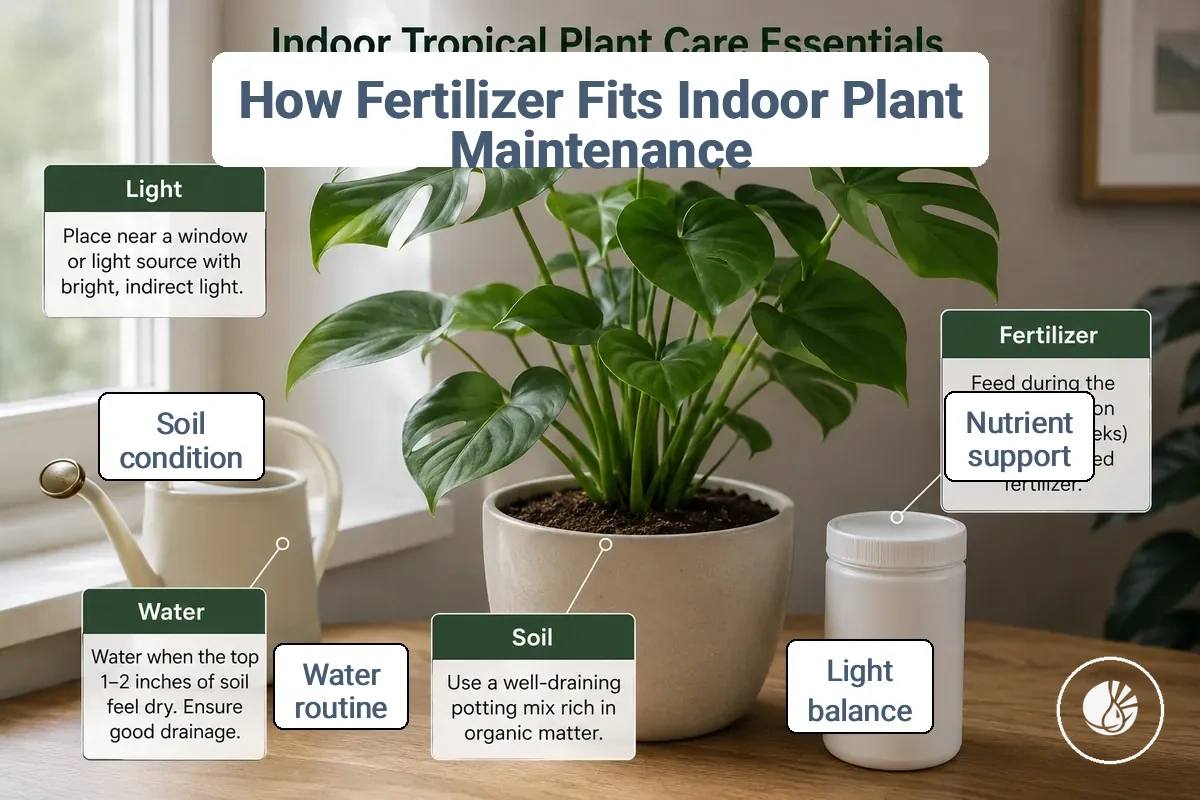
In practice, fertilizer contributes to the feeding routine while other care factors remain the main determinants of growth. Light intensity, soil quality, watering patterns, and humidity levels all influence nutrient uptake and plant response. The distinctions between fertilizer and primary care factors are outlined in the following table:
| Care factor | What it controls | What fertilizer cannot replace |
|---|---|---|
| Light | Photosynthesis and energy production | Cannot be substituted by nutrients |
| Water | Hydration and nutrient transport | Fertilizer does not provide hydration |
| Soil | Root support and nutrient holding capacity | Cannot replace soil structure |
| Humidity | Transpiration and moisture balance | Fertilizer does not adjust humidity |
For additional guidance on integrating fertilizer into overall routines, see indoor tropical plant care solutions, which details how feeding aligns with the broader indoor plant maintenance system.
Fertilizer, nutrients, and plant food boundaries
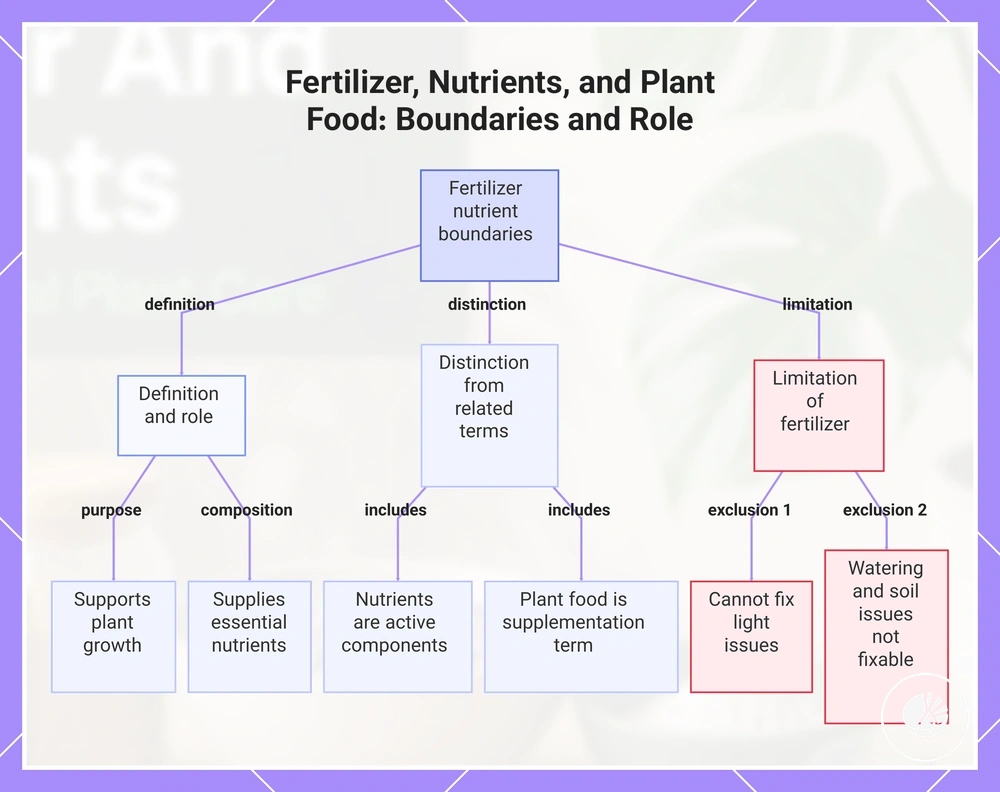
Fertilizer is a nutrient input designed to support plant growth under suitable indoor conditions. Its composition supplies essential nutrients that affect foliage, root development, and overall growth response. While fertilizer, nutrients, and plant food are related, they differ: fertilizer is the primary nutrient input, nutrients are the active components within the mixture, and plant food is a user-facing term for supplementation. Nutrient inputs cannot correct issues caused by unrelated care factors such as insufficient light, improper watering, or poor soil.
This chart explains the definition of fertilizer as a nutrient input, the distinction between fertilizer, nutrients, and plant food, and the limitations of fertilizer use.
Nutrient roles in foliage, roots, and steady growth
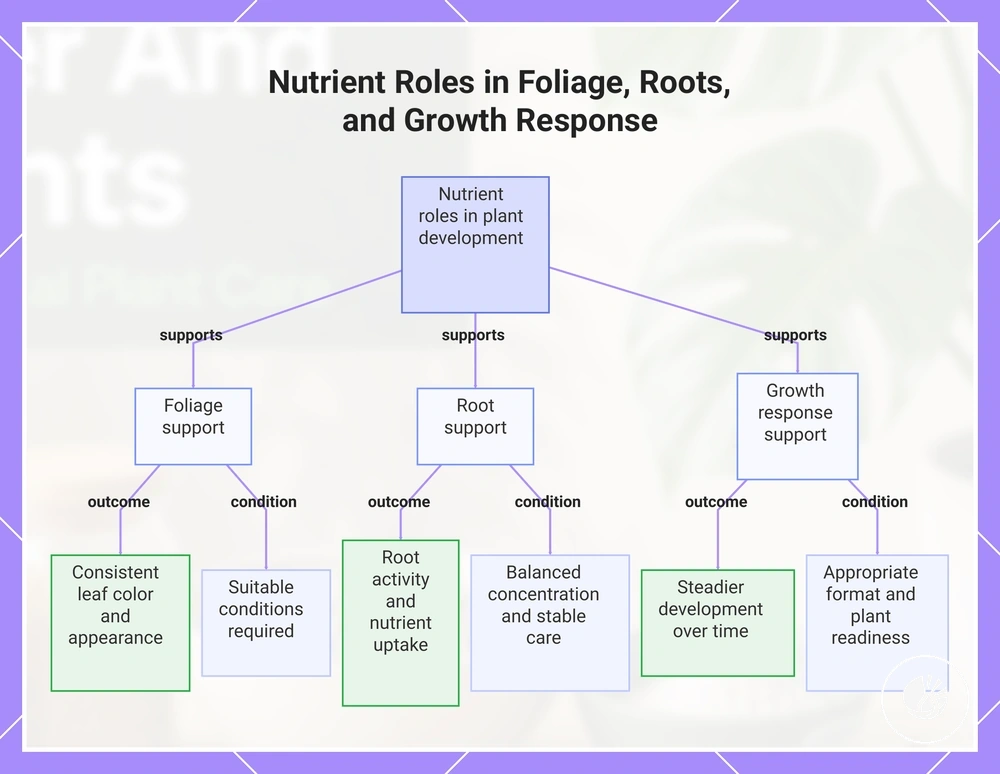
Nutrients support foliage, roots, and growth response by contributing to plant functions that influence visible development over time. Nutrient availability can help maintain foliage color, support root activity, and encourage steady growth when indoor conditions, plant condition, and fertilizer concentration are reasonably balanced. The effect of a fertilizer feeding routine may vary with dosage, release format, season, and growth stage, making observation an important local takeaway.
- Foliage: nutrient availability + suitable conditions → may support consistent leaf color and appearance.
- Roots: balanced nutrient concentration + stable care conditions → may support root activity and nutrient uptake.
- Growth response: appropriate fertilizer format and release pattern + plant readiness → may contribute to steadier development over time.
This chart shows how nutrients support foliage, roots, and growth response through specific outcomes and required conditions.
Choosing fertilizer types for indoor tropical plants
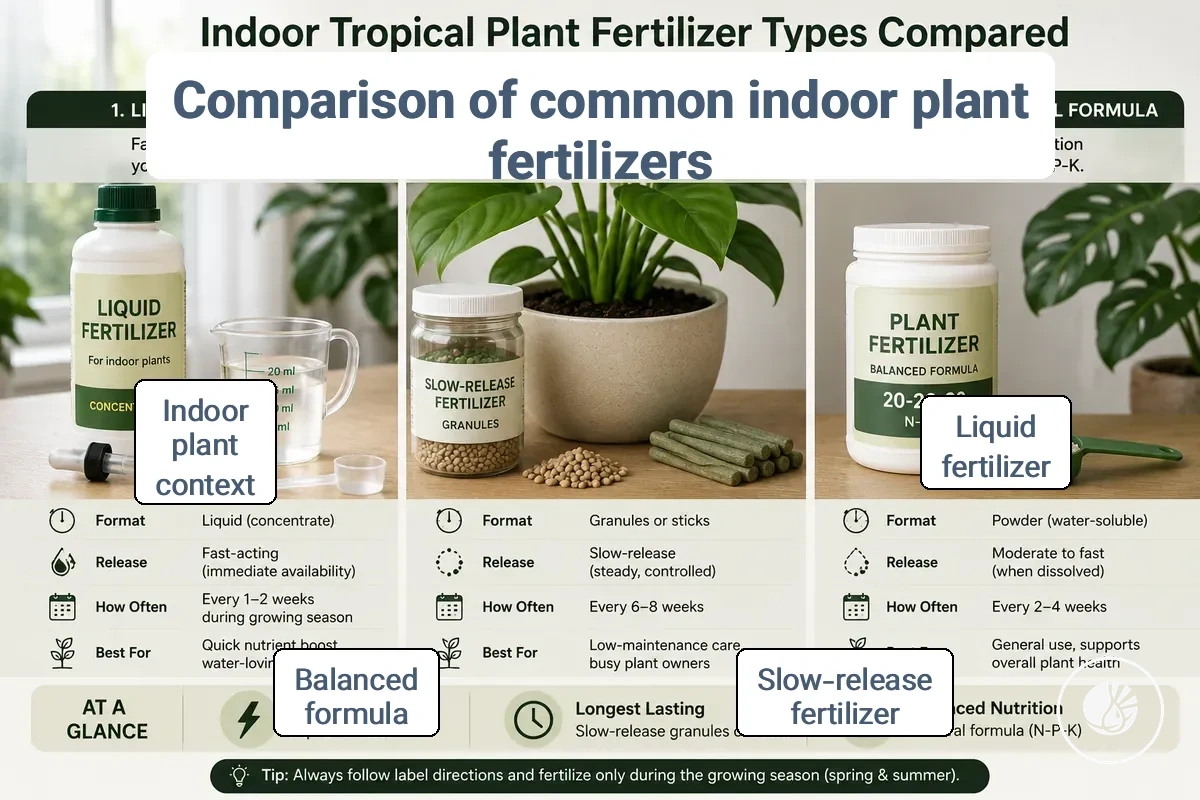
Choosing the right fertilizer type depends on plant sensitivity, routine consistency, dosage control, and feeding interval. Liquid fertilizer provides easier adjustment and flexible dosage, whereas slow-release fertilizer offers longer nutrient availability with less frequent attention. Balanced general formulas combine moderate control and adaptability for varied indoor conditions, allowing routines to match plant needs and user consistency.
To compare options, consider how each fertilizer type aligns with control, convenience, and interval for typical indoor tropical plant maintenance. The visual comparison below illustrates these distinctions, helping to orient selection decisions before exploring detailed H3-level choices.
| Option | Attribute | Trade-off | Best use case |
|---|---|---|---|
| Liquid fertilizer | Adjustable dosage and feeding frequency | Requires more attentive routine management | Growers who monitor plant condition regularly |
| Slow-release fertilizer | Gradual nutrient release with minimal attention | Less flexible once applied | Consistent indoor routines with stable conditions |
| Balanced general formulas | Moderate control and broad routine compatibility | May require adjustment for growth stage | Indoor tropical plants with varied conditions and feeding habits |
Decisions should follow label directions, pot size, and feeding consistency. Related supplies can be found under fertilizer options inside care kits to support practical routine setup:contentReference[oaicite:0]{index=0}.
Liquid fertilizer for controlled routine feeding
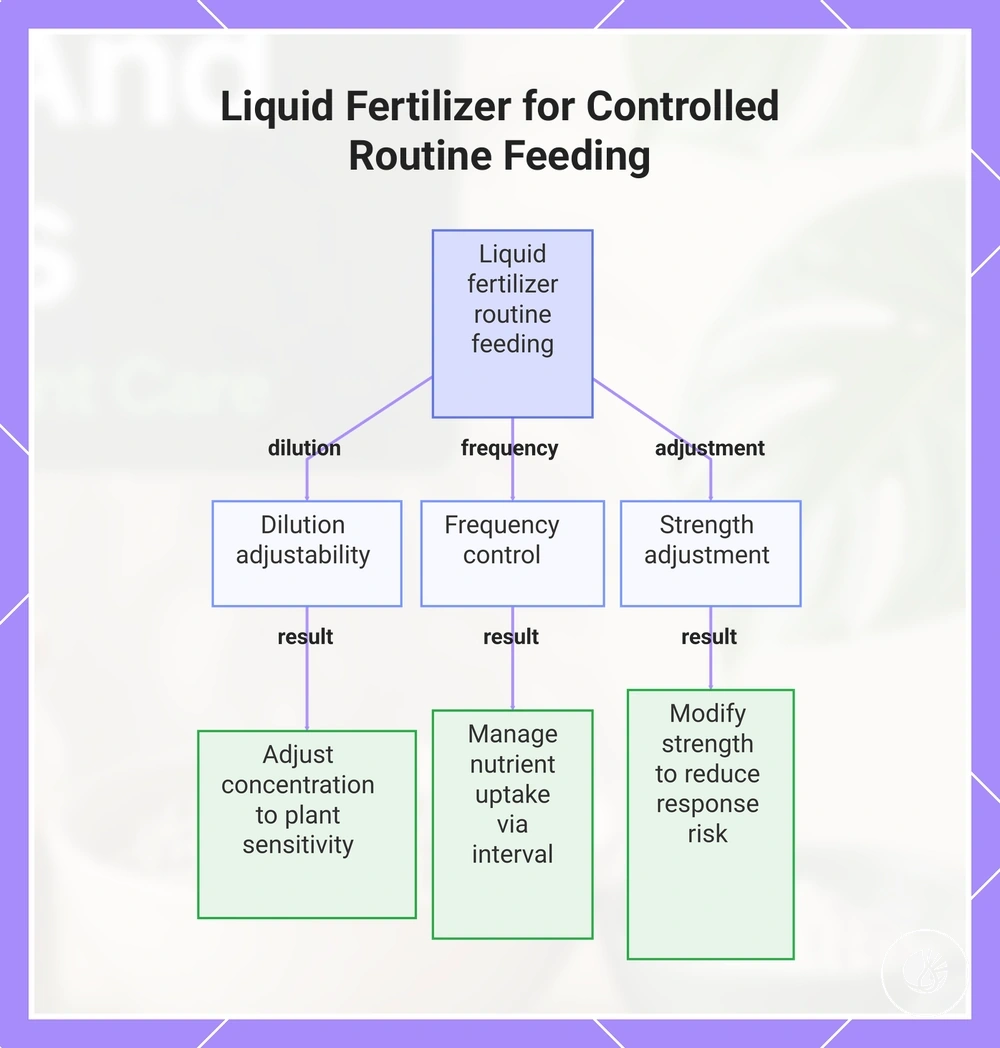
Liquid fertilizer is a controllable format that supports routine feeding for indoor tropical plants. Its concentration can be diluted to match plant sensitivity, and feeding strength may be adjusted according to growth response. This flexibility allows easier modification compared with fixed-release formats, particularly when label directions and plant condition require incremental changes.
- Dilution: adjust concentration → suit plant sensitivity
- Frequency: feeding interval → manage nutrient uptake
- Adjustment: modify strength → reduce response risk
This chart shows how liquid fertilizer's adjustable dilution, frequency, and strength enable controlled routine feeding for indoor tropical plants.
Slow-release fertilizer for longer feeding intervals
Slow-release fertilizer is a format that gradually releases nutrients over time, allowing longer intervals between feedings for indoor tropical plants. Placement in the soil or growing medium determines how evenly nutrients are delivered, and release can vary based on watering, temperature, and plant condition. While it reduces routine frequency, monitoring growth response is still important.
This format is convenient for steady nutrient supply to foliage and roots, but in small pots or with stressed plants, nutrients may accumulate more quickly, so conservative use is advisable. Compared with liquid fertilizer, slow-release forms require fewer adjustments, though label directions and local conditions influence concentration and reapplication timing.:contentReference[oaicite:0]{index=0}
Balanced formulas and tropical foliage needs
Balanced fertilizer formulas provide proportionate nutrients to support tropical foliage while considering indoor plant growth stages. Selection should be guided by plant condition, label instructions, and seasonal or growth-stage adjustments to ensure foliage responds appropriately without relying on exact ratio claims.
- Formula balance: proportionate nutrients → maintain foliage health
- Nitrogen emphasis: moderate levels → encourage leaf development
- Micronutrient presence: essential elements → support overall plant condition
- Growth stage alignment: adjust feeding routine → match plant development
- Seasonal consideration: timing and concentration → optimize foliage response
When indoor tropical plants should be fertilized
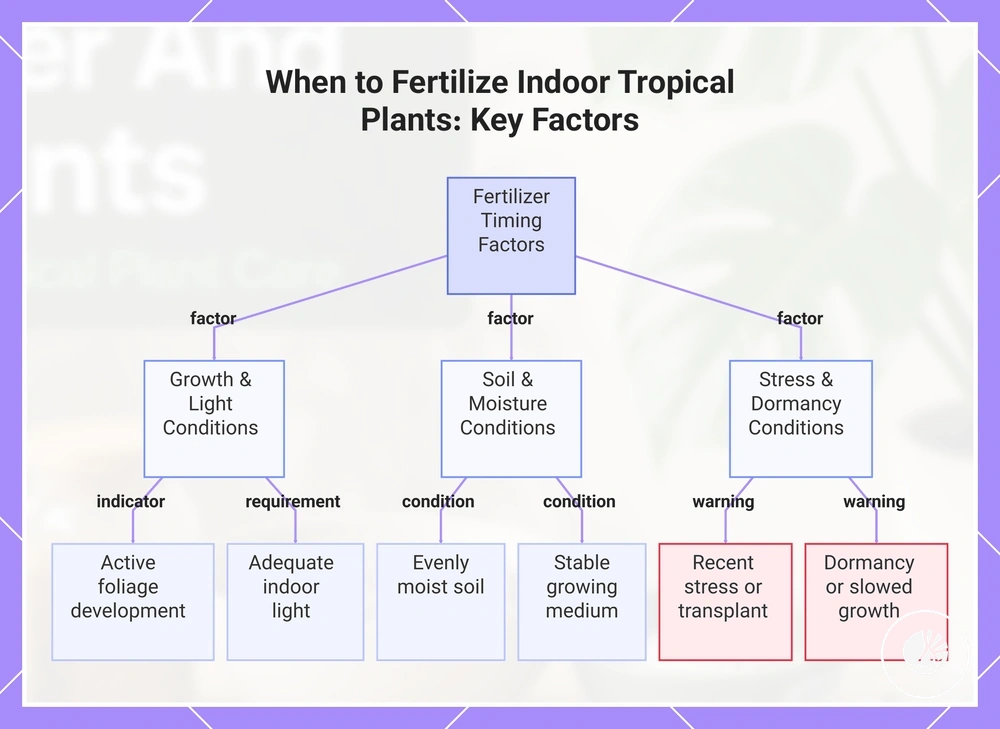
Deciding when to fertilize indoor tropical plants depends on growth stage, season, plant condition, light availability, soil moisture, and recent stress. Fertilizer should be applied when the plant shows active growth and stable care conditions, rather than following a fixed calendar. Evaluating these factors helps ensure the feeding routine aligns with current plant needs.:contentReference[oaicite:0]{index=0}
Readiness includes considering plant response to indoor light, moisture balance, and root health. Seasonal variations may influence timing; for more context, see seasonal fertilizing adjustments.
- Growth stage: active foliage development → may indicate readiness for fertilizer.
- Season and light: adequate indoor light → supports nutrient uptake.
- Recent stress: transplant or environmental stress → may require delay in feeding.
- Soil moisture: evenly moist soil → safer for nutrient application.
- Soil condition: stable medium → better root response to fertilizer.
Plants experiencing dormancy or slowed growth may require adjusted timing, as fertilizer effectiveness is influenced by growth activity, plant condition, and label guidance rather than a universal schedule.:contentReference[oaicite:1]{index=1}
This chart shows the main factors to evaluate when deciding to fertilize indoor tropical plants, focusing on growth, soil, and stress conditions.
Active growth periods and seasonal reduction
Feeding frequency for indoor tropical plants depends on active growth versus seasonal reduction. Nutrient demand and feeding intensity are higher during active growth periods and typically lower during seasonal reduction, which signals slowed growth or reduced light. Observing plant response and growth stage is essential for adjusting the fertilizer schedule.:contentReference[oaicite:0]{index=0}
During active growth, plants producing new foliage or showing steady expansion may require more frequent feeding within label guidance. In periods of slowed growth or dimmer indoor light, feeding routines can be reduced, but adjustments should be based on plant condition and observation rather than fixed calendar rules. For example, brighter indoor conditions may extend active feeding compared with lower light environments.:contentReference[oaicite:1]{index=1}
- Active growth: higher nutrient demand → increased feeding frequency.
- Seasonal reduction: slowed growth → reduced feeding intensity.
- Light condition: brighter rooms → may prolong active feeding period.
- Observation: ongoing plant response → guides schedule adjustments.
Plant condition before feeding
Plant condition must be assessed before feeding to ensure safe fertilizer use. Soil moisture, recent repotting, root condition, leaf health, and light level all influence how effectively nutrients are absorbed. Stressed plants often need condition correction before adding fertilizer.:contentReference[oaicite:0]{index=0}
- Soil moisture: evenly moist → supports safe nutrient uptake.
- Recent repotting: allow recovery → reduce feeding stress.
- Root condition: healthy roots → improve fertilizer response.
- Leaf health: intact foliage → better nutrient absorption.
- Light level: sufficient indoor light → supports effective feeding routine.
Checking these conditions helps align feeding routines with plant readiness, reducing the risk of nutrient stress while maintaining safe and effective fertilizer application.:contentReference[oaicite:1]{index=1}
How often to feed indoor tropical plants
Feeding frequency for indoor tropical plants depends on fertilizer format, plant growth stage, and indoor conditions. Liquid fertilizers are often applied more frequently with lighter dosages, while slow-release fertilizers provide extended nutrient availability with fewer applications. Observing plant response helps determine when to adjust, pause, or resume feeding to align with current growth and indoor environment.:contentReference[oaicite:0]{index=0}
The following table organizes typical feeding intervals by fertilizer format and plant condition, showing interval logic, adjustment criteria, and cautions. This framework is illustrative and intended to support routine decisions rather than prescribe a universal schedule.:contentReference[oaicite:1]{index=1}
| Fertilizer format | Usual interval logic | Adjust when | Caution |
|---|---|---|---|
| Liquid fertilizer | Short interval, low dose | Slowed growth or leaf stress | Pause/reduce if soil too wet or low light |
| Slow-release fertilizer | Long interval, steady release | Root stress or reduced growth | Observe plant and soil conditions |
| Paused/reduced feeding | Temporary suspension | Growth dormancy or adverse indoor conditions | Resume when plant conditions improve |
Routine schedules for liquid fertilizer
Liquid fertilizer schedules depend on dilution strength, dose, and plant observation. Full-strength applications can be used when plants show steady growth, while reduced-strength or half-dose applications may be preferable for sensitive plants or those with slower growth. Observation helps determine whether the feeding routine should continue, be reduced, or temporarily paused.:contentReference[oaicite:0]{index=0}
- Full-strength: label-directed dilution → suitable for active growth and consistent response.
- Half-strength: lighter dose → safer for sensitive or recovering plants.
- Reduced frequency: longer interval → may help when growth slows or conditions are less favorable.
- Pause and observe: stress or weakened response → stop feeding until plant condition stabilizes.
Schedule adjustments for slow-release fertilizer
Slow-release fertilizer schedule adjustments depend on product duration, pot size, watering frequency, and indoor temperature. After placement, nutrient release continues over the label-defined period, but observation remains essential because growth stage, season, and plant condition can influence uptake and response. Routine monitoring ensures that reapplication is timed appropriately and that plants do not accumulate excessive nutrients. :contentReference[oaicite:0]{index=0}
Factors affecting reapplication include smaller pots, frequent watering, or higher temperatures, which can accelerate nutrient release and require closer schedule adjustments. Slower growth or cooler indoor conditions may extend the effective duration before additional feeding is needed. Using slow-release fertilizer in combination with liquid feeding can increase excess-salt risk, so overlapping nutrient sources should be managed carefully. :contentReference[oaicite:1]{index=1}
How to fertilize indoor tropical plants safely
Safe fertilizing for indoor tropical plants starts with controlling dose, ensuring proper preparation, and observing plant response. Fertilizer should be applied when soil is appropriately moist and label directions are followed. Caution is needed for weak plants, recently repotted specimens, or when label instructions are unclear, and pause conditions should be respected to prevent nutrient stress.
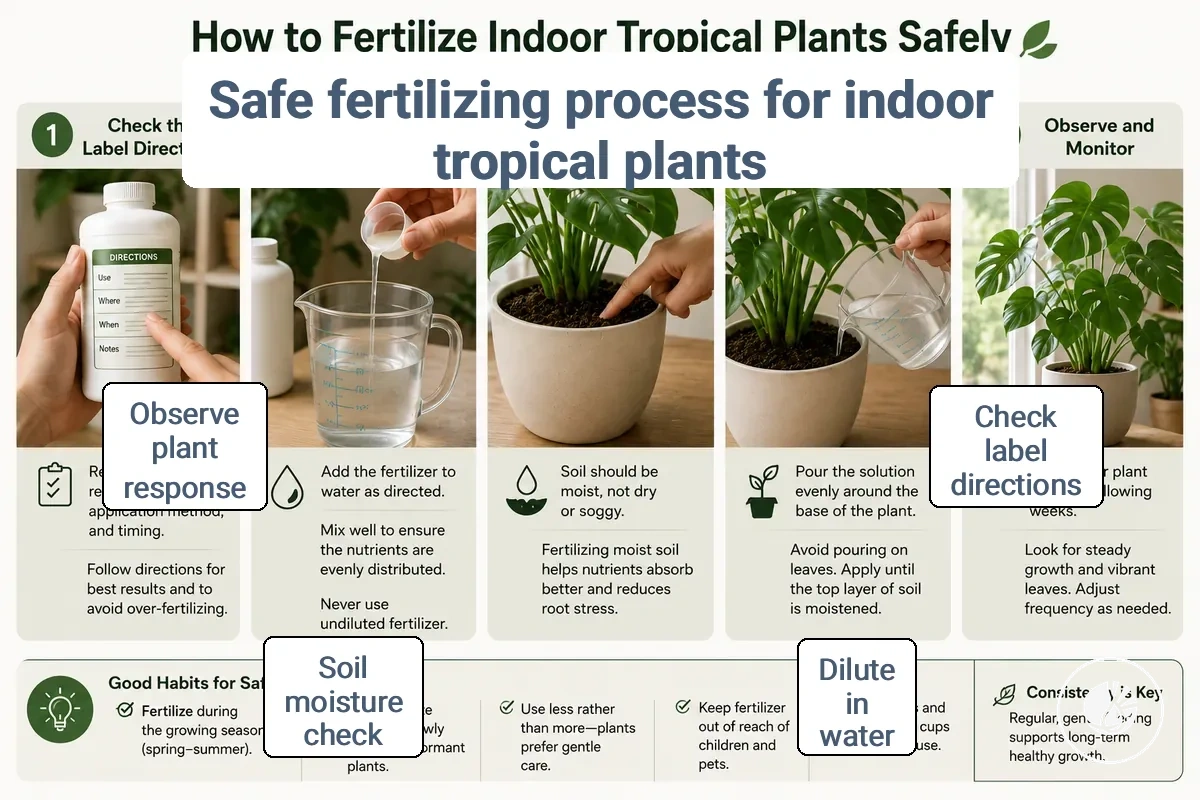
The fertilizing process involves checking the watering state, diluting the nutrient solution according to label directions, applying it evenly to the soil, and monitoring the plant afterward. Adjustments should be made based on plant condition, growth stage, and seasonal factors, and any stress indicators should trigger a temporary pause in feeding.are fertilizer following label directions → confirm clarity → avoid ambiguous mixtures.
Dilution and dose control
Dilution and dose control are central to safely applying fertilizer for indoor tropical plants. The amount of fertilizer, water volume, and resulting solution strength must be managed together, following label directions and observing plant condition. Adjustments may be necessary for sensitive or newly acquired plants to prevent stress or overexposure.:contentReference[oaicite:0]{index=0}
As an illustrative example, a measured fertilizer amount mixed into more water creates a weaker solution, while the same amount in less water increases strength. This example is not a fixed dosage but demonstrates how dilution and concentration interact. Conservative use is recommended for plants showing sensitivity, with observation guiding any future adjustment.:contentReference[oaicite:1]{index=1}
Application during watering
Applying fertilizer during watering starts with checking that soil moisture and plant condition are suitable for application. Fertilizer should be used according to label directions, with attention to dilution, dose, water volume, and observation of how the nutrient solution moves through the growing medium. If watering problems are present, they should be corrected separately before fertilizer can be applied safely. :contentReference[oaicite:0]{index=0}
- Check soil moisture → confirm the soil is not excessively dry → observe whether water is absorbed evenly.
- Prepare the fertilizer solution → use the intended dilution, dose, and water volume → observe that application follows label directions.
- Apply the nutrient solution to the soil surface → distribute application evenly around the root zone → observe uniform coverage.
- Monitor drainage behavior → allow excess water to move through the container when appropriate → observe signs of restricted flow or pooling.
- Observe runoff and plant response → check whether application appears even → observe foliage and soil condition after watering.
Application during watering focuses on placing fertilizer under suitable moisture conditions rather than managing watering frequency. Even application and runoff observation help verify that nutrients reach the root area under more appropriate conditions. :contentReference[oaicite:1]{index=1}
Measuring tools and consistency
Measuring tools help maintain consistent fertilizer use by reducing dosage variation and standardizing water volume with label instructions. Using these tools ensures repeatable applications in feeding routines, while observation of plant response remains essential for safe adjustments. :contentReference[oaicite:0]{index=0}
- Measuring spoon → verifies fertilizer amount → supports consistent dosage.
- Dropper → controls small quantities → ensures repeatability.
- Cap line → marks recommended volume → aligns with label instructions.
- Water volume → matches fertilizer dose → maintains solution strength.
- Label instruction → guides measurement → reduces variation risk.
Following this mini-checklist helps maintain predictable nutrient supply, particularly for sensitive or newly acquired indoor tropical plants, without implying the tools directly improve plant health. :contentReference[oaicite:1]{index=1}
Nutrient deficiency and overfertilizing signals
Nutrient deficiency and overfertilizing can show similar visible signals in indoor tropical plants, but careful observation helps differentiate likely fertilizer-related issues from other care stress. Symptoms such as yellow leaves or pale growth may indicate low nutrients, excess fertilizer salts, or unrelated factors like watering or low-light conditions. Use the table below to check symptom type, contextual conditions, and safe next actions, clarifying when fertilizer adjustment may be relevant. For additional clarification, see yellow leaves and nutrient issues.:contentReference[oaicite:0]{index=0}
Accurate assessment considers the symptom appearance, environmental factors, and recent feeding routine. Leaf yellowing can often stem from nitrogen or magnesium deficiency, while brown tips or margins may result from salt buildup. Observing watering, soil, and light conditions helps indicate whether the cause is fertilizer-related or another stress factor.:contentReference[oaicite:1]{index=1}
| Symptom | Likely attribute issue | Check | What it means |
|---|---|---|---|
| Yellowing leaves with pale growth | Nutrient deficiency (N, Mg, Fe) | Inspect soil, label directions, recent feeding | May indicate low nutrients; adjust fertilizer cautiously |
| Leaf tip burn or dark margins | Salt buildup from overfertilizing | Check for excessive fertilizer, inspect runoff | May require leaching or temporary feeding pause |
| Wilting or drooping leaves | Water stress or root issues | Soil moisture, root health | Usually not fertilizer-related; correct watering or pot condition |
| Slow growth under low light | Light limitation | Assess light exposure, plant placement | Fertilizer adjustments unlikely to help; consider light changes |
Yellow leaves, pale growth, and chlorosis
Yellow leaves, pale growth, and chlorosis can involve nutrient deficiency, but they do not prove a fertilizer issue on their own. Leaf color, growth pattern, old versus new leaves, feeding history, and soil condition should be checked together before choosing a safe next action. These symptoms can overlap with watering, light, or root stress, so fertilizer changes should stay cautious. :contentReference[oaicite:0]{index=0}
Older yellow leaves may point toward one nutrient pattern, while pale new growth may suggest a different nutrient-related check, but both still need context from recent fertilizer use and soil condition. Salt buildup from overfertilizing can also change leaf color or edges, especially when feeding has been frequent or concentrated. A safer response is to check the pattern, review the feeding routine, and adjust only when the plant condition supports it. :contentReference[oaicite:1]{index=1}
| Symptom | Likely attribute issue | Check | What it means |
|---|---|---|---|
| Yellow leaves on older foliage | Possible nutrient deficiency | Feeding history and soil condition | May support cautious nutrient adjustment if other conditions are stable |
| Pale growth on newer foliage | Possible nutrient availability issue | Leaf pattern, growth pattern, and recent fertilizer use | May require a conservative check before changing fertilizer dose |
| Yellowing with browned tips or edges | Possible salt buildup from overfertilizing | Fertilizer concentration, runoff, and soil condition | May suggest pausing or reducing feeding rather than adding more fertilizer |
Poor growth and weak foliage response
When poor growth and weak foliage response occur, more fertilizer is not automatically the safe next action. Check growth rate, leaf size, stem strength, recent feeding history, and plant condition before changing the feeding routine, because nutrient deficiency is only one possible explanation. Low light or cool indoor conditions can limit visible growth even when nutrients are available. :contentReference[oaicite:0]{index=0}
Poor growth may appear as smaller leaves, weaker stems, or limited new foliage, while overfertilizing can sometimes reduce healthy response through root stress or salt buildup. Recent fertilizer dosage, label directions, soil condition, and environmental support should be reviewed together. A context-based check helps distinguish whether nutrient availability, growth conditions, or the current feeding routine is limiting plant response. :contentReference[oaicite:1]{index=1}
| Symptom | Likely attribute issue | Check | What it means |
|---|---|---|---|
| Slow growth with small leaves | Possible nutrient deficiency | Recent feeding history and soil condition | May indicate limited nutrient availability if other conditions are suitable |
| Weak stems and limited foliage response | Possible growth limitation | Light, water, roots, and fertilizer history | May reflect environmental limits rather than a need for more fertilizer |
| Weak response after repeated feeding | Possible overfertilizing or salt buildup | Fertilizer dosage and plant condition | May support reducing or reviewing the feeding routine instead of increasing it |
Salt buildup and fertilizer stress
When salt buildup and fertilizer stress occur, repeated feeding is often a contributing condition that can affect roots and leaf edges. White crust on the soil surface, leaf-tip burn, and signs of root stress may indicate that excess nutrients are accumulating faster than the plant is using them. A conservative response is to pause fertilizer and reassess water and soil condition before making further feeding decisions. :contentReference[oaicite:0]{index=0}
Visible clues and feeding patterns should be evaluated together because a single symptom does not confirm fertilizer stress. The checklist below helps identify condition-to-risk signals linked to excess feeding. :contentReference[oaicite:1]{index=1}
- White crust on soil or container surfaces → may indicate salt buildup from accumulated nutrients.
- Leaf-tip burn or browned leaf edges → may be associated with fertilizer stress when linked to recent feeding history.
- Root stress or reduced root response → may occur when excess nutrients affect root conditions.
- Repeated feeding without adjustment for plant condition, growth stage, or season → can increase stress risk.
- Insufficient flushing through normal watering → may allow nutrient residues to remain in the soil.
Keeping fertilizer routines aligned with indoor tropical plant care
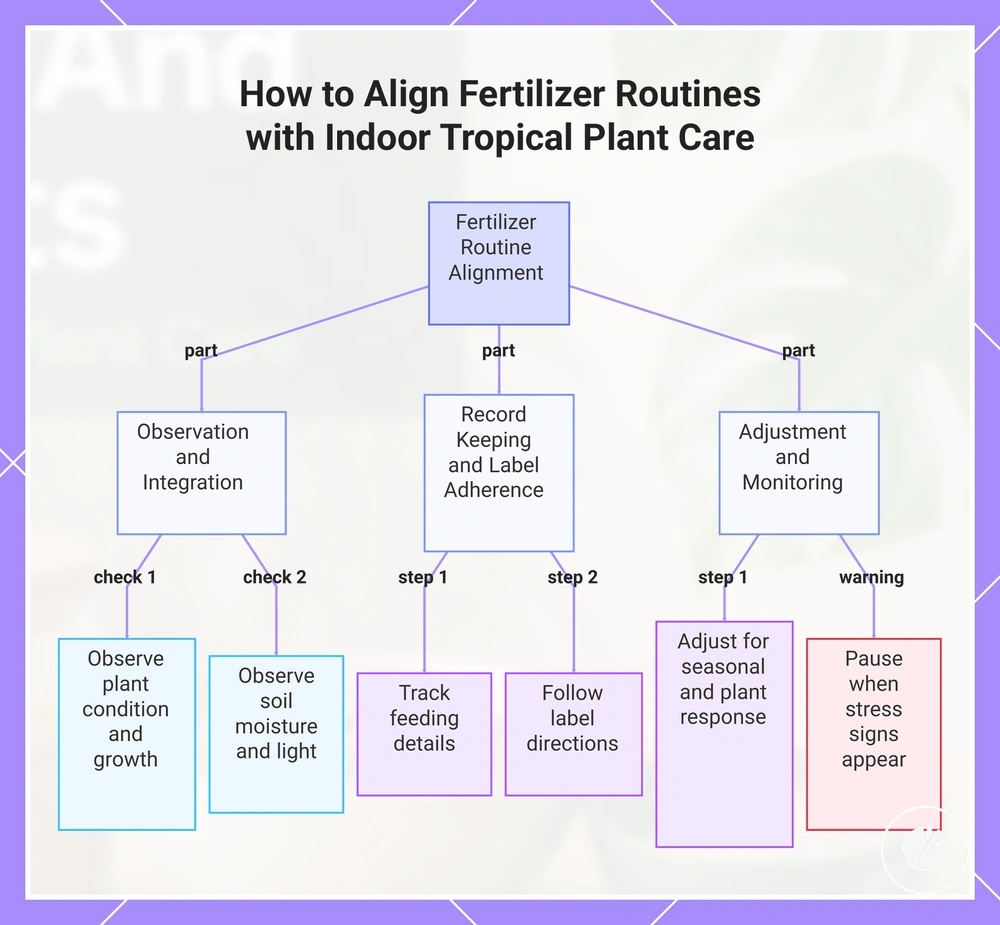
Keeping fertilizer routines aligned with indoor tropical plant care involves integrating feeding frequency into the overall maintenance routine while observing plant condition, soil moisture, light exposure, and growth stage. This integration helps ensure nutrient solutions support steady growth without causing stress or imbalance. Regular observation allows timely adjustments to maintain a responsive feeding routine.
Maintain detailed records of each feeding, including fertilizer type, dilution, and water volume, while following label directions. Accurate record-keeping and adherence to label guidance improve consistency and help identify whether changes in foliage, roots, or overall growth are related to the feeding routine or other care factors.
For additional structured guidance, consult the maintenance checklist for feeding routines, which supports integrating feeding with other indoor plant care practices and ensures alignment with ongoing observation and routine verification.
Adjust fertilizer routines based on seasonal changes and observable plant responses. Nutrient demand may shift with indoor light, growth stage, or temperature, and monitoring foliage and root development can guide conservative adjustments to feeding schedules. Pausing or modifying the routine when signs of over- or under-feeding appear helps maintain plant balance.
Use the following checklist to integrate fertilizer safely into the routine: track feeding dates, note fertilizer type and dilution, monitor for stress signals, coordinate with watering and light, and verify soil and root conditions. This structured approach aligns feeding with observation and plant response, supporting healthier indoor tropical plants.
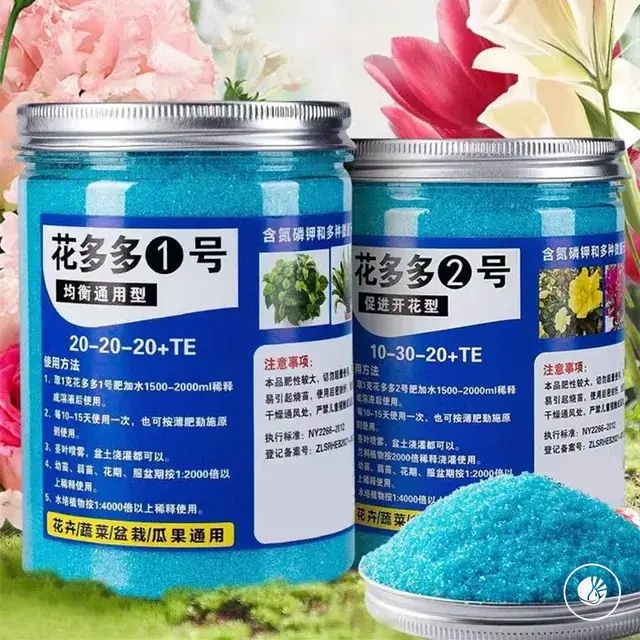
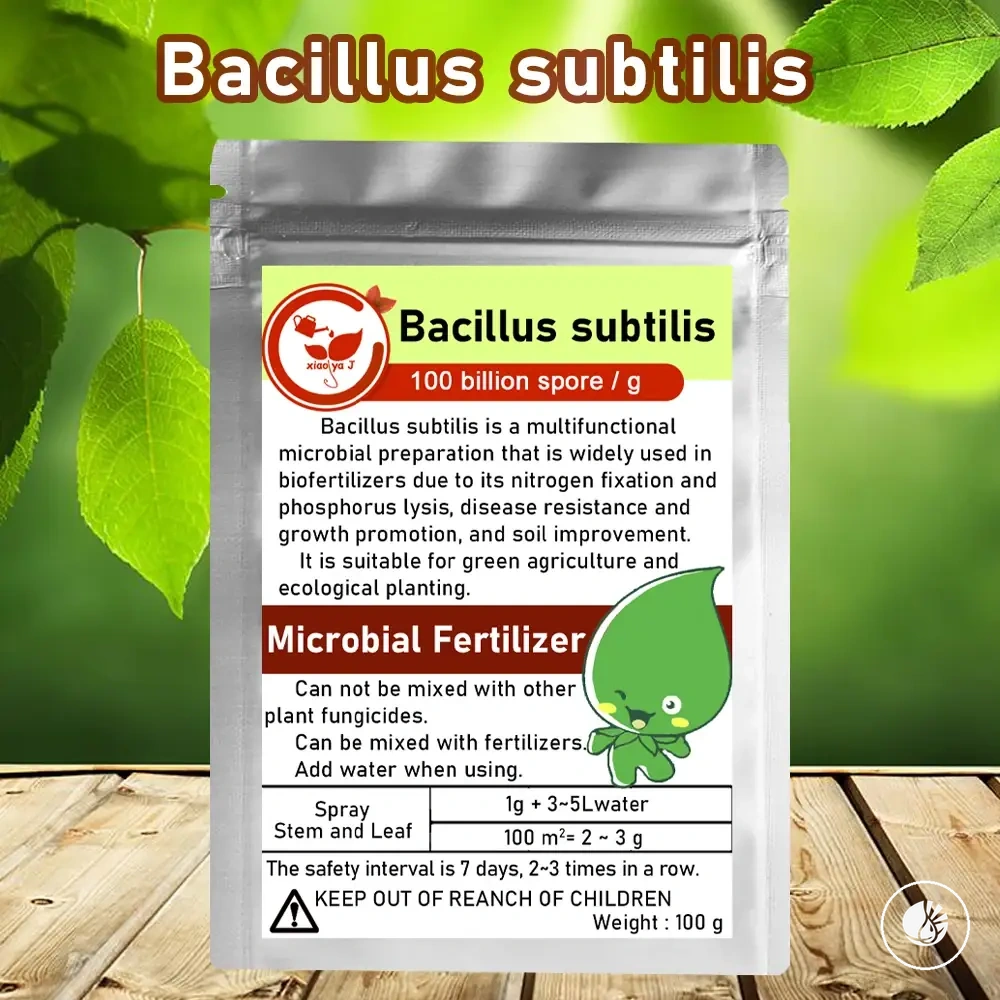
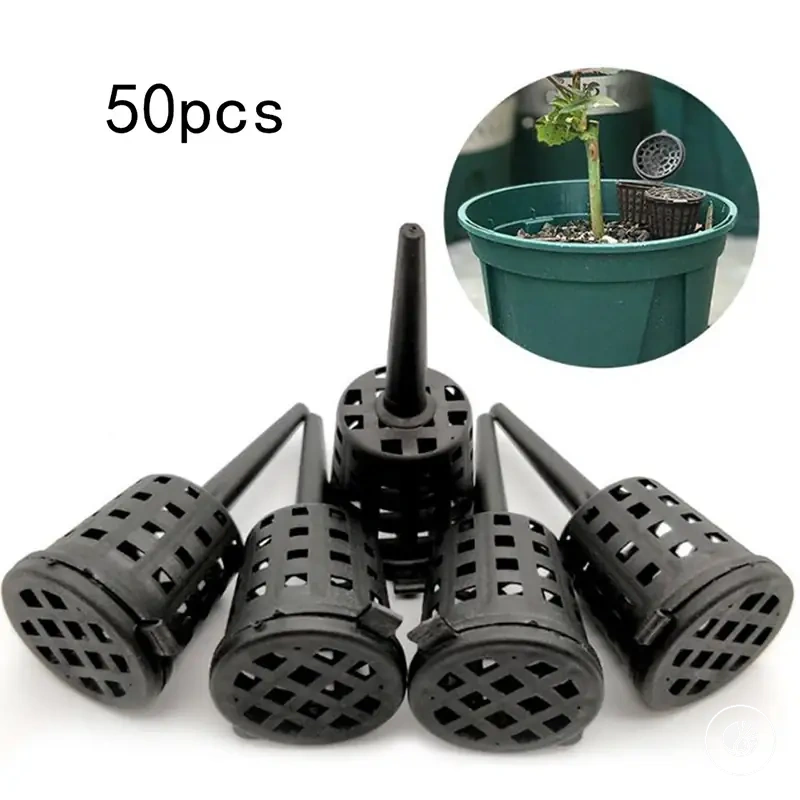
Here are product examples that may make comparison easier. Before buying, always review the compatibility criteria, essential features, and product details.
This chart shows how to integrate fertilizer feeding into indoor tropical plant care through observation, record-keeping, and responsive adjustment.